Adding and Subtracting Fractions - Algebra 2
Card 0 of 568

Tap to see back →
Convert each fraction to incorporate a common denominator. The least common denominator of 11 and 13 is 143. Multiply the first fraction by 13 divided by 13 and the second by 11 divided by 11 . Then add or subtract the resulting fractions.
Convert each fraction to incorporate a common denominator. The least common denominator of 11 and 13 is 143. Multiply the first fraction by 13 divided by 13 and the second by 11 divided by 11 . Then add or subtract the resulting fractions.

Tap to see back →
Convert each fraction to incorporate a common denominator. The least common denominator of 7 and 13 is 91. Multiply the first fraction by 13 divided by 13 and the second by 7 divided by 7 . Then add or subtract the resulting fractions.
Convert each fraction to incorporate a common denominator. The least common denominator of 7 and 13 is 91. Multiply the first fraction by 13 divided by 13 and the second by 7 divided by 7 . Then add or subtract the resulting fractions.

Tap to see back →
Convert each fraction to incorporate a common denominator. The least common denominator of 9 and 7 is 63. Multiply the first fraction by 7 divided by 7 and the second by 9 divided by 9 . Then add or subtract the resulting fractions.
Convert each fraction to incorporate a common denominator. The least common denominator of 9 and 7 is 63. Multiply the first fraction by 7 divided by 7 and the second by 9 divided by 9 . Then add or subtract the resulting fractions.

Tap to see back →
Convert each fraction to incorporate a common denominator. The least common denominator of 8 and 7 is 56. Multiply the first fraction by 7 divided by 7 and the second by 8 divided by 8 . Then add or subtract the resulting fractions.
Convert each fraction to incorporate a common denominator. The least common denominator of 8 and 7 is 56. Multiply the first fraction by 7 divided by 7 and the second by 8 divided by 8 . Then add or subtract the resulting fractions.

Tap to see back →
Convert each fraction to incorporate a common denominator. The least common denominator of 6 and 5 is 30. Multiply the first fraction by 5 divided by 5 and the second by 6 divided by 6 . Then add or subtract the resulting fractions.
Convert each fraction to incorporate a common denominator. The least common denominator of 6 and 5 is 30. Multiply the first fraction by 5 divided by 5 and the second by 6 divided by 6 . Then add or subtract the resulting fractions.

Tap to see back →
Convert each fraction to incorporate a common denominator. The least common denominator of 3 and 8 is 24. Multiply the first fraction by 8 divided by 8 and the second by 3 divided by 3 . Then add or subtract the resulting fractions.
Convert each fraction to incorporate a common denominator. The least common denominator of 3 and 8 is 24. Multiply the first fraction by 8 divided by 8 and the second by 3 divided by 3 . Then add or subtract the resulting fractions.

Tap to see back →
Convert each fraction to incorporate a common denominator. The least common denominator of 11 and 3 is 33. Multiply the first fraction by 3 divided by 3 and the second by 11 divided by 11 . Then add or subtract the resulting fractions.
Convert each fraction to incorporate a common denominator. The least common denominator of 11 and 3 is 33. Multiply the first fraction by 3 divided by 3 and the second by 11 divided by 11 . Then add or subtract the resulting fractions.

Tap to see back →
Convert each fraction to incorporate a common denominator. The least common denominator of 9 and 6 is 18. Multiply the first fraction by 2 divided by 2 and the second by 3 divided by 3 . Then add or subtract the resulting fractions.È
Convert each fraction to incorporate a common denominator. The least common denominator of 9 and 6 is 18. Multiply the first fraction by 2 divided by 2 and the second by 3 divided by 3 . Then add or subtract the resulting fractions.È
Add the fractions:

Add the fractions:
Tap to see back →
When adding fractions, the first thing we need to do is get a common denominator.

Then when adding, only add the numbers on the top, while leaving the common number on the bottom the same. Once we get a final answer, simplify accordingly.
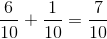
When adding fractions, the first thing we need to do is get a common denominator.
Then when adding, only add the numbers on the top, while leaving the common number on the bottom the same. Once we get a final answer, simplify accordingly.
Add the following fractions: 
Add the following fractions:
Tap to see back →
To be able to add the fractions, we will need to determine the least common denominator.
The least common denominator is  since this is the minimal term that is both divisible by
  and itself.
Convert only the first fraction with the denominator of  .
.

The answer is: 
To be able to add the fractions, we will need to determine the least common denominator.
The least common denominator is
Convert only the first fraction with the denominator of
The answer is:
Subtract the fractions: 
Subtract the fractions:
Tap to see back →
To subtract the fractions, we will need to find the least common denominator.
Write out the factors for both denominators.


Multiply four by 15 to get the least common denominator.
The least common denominator is  .
.
Convert both fractions.

The answer is: 
To subtract the fractions, we will need to find the least common denominator.
Write out the factors for both denominators.
Multiply four by 15 to get the least common denominator.
The least common denominator is
Convert both fractions.
The answer is:
Simplify 
Simplify
Tap to see back →
Find the least common denominator (LCD) and convert each fraction to the LCD and then add. Simplify as necessary.

The result is an improper fraction because the numerator is larger than the denominator and can be simplified and converted to a mix numeral.
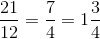
Find the least common denominator (LCD) and convert each fraction to the LCD and then add. Simplify as necessary.
The result is an improper fraction because the numerator is larger than the denominator and can be simplified and converted to a mix numeral.
Simplify the expression.

Simplify the expression.
Tap to see back →
Since the denominator is the same in both expressions, we can perform the subtraction in the numerator. The result will have the same denominator of 6x3y.


Simplify the expression:

Since the denominator is the same in both expressions, we can perform the subtraction in the numerator. The result will have the same denominator of 6x3y.
Simplify the expression:
Find the solution: 
Find the solution:
Tap to see back →
Multiply all the nominators and the denominators separately.
Then, simplify the solution untill you get an answer that is an option on the exam.

An alternate, quicker solution would be to cancel out any matching denominators and nominators.
Once that is done, the equation simpifies to 
Multiply all the nominators and the denominators separately.
Then, simplify the solution untill you get an answer that is an option on the exam.
An alternate, quicker solution would be to cancel out any matching denominators and nominators.
Once that is done, the equation simpifies to
Suppose a recipe calls for  cup of flour,
  cup of cinnamon, and
  cup of sugar.
How many cups of ingredients total does the recipe call for?
Suppose a recipe calls for
How many cups of ingredients total does the recipe call for?
Tap to see back →
To solve, we must first find a common denominator between 3, 4, and 12. All 3 numbers are factors of 12 and therefore 12 can be the common denominator. Then the numerators must be multiplied by the same factor as the demominator was.
This gives us our new fractions:

Next, we add the numerators, but our denominators stay the same:
 .
.
Lastly, we simplify to get  as our answer.
To solve, we must first find a common denominator between 3, 4, and 12. All 3 numbers are factors of 12 and therefore 12 can be the common denominator. Then the numerators must be multiplied by the same factor as the demominator was.
This gives us our new fractions:
Next, we add the numerators, but our denominators stay the same:
Lastly, we simplify to get
Simplify the following fraction:

Simplify the following fraction:
Tap to see back →
Determine the factors of both the numerator and the denominator:


We notice that 3 is a factor of both 12 and 39 so we can simplify by dividing both 12 and 39 by 3.


The result is therefore,

Determine the factors of both the numerator and the denominator:
We notice that 3 is a factor of both 12 and 39 so we can simplify by dividing both 12 and 39 by 3.
The result is therefore,
Find the simplified result:

Find the simplified result:
Tap to see back →
Start by making both fractions into the same denominator. One option is 
Then adjust the numerators by multiplying each fraction's numerator by the other fraction's denominator:


Then add the adjusted numerators:

Then we simplify by dividing both numerator and denominator by 2:

which gives us the final result.
Start by making both fractions into the same denominator. One option is
Then adjust the numerators by multiplying each fraction's numerator by the other fraction's denominator:
Then add the adjusted numerators:
Then we simplify by dividing both numerator and denominator by 2:
which gives us the final result.
Find the result. (It does not need to be simplified).

Find the result. (It does not need to be simplified).
Tap to see back →
We start by adjusting both equations to the same denominator.
Notice that the denominator of the second term is a factor of the denominator of the first term. Therefore we only need to adjust the second term by multiplying both numerator and denominator by 2:

Now we need to subtract the numerators:

We start by adjusting both equations to the same denominator.
Notice that the denominator of the second term is a factor of the denominator of the first term. Therefore we only need to adjust the second term by multiplying both numerator and denominator by 2:
Now we need to subtract the numerators:
What is the sum of  and
and  ?
?
What is the sum of
Tap to see back →
Convert the mixed number to an improper fraction.
Then add the numerators together and keep the common denominator.
Finally, simplify.

Convert the mixed number to an improper fraction.
Then add the numerators together and keep the common denominator.
Finally, simplify.
Add:

Add:
Tap to see back →
To add rational expressions, you must find the common denominator. In this case, it's  .
.
Next, you must change the numerators to offset the new denominator.
 becomes
  and
and  becomes
  .
.
Now you can combine the numerators:  .
.
Put that over the denomiator and see if you can simplify/factor further. In this case, you can't.
Therefore, your final answer is:
 .
.
To add rational expressions, you must find the common denominator. In this case, it's
Next, you must change the numerators to offset the new denominator.
Now you can combine the numerators:
Put that over the denomiator and see if you can simplify/factor further. In this case, you can't.
Therefore, your final answer is: