Adding and Subtracting Logarithms - Algebra 2
Card 0 of 200
Subtract the logarithms:

Subtract the logarithms:
Tap to see back →
When subtracting logarithms of the same base, all you have to do is divide the numbers inside the function as shown below:



When subtracting logarithms of the same base, all you have to do is divide the numbers inside the function as shown below:
Subtract the logarithms:

Subtract the logarithms:
Tap to see back →
When subtracting logarithms of the same base, all you have to do is divide the numbers inside the function as shown below:



When subtracting logarithms of the same base, all you have to do is divide the numbers inside the function as shown below:
Simplify the expression using logarithmic identities.

Simplify the expression using logarithmic identities.
Tap to see back →
The logarithm of a fraction is equal to the logarithm of the numerator minus the logarithm of the denominator.

If we encounter two logarithms with the same base, we can likely combine them. In this case, we can use the reverse of the above identity.


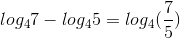
The logarithm of a fraction is equal to the logarithm of the numerator minus the logarithm of the denominator.
If we encounter two logarithms with the same base, we can likely combine them. In this case, we can use the reverse of the above identity.
Simplify the following logarithmic expression:

Simplify the following logarithmic expression:
Tap to see back →
Each term can be simplified as follows:


Combining these gives the answer: 
Each term can be simplified as follows:
Combining these gives the answer:
Use logarithmic properties to simplify this expression:

Use logarithmic properties to simplify this expression:
Tap to see back →
Use the sum/product rule to combine the first 2 terms:

Use the difference/quotient rule to combine the remaining terms:

Use the sum/product rule to combine the first 2 terms:
Use the difference/quotient rule to combine the remaining terms:
What is the value of  ?
?
What is the value of
Tap to see back →
Remember the rules of logarithms:


This means we can simplify it as follows:


The logarithm of anything with the same base is always  , so the correct answer is
  .
.
Remember the rules of logarithms:
This means we can simplify it as follows:
The logarithm of anything with the same base is always
Expand the following logarithmic expression into a list of sums or subtractions of logarithms:

Expand the following logarithmic expression into a list of sums or subtractions of logarithms:
Tap to see back →
One important property of logarithms is that multiplication inside the logarithm is the same thing as addition outside of it. In the same way division is "the same" as subtraction in logarithms. So our expression is the same as

But also, exponents can be moved outside in the same way.  is basically
  , so
, so  . This can be reduced even further to our final answer:

One important property of logarithms is that multiplication inside the logarithm is the same thing as addition outside of it. In the same way division is "the same" as subtraction in logarithms. So our expression is the same as
But also, exponents can be moved outside in the same way.
Which is another way of expressing
 ?
?
Which is another way of expressing
Tap to see back →
Use the rule:

therefore

Use the rule:
therefore
Which of the following is another way to express
 ?
?
Which of the following is another way to express
Tap to see back →
Use the rule

therefore

Use the rule
therefore
Simplify

Simplify
Tap to see back →
This problem can be solved using the properties of logs. When two logs are being subtracted from each other, it is the same thing as dividing two logs together. Remember that to use this rule, the logs must have the same base in this case  .
.

This problem can be solved using the properties of logs. When two logs are being subtracted from each other, it is the same thing as dividing two logs together. Remember that to use this rule, the logs must have the same base in this case
Subtract the logarithms:

Subtract the logarithms:
Tap to see back →
When subtracting logarithms of the same base, all you have to do is divide the numbers inside the function as shown below:



When subtracting logarithms of the same base, all you have to do is divide the numbers inside the function as shown below:
Condense this logarithm: 
Condense this logarithm:
Tap to see back →
In order to solve this problem you must understand the product property of logarithms  and the power property of logarithms
  . Note that these apply to logs of all bases not just base 10.

first move the constants in front of the logarithmic functions to their proper place using the power rule.

next factor out the logarithmic equation:

change the fractional exponent to a radical

In order to solve this problem you must understand the product property of logarithms
first move the constants in front of the logarithmic functions to their proper place using the power rule.
next factor out the logarithmic equation:
change the fractional exponent to a radical
Expand 
Expand
Tap to see back →
The rule for expanding and dividing logarithms is that you can subtract the terms inside the log. In this case, the question is not asking for an actual number, but just what the expanded version would be. Therefore you separate the terms inside the log by subtracting the denominator from the numerator. Therefore the answer is

The rule for expanding and dividing logarithms is that you can subtract the terms inside the log. In this case, the question is not asking for an actual number, but just what the expanded version would be. Therefore you separate the terms inside the log by subtracting the denominator from the numerator. Therefore the answer is
Add the logarithms:

Add the logarithms:
Tap to see back →
When adding logarithms of the same base, all you have to do is multiply the numbers inside the function as shown below:



When adding logarithms of the same base, all you have to do is multiply the numbers inside the function as shown below:
Add the logarithms:

Add the logarithms:
Tap to see back →
When adding logarithms of the same base, all you have to do is multiply the numbers inside the function as shown below:



When adding logarithms of the same base, all you have to do is multiply the numbers inside the function as shown below:
Add the logarithms:

Add the logarithms:
Tap to see back →
When adding logarithms of the same base, all you have to do is multiply the numbers inside the function as shown below:



When adding logarithms of the same base, all you have to do is multiply the numbers inside the function as shown below:
Subtract the logarithms:

Subtract the logarithms:
Tap to see back →
When subtracting logarithms of the same base, all you have to do is divide the numbers inside the function as shown below:



When subtracting logarithms of the same base, all you have to do is divide the numbers inside the function as shown below:
Subtract the logarithms:

Subtract the logarithms:
Tap to see back →
When subtracting logarithms of the same base, all you have to do is divide the numbers inside the function as shown below:



When subtracting logarithms of the same base, all you have to do is divide the numbers inside the function as shown below:
Subtract the logarithms:

Subtract the logarithms:
Tap to see back →
When subtracting logarithms of the same base, all you have to do is divide the numbers inside the function as shown below:



When subtracting logarithms of the same base, all you have to do is divide the numbers inside the function as shown below:
Add the logarithms:

Add the logarithms:
Tap to see back →
When adding logarithms of the same base, all you have to do is multiply the numbers inside the function as shown below:



When adding logarithms of the same base, all you have to do is multiply the numbers inside the function as shown below: