Complex Imaginary Numbers - Algebra 2
Card 0 of 248
Simplify:

Simplify:
Tap to see back →
To subtract complex numbers, subtract the real terms, then subtract the imaginary terms.

To subtract complex numbers, subtract the real terms, then subtract the imaginary terms.
Simplify:

Simplify:
Tap to see back →
To subtract complex numbers, subtract the real terms, then subtract the imaginary terms.

To subtract complex numbers, subtract the real terms, then subtract the imaginary terms.
Identify the real part of 
Identify the real part of
Tap to see back →
A complex number in its standard form is of the form:  , where
  stands for the real part and
  stands for the imaginary part. The symbol
  stands for
  .
.
The real part in this problem is 1.
A complex number in its standard form is of the form:
The real part in this problem is 1.

Tap to see back →

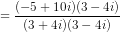
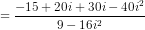
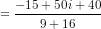


Multiply:

Multiply:
Tap to see back →
Use the FOIL technique:






Use the FOIL technique:
Evaluate:

Evaluate:
Tap to see back →
We can set  in the cube of a binomial pattern:


We can set
Evaluate 
Evaluate
Tap to see back →
To divide by a complex number, we must transform the expression by multiplying it by the complex conjugate of the denominator over itself. In the problem,  is our denominator, so we will multiply the expression by
  to obtain:
 .
.
We can then combine like terms and rewrite all  terms as
  . Therefore, the expression becomes:

Our final answer is therefore 
To divide by a complex number, we must transform the expression by multiplying it by the complex conjugate of the denominator over itself. In the problem,
We can then combine like terms and rewrite all
Our final answer is therefore
Simplify the following product:

Simplify the following product:
Tap to see back →
Multiply these complex numbers out in the typical way:

and recall that  by definition. Then, grouping like terms we get

which is our final answer.
Multiply these complex numbers out in the typical way:
and recall that
which is our final answer.
Simplify:

Simplify:
Tap to see back →
To add complex numbers, find the sum of the real terms, then find the sum of the imaginary terms.

To add complex numbers, find the sum of the real terms, then find the sum of the imaginary terms.
Simplify:

Simplify:
Tap to see back →
To add complex numbers, find the sum of the real terms, then find the sum of the imaginary terms.

To add complex numbers, find the sum of the real terms, then find the sum of the imaginary terms.
Simplify:

Simplify:
Tap to see back →
To add complex numbers, find the sum of the real terms, then find the sum of the imaginary terms.

To add complex numbers, find the sum of the real terms, then find the sum of the imaginary terms.
Simplify:

Simplify:
Tap to see back →
To subtract complex numbers, subtract the real terms together, then subtract the imaginary terms.

To subtract complex numbers, subtract the real terms together, then subtract the imaginary terms.
Simplify:

Simplify:
Tap to see back →
Start by using FOIL. Which means to multiply the first terms together then the outer terms followed by the inner terms and lastly, the last terms.

Remember that  , so
, so  .
.
Substitute in  for
for 

Start by using FOIL. Which means to multiply the first terms together then the outer terms followed by the inner terms and lastly, the last terms.
Remember that
Substitute in
Simplify:

Simplify:
Tap to see back →
Start by using FOIL. Which means to multiply the first terms together then the outer terms followed by the inner terms and lastly, the last terms.

Remember that  , so
, so  .
.
Substitute in  for
for 

Start by using FOIL. Which means to multiply the first terms together then the outer terms followed by the inner terms and lastly, the last terms.
Remember that
Substitute in
Simplify:

Simplify:
Tap to see back →
Start by using FOIL. Which means to multiply the first terms together then the outer terms followed by the inner terms and lastly, the last terms.

Remember that  , so
, so  .
.
Substitute in  for
for 

Start by using FOIL. Which means to multiply the first terms together then the outer terms followed by the inner terms and lastly, the last terms.
Remember that
Substitute in
Simplify:

Simplify:
Tap to see back →
Start by using FOIL. Which means to multiply the first terms together then the outer terms followed by the inner terms and lastly, the last terms.

Remember that  , so
, so  .
.
Substitute in  for
for  .
.

Start by using FOIL. Which means to multiply the first terms together then the outer terms followed by the inner terms and lastly, the last terms.
Remember that
Substitute in
Simplify:

Simplify:
Tap to see back →
To get rid of the fraction, multiply the numerator and denominator by the conjugate of the denominator.

Now, multiply and simplify.

Remember that 

To get rid of the fraction, multiply the numerator and denominator by the conjugate of the denominator.
Now, multiply and simplify.
Remember that
Simplify:

Simplify:
Tap to see back →
To get rid of the fraction, multiply the numerator and denominator by the conjugate of the denominator.

Now, multiply and simplify.

Remember that 

To get rid of the fraction, multiply the numerator and denominator by the conjugate of the denominator.
Now, multiply and simplify.
Remember that
Write in standard form: 
Write in standard form:
Tap to see back →

Multiply by the conjugate:


Multiply by the conjugate:
Write in standard form: 
Write in standard form:
Tap to see back →

Multiply by the conjugate:


Combine:

Simplify:


Multiply by the conjugate:
Combine:
Simplify: