Logarithms with Exponents - Algebra 2
Card 0 of 68
Simplify the following equation.

Simplify the following equation.
Tap to see back →
We can simplify the natural log exponents by using the following rules for naturla log.


Using these rules, we can perform the following steps.


Knowing that the e cancels the exponential natural log, we can cancel the first e.

Distribute the square into the parentheses and calculate.

Remember that a negative exponent is equivalent to a quotient. Write it as a quotient and then you're finished.

We can simplify the natural log exponents by using the following rules for naturla log.
Using these rules, we can perform the following steps.
Knowing that the e cancels the exponential natural log, we can cancel the first e.
Distribute the square into the parentheses and calculate.
Remember that a negative exponent is equivalent to a quotient. Write it as a quotient and then you're finished.
In this question we will use the notation  to represent the base 10 or common logarithm, i.e.
  .
.
Find  if
if  .
.
In this question we will use the notation
Find
Tap to see back →
We can use the Property of Equality for Logarithmic Functions to take the logarithm of both sides:

Use the Power Property of Logarithms:

Divide each side by  :
:

Use a calculator to get:

or

We can use the Property of Equality for Logarithmic Functions to take the logarithm of both sides:
Use the Power Property of Logarithms:
Divide each side by
Use a calculator to get:
or
Simplify

Simplify
Tap to see back →
Using Rules of Logarithm recall:
 .
.
Thus, in this situation we bring the 2 in front and we get our solution.

Using Rules of Logarithm recall:
Thus, in this situation we bring the 2 in front and we get our solution.
Evaluate the following expression

Evaluate the following expression
Tap to see back →
This is a simple exponent of a logarithmic answer.
 because

This is a simple exponent of a logarithmic answer.
Evaluate the following expression

Evaluate the following expression
Tap to see back →
Since the exponent is inside the parentheses, you must take the square of 1000 before finding the logarithim. Therefore

because 
Since the exponent is inside the parentheses, you must take the square of 1000 before finding the logarithim. Therefore
because
Evaluate the following expression

Evaluate the following expression
Tap to see back →
This is a two step problem. First find the log base 2 of 16
 because
then

This is a two step problem. First find the log base 2 of 16
then
Evaluate the following expression

Evaluate the following expression
Tap to see back →
Since the exponent is inside the parentheses, you must determine the value of the exponential expression first.

then you solve the logarithm
 because
Since the exponent is inside the parentheses, you must determine the value of the exponential expression first.
then you solve the logarithm
Which of the following equations is valid?
Which of the following equations is valid?
Tap to see back →
Since a logarithm answers the question of which exponent to raise the base to receive the number in parentheses, if the number in parentheses is the base raised to an exponent, the exponent must be the answer.
Since a logarithm answers the question of which exponent to raise the base to receive the number in parentheses, if the number in parentheses is the base raised to an exponent, the exponent must be the answer.
Evaluate the following for all integers of  and
and 

Evaluate the following for all integers of
Tap to see back →
 gives us the exponent to which
  must be raised to yield
When  is actually raised to that number in the equation given, the answer must be
When
Rewrite the following logarithmic expression into expanded form (that is, using addition and/or subtraction):

Rewrite the following logarithmic expression into expanded form (that is, using addition and/or subtraction):
Tap to see back →
Before we do anything, the exponent of 4 must be moved to the front of the expression, as the rules of logarithms dictate. We end up with  . Remember that a product inside of a logarithm can be rewritten as a sum:
  . Distributing, we get
  .
.
Before we do anything, the exponent of 4 must be moved to the front of the expression, as the rules of logarithms dictate. We end up with
Use

and

Evaluate:

Use
and
Evaluate:
Tap to see back →
Since the question gives,
and
To evaluate

manipulate the expression to use what is given.


Since the question gives,
and
To evaluate
manipulate the expression to use what is given.
Simplify: 
Simplify:
Tap to see back →
According to log rules, when an exponential is raised to the power of a logarithm, the exponential and log will cancel out, leaving only the power.
Simplify the given expression.

Distribute the integer to both terms of the binomial.
The answer is: 
According to log rules, when an exponential is raised to the power of a logarithm, the exponential and log will cancel out, leaving only the power.
Simplify the given expression.
Distribute the integer to both terms of the binomial.
The answer is:
Simplify: 
Simplify:
Tap to see back →
The natural log has a default base of  .
.
This means that the expression written can also be:

Recall the log property that:

This would eliminate both the natural log and the base, leaving only the exponent.
The natural log and the base  will be eliminated.
The expression will simplify to:

The answer is: 
The natural log has a default base of
This means that the expression written can also be:
Recall the log property that:
This would eliminate both the natural log and the base, leaving only the exponent.
The natural log and the base
The expression will simplify to:
The answer is:
Simplify: 
Simplify:
Tap to see back →
The log property need to solve this problem is:

The base and the log of the base are similar. They will both cancel and leave just the quantity of log based two.

The answer is: 
The log property need to solve this problem is:
The base and the log of the base are similar. They will both cancel and leave just the quantity of log based two.
The answer is:
Solve: 
Solve:
Tap to see back →
Rewrite the log so that the terms are in a fraction.
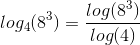
Both terms can now be rewritten in base two.

The exponents can be moved to the front as coefficients.
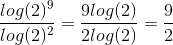
The answer is: 
Rewrite the log so that the terms are in a fraction.
Both terms can now be rewritten in base two.
The exponents can be moved to the front as coefficients.
The answer is:
Which statement is true of  for all positive values of
  ?
?
Which statement is true of
Tap to see back →
By the Logarithm of a Power Property, for all real  , all
, all  ,
, 

Setting  , the above becomes
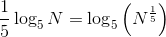
Since, for any  for which the expressions are defined,
 ,
,
setting  , th equation becomes
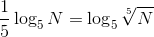 .
.
By the Logarithm of a Power Property, for all real
Setting
Since, for any
setting
Which statement is true of

for all integers  ?
?
Which statement is true of
for all integers
Tap to see back →
Due to the following relationship:
 ; therefore, the expression

can be rewritten as

By definition,
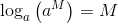 .
.
Set  and
and  , and the equation above can be rewritten as
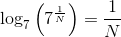 ,
,
or, substituting back,
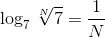
Due to the following relationship:
can be rewritten as
By definition,
Set
or, substituting back,
Simplify the following equation.
Simplify the following equation.
Tap to see back →
We can simplify the natural log exponents by using the following rules for naturla log.
Using these rules, we can perform the following steps.
Knowing that the e cancels the exponential natural log, we can cancel the first e.
Distribute the square into the parentheses and calculate.
Remember that a negative exponent is equivalent to a quotient. Write it as a quotient and then you're finished.
We can simplify the natural log exponents by using the following rules for naturla log.
Using these rules, we can perform the following steps.
Knowing that the e cancels the exponential natural log, we can cancel the first e.
Distribute the square into the parentheses and calculate.
Remember that a negative exponent is equivalent to a quotient. Write it as a quotient and then you're finished.
In this question we will use the notation to represent the base 10 or common logarithm, i.e. .
Find if .
In this question we will use the notation
Find
Tap to see back →
We can use the Property of Equality for Logarithmic Functions to take the logarithm of both sides:
Use the Power Property of Logarithms:
Divide each side by :
Use a calculator to get:
or
We can use the Property of Equality for Logarithmic Functions to take the logarithm of both sides:
Use the Power Property of Logarithms:
Divide each side by
Use a calculator to get:
or
Simplify
Simplify
Tap to see back →
Using Rules of Logarithm recall:
.
Thus, in this situation we bring the 2 in front and we get our solution.
Using Rules of Logarithm recall:
Thus, in this situation we bring the 2 in front and we get our solution.