Elementary Operations - Algebra 2
Card 0 of 740
Subtract:

Subtract:
Tap to see back →


Evaluate: 
Evaluate:
Tap to see back →
In order to subtract the number, take the bigger number and subtract the smaller number, and then apply the negative sign.
The common factor of negative one can be pulled out to rearrange the numbers.


In order to subtract the number, take the bigger number and subtract the smaller number, and then apply the negative sign.
The common factor of negative one can be pulled out to rearrange the numbers.
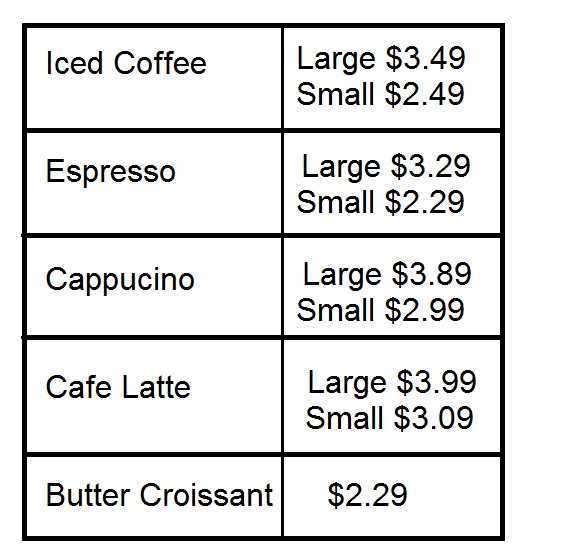
Above is the menu at a coffee shop.
Jerry has a coupon that entitles him to a free butter croissant with the purchase of one large drink of any kind. The coupon says "limit one per coupon".
He decides to purchase a large espresso, a large cappucino, and two butter croissants. Disregarding tax, how much will he pay for them?
Above is the menu at a coffee shop.
Jerry has a coupon that entitles him to a free butter croissant with the purchase of one large drink of any kind. The coupon says "limit one per coupon".
He decides to purchase a large espresso, a large cappucino, and two butter croissants. Disregarding tax, how much will he pay for them?
Tap to see back →
The coupon will entitle him to one free croissant, so Jerry will pay for the large espresso, the large cappucino, and one butter croissant. The charge will be the sum of the three prices:

The coupon will entitle him to one free croissant, so Jerry will pay for the large espresso, the large cappucino, and one butter croissant. The charge will be the sum of the three prices:
Find the distance,  , between point
  and point
  .
.

Find the distance,
Tap to see back →
Use the distance formula to solve this problem.


Plugging in our points A and B we get the following distance.


Use the distance formula to solve this problem.
Plugging in our points A and B we get the following distance.
Solve the equation by Substitution.


Solve the equation by Substitution.
Tap to see back →
First, take the first equation and solve for x in terms of y.


From here, substitute the equation you found for x into the second equation and solve for y.


Now, substitute the y value found into the original equation and solve for x.


First, take the first equation and solve for x in terms of y.
From here, substitute the equation you found for x into the second equation and solve for y.
Now, substitute the y value found into the original equation and solve for x.
Solve: 
Solve:
Tap to see back →
Simplify first by eliminating the parentheses. To do this you will need to distribute the coefficient term outside the parentheses to each term within the parentheses.

Next, combine like terms.


Simplify first by eliminating the parentheses. To do this you will need to distribute the coefficient term outside the parentheses to each term within the parentheses.
Next, combine like terms.
Simplify, if possible: 
Simplify, if possible:
Tap to see back →
There is only one like-term in the expression given, which is  .
.

Add the like term. The rest of the terms cannot be combined by adding or subtracting.
The correct answer is:

There is only one like-term in the expression given, which is
Add the like term. The rest of the terms cannot be combined by adding or subtracting.
The correct answer is:
Solve: 
Solve:
Tap to see back →
Add the ones digits.

Since this number is  or greater, use the tens digit as a carry over.
Add the tens digits with the carry over.

Add the hundreds digit with the carry over. The hundreds digit for the second number in the problem is zero.

Since there is no carry over and there is no thousands digit for the second number, the thousands digit of the answer is just  .
.
Combine all the ones digits in chronological order from thousands to the ones digits.
The answer is: 
Add the ones digits.
Since this number is
Add the tens digits with the carry over.
Add the hundreds digit with the carry over. The hundreds digit for the second number in the problem is zero.
Since there is no carry over and there is no thousands digit for the second number, the thousands digit of the answer is just
Combine all the ones digits in chronological order from thousands to the ones digits.
The answer is:
Solve: 
Solve:
Tap to see back →
In order to simplify this, we need to combine like-terms. The coefficients of unlike terms cannot be combined.
Add  and
and  .
.

Add  and
and  .
.

Add  and
and  .
.

Combine all the terms.
The answer is: 
In order to simplify this, we need to combine like-terms. The coefficients of unlike terms cannot be combined.
Add
Add
Add
Combine all the terms.
The answer is:
Solve: 
Solve:
Tap to see back →
In order to solve the problem, first evaluate  .
.
Borrow a one from the six in the tens digit in order to subtract the ones digit.

The six in the tens digit becomes a five. Subtract the five with the tens digit of the second number.


Add  .
.
Add the ones digit.

Since the number is ten or greater, use the tens digit as a carryover to the next calculation.

Combine the ones digits.
The answer is  .
.
In order to solve the problem, first evaluate
Borrow a one from the six in the tens digit in order to subtract the ones digit.
The six in the tens digit becomes a five. Subtract the five with the tens digit of the second number.
Add
Add the ones digit.
Since the number is ten or greater, use the tens digit as a carryover to the next calculation.
Combine the ones digits.
The answer is
Combine the following terms:

Combine the following terms:
Tap to see back →
Combine the following terms:

To begin, we can consider each step independently. Because we are only dealing with addition and subtraction, the order we do this in does not matter. Rewrite as follows:


So there we go,  is our answer.
Combine the following terms:
To begin, we can consider each step independently. Because we are only dealing with addition and subtraction, the order we do this in does not matter. Rewrite as follows:
So there we go,
Simplify the following expression:

Simplify the following expression:
Tap to see back →
Simplify the following expression:

Let's break this into parts.
First, realize that adding a negative number is the same as subtracting that number:

Next, subtract the 88:

Our answer must be negative, because 88 is bigger than 84. Therefore our answer is -4
Simplify the following expression:
Let's break this into parts.
First, realize that adding a negative number is the same as subtracting that number:
Next, subtract the 88:
Our answer must be negative, because 88 is bigger than 84. Therefore our answer is -4
If  and
and  , what is
  ?
?
If
Tap to see back →
When we add the functions together, we can only add terms that have matching exponents. First, let's add the terms that are squared:

Next, let's do the linear terms:

Finally, we add the constants:

Then we collect all the terms back together:

When we add the functions together, we can only add terms that have matching exponents. First, let's add the terms that are squared:
Next, let's do the linear terms:
Finally, we add the constants:
Then we collect all the terms back together:
Add the following numbers: 
Add the following numbers:
Tap to see back →
Add the ones digits.

The tens place is the carry over.
Add the tens digits with the carry over.

The tens place is the carry over for the next calculation.
Add the hundreds place with the carryover.

Combine this number with the ones digits of the previous calculations.
The answer is: 
Add the ones digits.
The tens place is the carry over.
Add the tens digits with the carry over.
The tens place is the carry over for the next calculation.
Add the hundreds place with the carryover.
Combine this number with the ones digits of the previous calculations.
The answer is:
Add the following numbers: 
Add the following numbers:
Tap to see back →
Add the ones digits.

The two in the tens place is the carryover.
Add the tens digits with the carryover.

The one in the tens place is the carryover.
Add the hundreds places with the carryover.

The one in the tens place is the carryover.
Add the thousands places with the carryover.

Combine this number with the ones digits from the previous calculations.
The answer is: 
Add the ones digits.
The two in the tens place is the carryover.
Add the tens digits with the carryover.
The one in the tens place is the carryover.
Add the hundreds places with the carryover.
The one in the tens place is the carryover.
Add the thousands places with the carryover.
Combine this number with the ones digits from the previous calculations.
The answer is:
Add the following numbers: 
Add the following numbers:
Tap to see back →
Add the ones digits.

Add the tens digits.

The carryover is the tens digit.
Add the hundreds digits with the carryover.

Add the thousands digits.

Combine this number with the ones digits of the previous calculations.
The answer is: 
Add the ones digits.
Add the tens digits.
The carryover is the tens digit.
Add the hundreds digits with the carryover.
Add the thousands digits.
Combine this number with the ones digits of the previous calculations.
The answer is:
Add the following numbers: 
Add the following numbers:
Tap to see back →
Add the ones digits.

The carryover is the tens digit.
Add the tens digits with the carryover.

The carryover is the tens digit.
Add the hundreds digits with the carryover.

The carryover is the tens digit.
Add the thousands digits with the carryover. The thousands digit to 385 is zero.

Combine all the ones digits from each calculation.
The answer is: 
Add the ones digits.
The carryover is the tens digit.
Add the tens digits with the carryover.
The carryover is the tens digit.
Add the hundreds digits with the carryover.
The carryover is the tens digit.
Add the thousands digits with the carryover. The thousands digit to 385 is zero.
Combine all the ones digits from each calculation.
The answer is:
Solve: 
Solve:
Tap to see back →
Add the ones digits.

Add the tens digits.

The tens place will be the carryover.
Add the hundreds place with the carryover.

The tens place will be the carryover.
Add the thousands place with the carryover. The thousands place of 381 is zero.

Combine all the ones digits from each calculation.
The answer is: 
Add the ones digits.
Add the tens digits.
The tens place will be the carryover.
Add the hundreds place with the carryover.
The tens place will be the carryover.
Add the thousands place with the carryover. The thousands place of 381 is zero.
Combine all the ones digits from each calculation.
The answer is:
Add the numbers: 
Add the numbers:
Tap to see back →
Add the ones digits.

The carryover is the tens digit.
Add the tens digits with the carryover, one.

The carryover is the tens digit.
Add the hundreds digits with the carryover, which is also one.

The carryover is the tens digit.
Add the thousands digits with the carryover, which is two.

Combine all the ones digits from the previous calculations.
The answer is: 
Add the ones digits.
The carryover is the tens digit.
Add the tens digits with the carryover, one.
The carryover is the tens digit.
Add the hundreds digits with the carryover, which is also one.
The carryover is the tens digit.
Add the thousands digits with the carryover, which is two.
Combine all the ones digits from the previous calculations.
The answer is:
Add the following numbers: 
Add the following numbers:
Tap to see back →
Add the ones digits.

The carryover is the tens place.
Add the tens digits with the carryover.

The carryover is the tens place.
Add the hundreds digits with the carryover.

The carryover is the tens place.
Add the thousands digits with the carryover.

The answer is: 
Add the ones digits.
The carryover is the tens place.
Add the tens digits with the carryover.
The carryover is the tens place.
Add the hundreds digits with the carryover.
The carryover is the tens place.
Add the thousands digits with the carryover.
The answer is: