Exponents - Algebra 2
Card 0 of 3072
Simplify 
Simplify
Tap to see back →
First, combine exponents of like variables. This gives us 
First, combine exponents of like variables. This gives us
Simplify 
Simplify
Tap to see back →
First, combine exponents of like variables. This gives us  which simplifies to
First, combine exponents of like variables. This gives us
Expand: 
Expand:
Tap to see back →
To expand the exponent, we multiply the base by whatever the exponent is.

To expand the exponent, we multiply the base by whatever the exponent is.
Evaluate: 
Evaluate:
Tap to see back →
Although we have two variables, we do know that a number raised to a zero power is one. Therefore:

Although we have two variables, we do know that a number raised to a zero power is one. Therefore:
Simplify.

Simplify.
Tap to see back →
When multiplying exponents with the same base, you just have to add the exponents.

When multiplying exponents with the same base, you just have to add the exponents.
Simplify.

Simplify.
Tap to see back →
When dividing exponents with the same base, we just subtract the exponents.

When dividing exponents with the same base, we just subtract the exponents.
Simplify.

Simplify.
Tap to see back →
When dividing exponents with the same base, we just subtract the exponents.

When dividing exponents with the same base, we just subtract the exponents.
Simplify: 
Simplify:
Tap to see back →
When dividing exponents with the same base, we subtract the exponents and keep the base the same.

When dividing exponents with the same base, we subtract the exponents and keep the base the same.
Simplify: 
Simplify:
Tap to see back →
When multiplying exponents with the same base, we add the exponents and keep the base the same.

When multiplying exponents with the same base, we add the exponents and keep the base the same.
Simplify: 
Simplify:
Tap to see back →
When multiplying exponents with the same base, we add the exponents and keep the base the same.

When multiplying exponents with the same base, we add the exponents and keep the base the same.
Simplify: 
Simplify:
Tap to see back →
When multiplying exponents with the same base, we add the exponents and keep the base the same.

When multiplying exponents with the same base, we add the exponents and keep the base the same.
Simplify: 
Simplify:
Tap to see back →
When multiplying exponents with the same base, we just keep the base the same and add the exponents.

When multiplying exponents with the same base, we just keep the base the same and add the exponents.
Simplify: 
Simplify:
Tap to see back →
When multiplying exponents with the same base, we just keep the base the same and add the exponents.

When multiplying exponents with the same base, we just keep the base the same and add the exponents.
Simplify:

Simplify:
Tap to see back →
When dealing with exponents being raised by another exponent, we just multiply the powers and keep the base the same.

When dealing with exponents being raised by another exponent, we just multiply the powers and keep the base the same.
Simplify: 
Simplify:
Tap to see back →
To simplify this expression, square every term in the parentheses:
 .
.
Then simplify and get rid of the negative exponent by putting the b term on the denominator:
 .
.
To simplify this expression, square every term in the parentheses:
Then simplify and get rid of the negative exponent by putting the b term on the denominator:
Simplify:

Simplify:
Tap to see back →
When an exponent is raised by another exponent, we will multiply the exponents and keep the base the same.
Simplify:

When an exponent is raised by another exponent, we will multiply the exponents and keep the base the same.
Simplify:
What is  the same as?
What is
Tap to see back →
While a positive exponent says how many times to multiply by a number, a negative exponent says how many times to divide by the number.
To solve for negative exponents, just calculate the reciprocal.
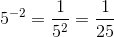
While a positive exponent says how many times to multiply by a number, a negative exponent says how many times to divide by the number.
To solve for negative exponents, just calculate the reciprocal.
Solve: 
Solve:
Tap to see back →
To evaluate a negative exponent, convert the exponent to positive by taking the inverse.
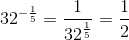
To evaluate a negative exponent, convert the exponent to positive by taking the inverse.
Simplify:

Simplify:
Tap to see back →
When an exponent is raised by another exponent, we will multiply the exponents and keep the base the same.
Simplify:

When an exponent is raised by another exponent, we will multiply the exponents and keep the base the same.
Simplify:
Simplify:

Simplify:
Tap to see back →
When an exponent is raised by another exponent, we will multiply the exponents and keep the base the same.
Simplify:

When an exponent is raised by another exponent, we will multiply the exponents and keep the base the same.
Simplify: