Fractions - Algebra 2
Card 0 of 1112
Multiply these fractions:

Multiply these fractions:
Tap to see back →
When multiplying fractions, all we have to do is multiply the numerators together and multiply the denominators together:

When multiplying fractions, all we have to do is multiply the numerators together and multiply the denominators together:
Multiply the fractions:

Multiply the fractions:
Tap to see back →
When multiplying fractions, multiply the numbers on the top together and the numbers on the bottom together. Then simplify accordingly.

When multiplying fractions, multiply the numbers on the top together and the numbers on the bottom together. Then simplify accordingly.
Multiply the fractions:

Multiply the fractions:
Tap to see back →
When multiplying fractions, multiply the numbers on the top together and the numbers on the bottom together. Then simplify accordingly.

When multiplying fractions, multiply the numbers on the top together and the numbers on the bottom together. Then simplify accordingly.
Multiply the fractions:

Multiply the fractions:
Tap to see back →
When multiplying fractions, multiply the numbers on the top together and the numbers on the bottom together. Then simplify accordingly.

When multiplying fractions, multiply the numbers on the top together and the numbers on the bottom together. Then simplify accordingly.
Multiply the fractions:

Multiply the fractions:
Tap to see back →
When multiplying fractions, multiply the numbers on the top together and the numbers on the bottom together. Then simplify accordingly.

When multiplying fractions, multiply the numbers on the top together and the numbers on the bottom together. Then simplify accordingly.
Multiply the fractions:

Multiply the fractions:
Tap to see back →
When multiplying fractions, multiply the numbers on the top together and the numbers on the bottom together. Then simplify accordingly.

When multiplying fractions, multiply the numbers on the top together and the numbers on the bottom together. Then simplify accordingly.
Divide the fractions:

Divide the fractions:
Tap to see back →
When dividing fractions, first we flip the second fraction in the problem. Then we multiply the numbers on the top together and the numbers on the bottom together. Finally simplify accordingly.

When dividing fractions, first we flip the second fraction in the problem. Then we multiply the numbers on the top together and the numbers on the bottom together. Finally simplify accordingly.
Divide the fractions:

Divide the fractions:
Tap to see back →
When dividing fractions, first we flip the second fraction in the problem. Then we multiply the numbers on the top together and the numbers on the bottom together. Finally simplify accordingly.

When dividing fractions, first we flip the second fraction in the problem. Then we multiply the numbers on the top together and the numbers on the bottom together. Finally simplify accordingly.

Tap to see back →
Convert each fraction to incorporate a common denominator. The least common denominator of 11 and 13 is 143. Multiply the first fraction by 13 divided by 13 and the second by 11 divided by 11 . Then add or subtract the resulting fractions.
Convert each fraction to incorporate a common denominator. The least common denominator of 11 and 13 is 143. Multiply the first fraction by 13 divided by 13 and the second by 11 divided by 11 . Then add or subtract the resulting fractions.

Tap to see back →
Convert each fraction to incorporate a common denominator. The least common denominator of 7 and 13 is 91. Multiply the first fraction by 13 divided by 13 and the second by 7 divided by 7 . Then add or subtract the resulting fractions.
Convert each fraction to incorporate a common denominator. The least common denominator of 7 and 13 is 91. Multiply the first fraction by 13 divided by 13 and the second by 7 divided by 7 . Then add or subtract the resulting fractions.

Tap to see back →
Convert each fraction to incorporate a common denominator. The least common denominator of 9 and 7 is 63. Multiply the first fraction by 7 divided by 7 and the second by 9 divided by 9 . Then add or subtract the resulting fractions.
Convert each fraction to incorporate a common denominator. The least common denominator of 9 and 7 is 63. Multiply the first fraction by 7 divided by 7 and the second by 9 divided by 9 . Then add or subtract the resulting fractions.

Tap to see back →
Convert each fraction to incorporate a common denominator. The least common denominator of 8 and 7 is 56. Multiply the first fraction by 7 divided by 7 and the second by 8 divided by 8 . Then add or subtract the resulting fractions.
Convert each fraction to incorporate a common denominator. The least common denominator of 8 and 7 is 56. Multiply the first fraction by 7 divided by 7 and the second by 8 divided by 8 . Then add or subtract the resulting fractions.

Tap to see back →
Convert each fraction to incorporate a common denominator. The least common denominator of 6 and 5 is 30. Multiply the first fraction by 5 divided by 5 and the second by 6 divided by 6 . Then add or subtract the resulting fractions.
Convert each fraction to incorporate a common denominator. The least common denominator of 6 and 5 is 30. Multiply the first fraction by 5 divided by 5 and the second by 6 divided by 6 . Then add or subtract the resulting fractions.

Tap to see back →
Convert each fraction to incorporate a common denominator. The least common denominator of 3 and 8 is 24. Multiply the first fraction by 8 divided by 8 and the second by 3 divided by 3 . Then add or subtract the resulting fractions.
Convert each fraction to incorporate a common denominator. The least common denominator of 3 and 8 is 24. Multiply the first fraction by 8 divided by 8 and the second by 3 divided by 3 . Then add or subtract the resulting fractions.

Tap to see back →
Convert each fraction to incorporate a common denominator. The least common denominator of 11 and 3 is 33. Multiply the first fraction by 3 divided by 3 and the second by 11 divided by 11 . Then add or subtract the resulting fractions.
Convert each fraction to incorporate a common denominator. The least common denominator of 11 and 3 is 33. Multiply the first fraction by 3 divided by 3 and the second by 11 divided by 11 . Then add or subtract the resulting fractions.

Tap to see back →
Convert each fraction to incorporate a common denominator. The least common denominator of 9 and 6 is 18. Multiply the first fraction by 2 divided by 2 and the second by 3 divided by 3 . Then add or subtract the resulting fractions.È
Convert each fraction to incorporate a common denominator. The least common denominator of 9 and 6 is 18. Multiply the first fraction by 2 divided by 2 and the second by 3 divided by 3 . Then add or subtract the resulting fractions.È
Divide the fractions:

Divide the fractions:
Tap to see back →
When dividing fractions, first we flip the second fraction in the problem. Then we multiply the numbers on the top together and the numbers on the bottom together. Finally simplify accordingly.

When dividing fractions, first we flip the second fraction in the problem. Then we multiply the numbers on the top together and the numbers on the bottom together. Finally simplify accordingly.
Divide the fractions:

Divide the fractions:
Tap to see back →
When dividing fractions, first we flip the second fraction in the problem. Then we multiply the numbers on the top together and the numbers on the bottom together. Finally simplify accordingly.

When dividing fractions, first we flip the second fraction in the problem. Then we multiply the numbers on the top together and the numbers on the bottom together. Finally simplify accordingly.
Multiply:
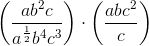
Multiply:
Tap to see back →
To multiply fractions, multiply the numerators and denominators together, then simplify.

To multiply fractions, multiply the numerators and denominators together, then simplify.
Multiply:
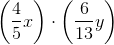
Multiply:
Tap to see back →
Multiply the numerators and denominators. Then, simplify.

Multiply the numerators and denominators. Then, simplify.