Multiplying and Dividing Exponents - Algebra 2
Card 0 of 748
Simplify 
Simplify
Tap to see back →
First, combine exponents of like variables. This gives us 
First, combine exponents of like variables. This gives us
Simplify 
Simplify
Tap to see back →
First, combine exponents of like variables. This gives us  which simplifies to
First, combine exponents of like variables. This gives us
Simplify.

Simplify.
Tap to see back →
When multiplying exponents with the same base, you just have to add the exponents.

When multiplying exponents with the same base, you just have to add the exponents.
Simplify.

Simplify.
Tap to see back →
When dividing exponents with the same base, we just subtract the exponents.

When dividing exponents with the same base, we just subtract the exponents.
Simplify.

Simplify.
Tap to see back →
When dividing exponents with the same base, we just subtract the exponents.

When dividing exponents with the same base, we just subtract the exponents.
Simplify: 
Simplify:
Tap to see back →
When dividing exponents with the same base, we subtract the exponents and keep the base the same.

When dividing exponents with the same base, we subtract the exponents and keep the base the same.
Simplify: 
Simplify:
Tap to see back →
When multiplying exponents with the same base, we add the exponents and keep the base the same.

When multiplying exponents with the same base, we add the exponents and keep the base the same.
Simplify: 
Simplify:
Tap to see back →
When multiplying exponents with the same base, we add the exponents and keep the base the same.

When multiplying exponents with the same base, we add the exponents and keep the base the same.
Simplify: 
Simplify:
Tap to see back →
When multiplying exponents with the same base, we add the exponents and keep the base the same.

When multiplying exponents with the same base, we add the exponents and keep the base the same.
Simplify: 
Simplify:
Tap to see back →
When multiplying exponents with the same base, we just keep the base the same and add the exponents.

When multiplying exponents with the same base, we just keep the base the same and add the exponents.
Simplify: 
Simplify:
Tap to see back →
When multiplying exponents with the same base, we just keep the base the same and add the exponents.

When multiplying exponents with the same base, we just keep the base the same and add the exponents.
Simplify the following expression

Simplify the following expression
Tap to see back →

Remember that any number raised to the 0th power equals 1
Remember that any number raised to the 0th power equals 1
Evaluate:

Evaluate:
Tap to see back →
When multiplying with same base but different exponents, you just add the exponents and keep the base the same.

When multiplying with same base but different exponents, you just add the exponents and keep the base the same.
Simplify this expression:

Simplify this expression:
Tap to see back →
When different powers of the same variable are multiplied, the exponents are added. When different powers of the same variable are divided, the exponents are subtracted. So, as an example:

For the above problem,

Therefore, the expression simplifies to:

When different powers of the same variable are multiplied, the exponents are added. When different powers of the same variable are divided, the exponents are subtracted. So, as an example:
For the above problem,
Therefore, the expression simplifies to:
Simplify.

Simplify.
Tap to see back →
Put the negative exponent on the bottom so that you have  which simplifies further to
  .
.
Put the negative exponent on the bottom so that you have
Simplify the rational expression.

Simplify the rational expression.
Tap to see back →

To simplify variables with exponents through division, you must subtract the exponent in the denominator from the numerator.

Remember that negative exponents will eventually be moved back to the denominator.
To simplify variables with exponents through division, you must subtract the exponent in the denominator from the numerator.
Remember that negative exponents will eventually be moved back to the denominator.
Simplify 
Simplify
Tap to see back →
Rewrite so that you are multiplying the reciprocal of the second fraction:

You can then simplify using rules of exponents:
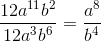
Rewrite so that you are multiplying the reciprocal of the second fraction:
You can then simplify using rules of exponents:
Simplify the expression.

Simplify the expression.
Tap to see back →

Rearrange the expression so that the  and
and  variables of different powers are right next to each other.

When multiplying the same variable with different exponents, it is the same as adding the exponents:  . Taking advantage of this rule, the problem can be rewritten.


Rearrange the expression so that the
When multiplying the same variable with different exponents, it is the same as adding the exponents:
Simplify:
Simplify:
Tap to see back →
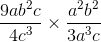
In this problem, you have two fractions being multiplied. You can first divide and cancel the coefficients in the numerators and denominators, by dividing 9 and 3 each by 3:

Next you can multiply the two numerators, and multiply the two denominators. Remember that when multiplying like variables with exponents, you add the exponents together:
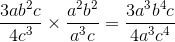
If a variable shows up in both the numerator and denominator, you can simplify by subtracting the numerator's exponent by the denominator's exponent. If you end up with a negative exponent in the numerator, you can move the variable and exponent to the denominator to make it positive:

In this problem, you have two fractions being multiplied. You can first divide and cancel the coefficients in the numerators and denominators, by dividing 9 and 3 each by 3:
Next you can multiply the two numerators, and multiply the two denominators. Remember that when multiplying like variables with exponents, you add the exponents together:
If a variable shows up in both the numerator and denominator, you can simplify by subtracting the numerator's exponent by the denominator's exponent. If you end up with a negative exponent in the numerator, you can move the variable and exponent to the denominator to make it positive:
Simplify the following:
Simplify the following:
Tap to see back →
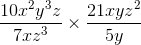
In this problem, you have two fractions being multiplied. You can first divide and cancel the coefficients in the numerators and denominators, by dividing 10 and 5 each by 5 and dividing 21 and 7 each by 7:

Next you can multiply the two numerators, and multiply the two denominators. Remember that when multiplying like variables with exponents, you add the exponents together:
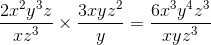
If a variable shows up in both the numerator and denominator, you can simplify by subtracting the numerator's exponent by the denominator's exponent:
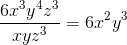
In this problem, you have two fractions being multiplied. You can first divide and cancel the coefficients in the numerators and denominators, by dividing 10 and 5 each by 5 and dividing 21 and 7 each by 7:
Next you can multiply the two numerators, and multiply the two denominators. Remember that when multiplying like variables with exponents, you add the exponents together:
If a variable shows up in both the numerator and denominator, you can simplify by subtracting the numerator's exponent by the denominator's exponent: