Types of Numbers - Algebra 2
Card 0 of 72
Which of these numbers is prime?

Which of these numbers is prime?
Tap to see back →
For a number to be prime it must only have factors of one and itself.
10 has factors 1, 2, 5, 10.
15 has factors 1, 3, 5, 15.
18 has factors 1, 2, 3, 6, 9, 18.
The only factors of 13 are 1 and 13. As such it is prime.
For a number to be prime it must only have factors of one and itself.
10 has factors 1, 2, 5, 10.
15 has factors 1, 3, 5, 15.
18 has factors 1, 2, 3, 6, 9, 18.
The only factors of 13 are 1 and 13. As such it is prime.
Simplify  .
.
Simplify
Tap to see back →
Multiplying out using FOIL (First, Inner, Outer, Last) results in,
 .
.
Remember that 

Multiplying out using FOIL (First, Inner, Outer, Last) results in,
Remember that
Which of the following describes the number  ?
?
Which of the following describes the number
Tap to see back →
 is a real number, because you can represent it on the Cartesian coordinate plane, but it is irrational because it cannot be represented by a fraction of two integers. Natural numbers are integers greater than 0.
Which of the following sets of numbers contain only natural numbers.
Which of the following sets of numbers contain only natural numbers.
Tap to see back →
Natural numbers are simply whole, non-negative numbers.
Using this definition, we see only one set of numbers within our answer choices containing only whole, non-negative numbers. Any set containing decimals or negative numbers, will violate our defintion of natural numbers and thus be an incorrect answer.
Natural numbers are simply whole, non-negative numbers.
Using this definition, we see only one set of numbers within our answer choices containing only whole, non-negative numbers. Any set containing decimals or negative numbers, will violate our defintion of natural numbers and thus be an incorrect answer.
What is the value of  ?
?
What is the value of
Tap to see back →
There is a repeating pattern of four exponent values of  .
.
 is the same as
  .
.

There is a repeating pattern of four exponent values of
Which of the below is an irrational number?
Which of the below is an irrational number?
Tap to see back →
Irrational numbers are defined by the fact that they cannot be written as a fraction which means that the decimals continue forever.
Looking at our possible answer choices we see,
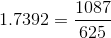
 is already in fraction form
 which is an imaginary number but still rational.
Therefore since,

we can conclude it is irrational.
Irrational numbers are defined by the fact that they cannot be written as a fraction which means that the decimals continue forever.
Looking at our possible answer choices we see,
Therefore since,
we can conclude it is irrational.

Which of the following describes the type of  ?
?
Which of the following describes the type of
Tap to see back →
An irrational number is a number that cannot be written in fraction form. In other words a nonrepeating decimal is an irrational number.
The  is an irrational number.
 is a real number with a value of
  .
.
Therefore,  . This is a real but irrational number.
An irrational number is a number that cannot be written in fraction form. In other words a nonrepeating decimal is an irrational number.
The
Therefore,
What is the most specific classification for the x-intercepts to the equation graphed:
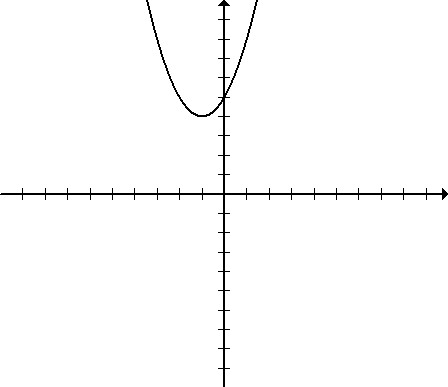
What is the most specific classification for the x-intercepts to the equation graphed:
Tap to see back →
The graph shown never intersects with the x-axis. This means that the x-intercepts must be imaginary.
The graph shown never intersects with the x-axis. This means that the x-intercepts must be imaginary.
What is the most specific classification for 
What is the most specific classification for
Tap to see back →
The square root of 5 is irrational since it is a non-terminating, non-repeating decimal that cannot be expressed as a fraction.
The square root of 5 is irrational since it is a non-terminating, non-repeating decimal that cannot be expressed as a fraction.
Which of the following is a complex number?
Which of the following is a complex number?
Tap to see back →
By definition, a complex number is a number with an imaginary term denoted as i.
A complex number is in the form,

where  represents the real part of the number and
  represents the imaginary portion of the complex number.
Therefore, the complex number which is the solution is  .
.
By definition, a complex number is a number with an imaginary term denoted as i.
A complex number is in the form,
where
Therefore, the complex number which is the solution is
What sets do the numbers  have in common?
What sets do the numbers
Tap to see back →
Step 1: Define the different sets:
Rational: Any number that can be expressed as a fraction (improper/proper form) (example:  )
)
Irrational: Any number whose decimal expansion cannot be written as a fraction. (example:  )
)
Real numbers: The combination of all numbers that belong in the Rational and the Irrational set. (Example:  )
)
Integers: All whole numbers from  . (Example:
  )
)
Natural Numbers (AKA Counting numbers): All numbers greater than or equal to 1, 
Step 2: Let's categorize the numbers given in the question to these sets above:
 belongs to the set of rational numbers, natural numbers, and integers.
 belongs to the set of rational numbers and integers.
 belongs to the set of rational numbers.
Step 3: Analyze each number closely and pull out any sets where all three numbers belong..
All three numbers belong to the set of rational numbers.
In math, we symbolize rational numbers as  .
.
So, all three numbers belong to the sets  .
.
Step 1: Define the different sets:
Rational: Any number that can be expressed as a fraction (improper/proper form) (example:
Irrational: Any number whose decimal expansion cannot be written as a fraction. (example:
Real numbers: The combination of all numbers that belong in the Rational and the Irrational set. (Example:
Integers: All whole numbers from
Natural Numbers (AKA Counting numbers): All numbers greater than or equal to 1,
Step 2: Let's categorize the numbers given in the question to these sets above:
Step 3: Analyze each number closely and pull out any sets where all three numbers belong..
All three numbers belong to the set of rational numbers.
In math, we symbolize rational numbers as
So, all three numbers belong to the sets
Which of the following is a rational number?
Which of the following is a rational number?
Tap to see back →
 A rational number is a number that can be expressed in the form p/q. in this case p=3 and q=1. The other answers are irrational because they cannot be expressed as whole numbers or fractions.
Which of the following are natural numbers?
Which of the following are natural numbers?
Tap to see back →
The definition of natural numbers states that the number may not be negative, and must be countable where:

Decimal places and fractions are also not allowed.
The value of fifty percent equates to  .
.
The only possible answer is: 
The definition of natural numbers states that the number may not be negative, and must be countable where:
Decimal places and fractions are also not allowed.
The value of fifty percent equates to
The only possible answer is:
Which of the following represents a natural number?
Which of the following represents a natural number?
Tap to see back →
Natural numbers are numbers can be countable. Natural numbers cannot be negative. They are whole numbers which include zero.
The fraction given is not a natural number.
Notice that the imaginary term  can be reduced. Recall that
  , and
, and  . This means that
  .
.
The answer is: 
Natural numbers are numbers can be countable. Natural numbers cannot be negative. They are whole numbers which include zero.
The fraction given is not a natural number.
Notice that the imaginary term
The answer is:
Which of these numbers is prime?
Which of these numbers is prime?
Tap to see back →
For a number to be prime it must only have factors of one and itself.
10 has factors 1, 2, 5, 10.
15 has factors 1, 3, 5, 15.
18 has factors 1, 2, 3, 6, 9, 18.
The only factors of 13 are 1 and 13. As such it is prime.
For a number to be prime it must only have factors of one and itself.
10 has factors 1, 2, 5, 10.
15 has factors 1, 3, 5, 15.
18 has factors 1, 2, 3, 6, 9, 18.
The only factors of 13 are 1 and 13. As such it is prime.
Simplify .
Simplify
Tap to see back →
Multiplying out using FOIL (First, Inner, Outer, Last) results in,
.
Remember that
Multiplying out using FOIL (First, Inner, Outer, Last) results in,
Remember that
Which of the following describes the number ?
Which of the following describes the number
Tap to see back →
is a real number, because you can represent it on the Cartesian coordinate plane, but it is irrational because it cannot be represented by a fraction of two integers. Natural numbers are integers greater than 0.
Which of the following sets of numbers contain only natural numbers.
Which of the following sets of numbers contain only natural numbers.
Tap to see back →
Natural numbers are simply whole, non-negative numbers.
Using this definition, we see only one set of numbers within our answer choices containing only whole, non-negative numbers. Any set containing decimals or negative numbers, will violate our defintion of natural numbers and thus be an incorrect answer.
Natural numbers are simply whole, non-negative numbers.
Using this definition, we see only one set of numbers within our answer choices containing only whole, non-negative numbers. Any set containing decimals or negative numbers, will violate our defintion of natural numbers and thus be an incorrect answer.
What is the value of ?
What is the value of
Tap to see back →
There is a repeating pattern of four exponent values of .
is the same as .
There is a repeating pattern of four exponent values of
Which of the below is an irrational number?
Which of the below is an irrational number?
Tap to see back →
Irrational numbers are defined by the fact that they cannot be written as a fraction which means that the decimals continue forever.
Looking at our possible answer choices we see,
is already in fraction form
which is an imaginary number but still rational.
Therefore since,
we can conclude it is irrational.
Irrational numbers are defined by the fact that they cannot be written as a fraction which means that the decimals continue forever.
Looking at our possible answer choices we see,
Therefore since,
we can conclude it is irrational.