Parametric, Polar, and Vector Functions - AP Calculus BC
Card 0 of 390
Rewrite as a Cartesian equation:

Rewrite as a Cartesian equation:
Tap to see back →


So
 or
or 
We are restricting  to values on
  , so
, so  is nonnegative; we choose
 .
.
Also,


So
 or
or 
We are restricting  to values on
  , so
, so  is nonpositive; we choose

or equivalently,

to make  nonpositive.
Then,

and


So
We are restricting
Also,
So
We are restricting
or equivalently,
to make
Then,
and
Rewrite as a Cartesian equation:

Rewrite as a Cartesian equation:
Tap to see back →

 , so
, so

This makes the Cartesian equation
 .
.
This makes the Cartesian equation
Draw the graph of  from
from  .
.
Draw the graph of
Tap to see back →
Between  and
and  , the radius approaches
  from
from  .
.
From  to
to  the radius goes from
  to
to  .
.
Between  and
and  , the curve is redrawn in the opposite quadrant, the first quadrant as the radius approaches
  .
.
From  and
and  , the curve is redrawn in the second quadrant as the radius approaches
  from
from  .
.
Between
From
Between
From
Draw the graph of  where
where  .
.
Draw the graph of
Tap to see back →
Because this function has a period of  , the amplitude of the graph
  appear at a reference angle of
  (angles halfway between the angles of the axes).
Between  and
and  the radius approaches 1 from 0.
Between  and
and  , the radius approaches 0 from 1.
From  to
to  the radius approaches -1 from 0 and is drawn in the opposite quadrant, the fourth quadrant because it has a negative radius.
Between  and
and  , the radius approaches 0 from -1, and is also drawn in the fourth quadrant.
From  and
and  , the radius approaches 1 from 0. Between
  and
and  , the radius approaches 0 from 1.
Then between  and
and  the radius approaches -1 from 0. Because it is a negative radius, it is drawn in the opposite quadrant, the second quadrant. Likewise, as the radius approaches 0 from -1. Between
  and
and  , the curve is drawn in the second quadrant.
Because this function has a period of
Between
Between
From
Between
From
Then between
Graph  where
where  .
.
Graph
Tap to see back →
Taking the graph of  , we only want the areas in the positive first quadrant because the radius is squared and cannot be negative.
This leaves us with the areas from  to
to  ,
,  to
to  , and
, and  to
to  .
.
Then, when we take the square root of the radius, we get both a positive and negative answer with a maximum and minimum radius of  .
.
To draw the graph, the radius is 1 at  and traces to 0 at
  . As well, the negative part of the radius starts at -1 and traces to zero in the opposite quadrant, the third quadrant.
From  to
to  , the curves are traced from 0 to 1 and 0 to -1 in the fourth quadrant. Following this pattern, the graph is redrawn again from the areas included in
  to
to  .
.
Taking the graph of
This leaves us with the areas from
Then, when we take the square root of the radius, we get both a positive and negative answer with a maximum and minimum radius of
To draw the graph, the radius is 1 at
From
Draw the curve of  from
from  .
.
Draw the curve of
Tap to see back →
Taking the graph of  , we only want the areas in the positive first quadrant because the radius is squared and cannot be negative.
This leaves us with the areas from  to
to  and
and  to
to  .
.
Then, when we take the square root of the radius, we get both a positive and negative answer with a maximum and minimum radius of  .
.
To draw the graph, the radius is 0 at  and traces to 1 at
  . As well, the negative part of the radius starts at 0 and traces to-1 in the opposite quadrant, the third quadrant.
From  to
to  , the curves are traced from 1 to 0 and -1 to 0 in the third quadrant.
Following this pattern, the graph is redrawn again from the areas included in  to
to  .
.
Taking the graph of
This leaves us with the areas from
Then, when we take the square root of the radius, we get both a positive and negative answer with a maximum and minimum radius of
To draw the graph, the radius is 0 at
From
Following this pattern, the graph is redrawn again from the areas included in
If  and
and  , what is
  in terms of
  (rectangular form)?
If
Tap to see back →
Given  and
and  , we can find
  in terms of
  by isolating
  in both equations:


Since both of these transformations equal  , we can set them equal to each other:


Given
Since both of these transformations equal
Find the length of the following parametric curve
 ,
,  ,
,  .
.
Find the length of the following parametric curve
Tap to see back →
The length of a curve is found using the equation 
We use the product rule,
 , when
  and
and  are functions of
  ,
,
the trigonometric rule,
 and
and 
and exponential rule,
 to find
  and
and  .
.
In this case
 ,
, 


The length of this curve is

Using the identity 


Using the identity 

Using the trigonometric identity  where
where  is a constant and

Using the exponential rule, 

Using the exponential rule,  , gives us the final solution

The length of a curve is found using the equation
We use the product rule,
the trigonometric rule,
and exponential rule,
In this case
The length of this curve is
Using the identity
Using the identity
Using the trigonometric identity
Using the exponential rule,
Using the exponential rule,
Given  and
and  , what is the arc length between
  ?
?
Given
Tap to see back →
In order to find the arc length, we must use the arc length formula for parametric curves:
 .
.
Given  and
and  , we can use using the Power Rule
 for all  , to derive
 and
and
 .
.
Plugging these values and our boundary values for  into the arc length equation, we get:


Now, using the Power Rule for Integrals
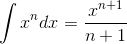 for all
  ,
,
we can determine that:


In order to find the arc length, we must use the arc length formula for parametric curves:
Given
 for all
Plugging these values and our boundary values for
Now, using the Power Rule for Integrals
we can determine that:
Given  and
and  , what is the length of the arc from
  ?
?
Given
Tap to see back →
In order to find the arc length, we must use the arc length formula for parametric curves:
 .
.
Given  and
and  , we can use using the Power Rule
 for all , to derive
 and
and
 .
.
Plugging these values and our boundary values for into the arc length equation, we get:


Now, using the Power Rule for Integrals
for all ,
we can determine that:


In order to find the arc length, we must use the arc length formula for parametric curves:
Given
 for all
Plugging these values and our boundary values for
Now, using the Power Rule for Integrals
we can determine that:
Find dy/dx at the point corresponding to the given value of the parameter without eliminating the parameter:

Find dy/dx at the point corresponding to the given value of the parameter without eliminating the parameter:
Tap to see back →
The formula for dy/dx for parametric equations is given as:

From the problem statement:

If we plug these into the above equation we end up with:


If we plug in our given value for t, we end up with:

This is one of the answer choices.
The formula for dy/dx for parametric equations is given as:
From the problem statement:
If we plug these into the above equation we end up with:
If we plug in our given value for t, we end up with:
This is one of the answer choices.
Rewrite in polar form:

Rewrite in polar form:
Tap to see back →


Graph the equation  where
where  .
.
Graph the equation
Tap to see back →
At angle  the graph as a radius of
  . As it approaches
  , the radius approaches
  .
.
As the graph approaches  , the radius approaches
  .
.
Because this is a negative radius, the curve is drawn in the opposite quadrant between  and
and  .
.
Between  and
and  , the radius approaches
  from
from  and redraws the curve in the first quadrant.
Between  and
and  , the graph redraws the curve in the fourth quadrant as the radius approaches
  from
from  .
.
At angle
As the graph approaches
Because this is a negative radius, the curve is drawn in the opposite quadrant between
Between
Between
Draw the graph of  from
from  .
.
Draw the graph of
Tap to see back →
Because this function has a period of  , the x-intercepts of the graph
  happen at a reference angle of
  (angles halfway between the angles of the axes).
Between and  the radius approaches
  from
from  .
.
Between  and
and  , the radius approaches
  from
from  and is drawn in the opposite quadrant, the third quadrant because it has a negative radius.
From  to
to  the radius approaches
  from
from  , and is drawn in the fourth quadrant, the opposite quadrant.
Between  and
and  , the radius approaches
  from
from  .
.
From  and
and  , the radius approaches
  from
from  .
.
Between  and
and  , the radius approaches
  from
from  . Because it is a negative radius, it is drawn in the opposite quadrant, the first quadrant.
Then between  and
and  the radius approaches
  from
from  and is draw in the second quadrant.
Finally between  and
and  , the radius approaches
  from
from  .
.
Because this function has a period of
Between
Between
From
Between
From
Between
Then between
Finally between
What is the following coordinate in polar form?

Provide the angle in degrees.
What is the following coordinate in polar form?
Provide the angle in degrees.
Tap to see back →
To calculate the polar coordinate, use


However, keep track of the angle here. 68 degree is the mathematical equivalent of the expression, but we know the point (-2,-5) is in the 3rd quadrant, so we have to add 180 to it to get 248.
Some calculators might already have provided you with the correct answer.
 .
.
To calculate the polar coordinate, use
However, keep track of the angle here. 68 degree is the mathematical equivalent of the expression, but we know the point (-2,-5) is in the 3rd quadrant, so we have to add 180 to it to get 248.
Some calculators might already have provided you with the correct answer.
What is the equation  in polar form?
What is the equation
Tap to see back →
We can convert from rectangular form to polar form by using the following identities:  and
and  . Given
  , then
  .
.
 . Dividing both sides by
  ,
,


We can convert from rectangular form to polar form by using the following identities:
What is the equation  in polar form?
What is the equation
Tap to see back →
We can convert from rectangular form to polar form by using the following identities: and . Given  , then
  . Multiplying both sides by
  ,
,


We can convert from rectangular form to polar form by using the following identities:
Convert the following function into polar form:

Convert the following function into polar form:
Tap to see back →
The following formulas were used to convert the function from polar to Cartestian coordinates:

Note that the last formula is a manipulation of a trignometric identity.
Simply replace these with x and y in the original function.


The following formulas were used to convert the function from polar to Cartestian coordinates:
Note that the last formula is a manipulation of a trignometric identity.
Simply replace these with x and y in the original function.
What is the equation  in polar form?
What is the equation
Tap to see back →
We can convert from rectangular to polar form by using the following trigonometric identities:  and
and  . Given
  , then:


Dividing both sides by  , we get:


We can convert from rectangular to polar form by using the following trigonometric identities:
Dividing both sides by
What is the polar form of  ?
?
What is the polar form of
Tap to see back →
We can convert from rectangular to polar form by using the following trigonometric identities:  and
and  . Given
  , then:


Dividing both sides by  , we get:


We can convert from rectangular to polar form by using the following trigonometric identities:
Dividing both sides by