Externalities
Help Questions
AP Microeconomics › Externalities
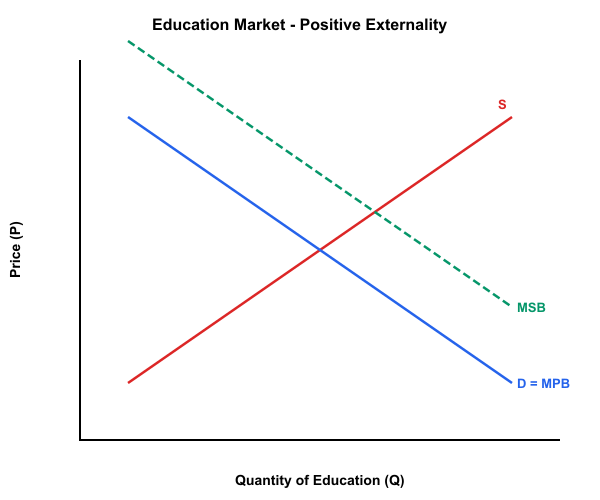
A market for education (years of schooling) creates a positive externality because more educated workers raise productivity and civic participation. Based on the externality shown in the graph, is the market outcome socially efficient?
Curves (linear):
- Demand: $D=MPB: P=90-3Q$
- Social benefit: $MSB: P=120-3Q$
- Supply: $S=MPC=MSC: P=0+3Q$
(Price/Cost on vertical axis; Quantity of years of schooling (in millions) on horizontal axis.)
No; the external benefit is a transfer only, so there is no inefficiency.
Yes; because $MSB$ is above $MPB$, the market equilibrium quantity is efficient.
Yes; because $MSC=MPC$, the market equilibrium is socially optimal even when $MSB>MPB$.
No; the market underproduces because $MSB>MPB$, so the efficient quantity is greater than the market quantity.
No; the market overproduces because $MSC>MPC$, so the efficient quantity is less than the market quantity.
Explanation
This question tests your understanding of externalities and market efficiency in AP Microeconomics. A positive externality occurs when production or consumption provides unaccounted benefits to third parties, making marginal social benefit (MSB) greater than marginal private benefit (MPB), while a negative externality imposes unaccounted costs, making marginal social cost (MSC) greater than marginal private cost (MPC). In the graph, the MSB curve is above the MPB curve, showing the positive externality from education's societal benefits, with MSC equal to MPC. The market outcome is not socially efficient because it underproduces, as MSB > MPB leads to an efficient quantity greater than the market quantity where MPB = MPC. A common misconception is that the market equilibrium equals the social optimum, but with positive externalities, the market fails to account for external benefits, resulting in inefficiency. To analyze such problems, always compare marginal social costs to marginal social benefits. The efficient outcome occurs where MSC equals MSB, maximizing net social welfare.
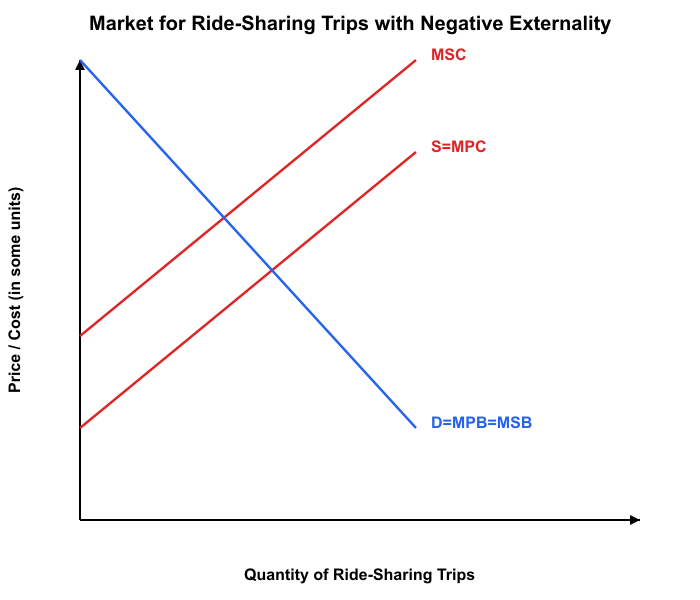
A market for ride-sharing trips is shown in the graph. Additional trips increase traffic congestion for other drivers, a negative externality. Based on the externality shown in the graph, what is the socially optimal quantity of ride-sharing trips?
$Q=25$ trips, because it is where $S=MPC$ intersects $MSC$
$Q=30$ trips, because it is where $MSC$ intersects $D=MSB$
$Q=20$ trips, because it is where $S=MPC$ intersects $D=MPB$
$Q=30$ trips, because it is where $S=MPC$ intersects $D=MPB$
$Q=25$ trips, because it is where $MSC$ intersects $D=MSB$
Explanation
This question tests your understanding of externalities and efficiency in markets. A negative externality occurs when consumption imposes uncompensated costs on third parties, like traffic congestion, while a positive externality provides benefits; marginal social cost (MSC) equals marginal private cost (MPC) plus external costs, and marginal social benefit (MSB) equals marginal private benefit (MPB) plus external benefits. The graph shows the MSC curve above the S=MPC supply curve due to the congestion externality, with demand as D=MPB=MSB. The socially optimal quantity is Q=25 trips, because it is where MSC intersects D=MSB, equating full societal costs and benefits for maximum welfare. A common misconception is that the market equilibrium equals the social optimum, but negative externalities cause overproduction as private costs ignore external harms. To analyze similar problems, compare MSC to MSB on the graph. The efficient outcome occurs where MSC equals MSB.
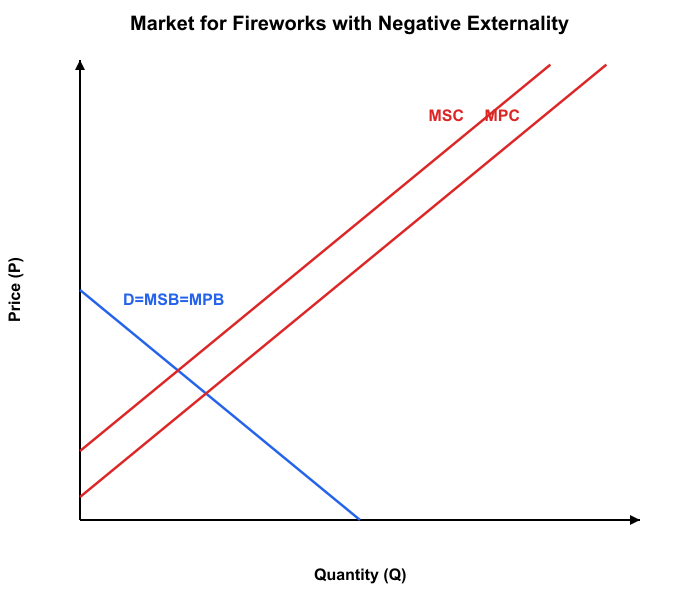
A market for fireworks produces a negative externality from noise and air pollution affecting nearby residents. Based on the externality shown in the graph, is the market outcome socially efficient?
Curves (linear):
- Demand: $D=MSB=MPB: P=50-Q$
- Private supply: $S=MPC: P=5+Q$
- Social cost: $MSC: P=15+Q$
(Price/Cost on vertical axis; Quantity of fireworks packs on horizontal axis.)
Yes; because $MSB=MPB$, the market equilibrium equals the socially optimal quantity.
No; the market underproduces because $MSB>MPB$, so the efficient quantity is greater than the market quantity.
Yes; because $MSC$ lies above demand, the market equilibrium is efficient.
No; the market overproduces because $MSC>MPC$, so the efficient quantity is less than the market quantity.
No; the external cost is a transfer only, so there is no efficiency loss.
Explanation
This question tests your understanding of externalities and market efficiency in AP Microeconomics. A negative externality occurs when production or consumption imposes unaccounted costs on third parties, making marginal social cost (MSC) greater than marginal private cost (MPC), while a positive externality provides unaccounted benefits, making marginal social benefit (MSB) greater than marginal private benefit (MPB). In the graph, the MSC curve is above the MPC curve, indicating the negative externality from fireworks noise and pollution, with MSB equal to MPB. The market outcome is not socially efficient because it overproduces, as MSC > MPC leads to an efficient quantity less than the market quantity where MPB = MPC. A common misconception is that the market equilibrium equals the social optimum, but with negative externalities, the market fails to account for external costs, causing inefficiency. To analyze such problems, always compare marginal social costs to marginal social benefits. The efficient outcome occurs where MSC equals MSB, maximizing net social welfare.
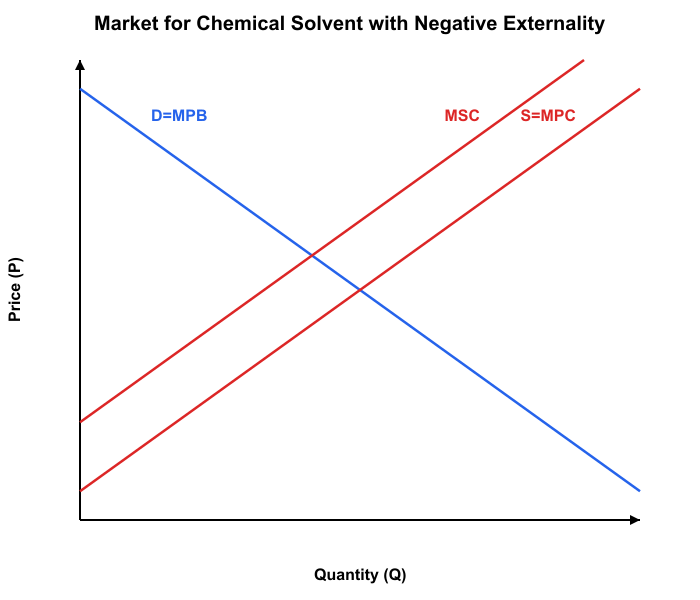
A market for chemical solvent used by factories is shown in the graph. Disposal contaminates groundwater, creating a negative externality. Based on the externality shown, which curve represents the marginal social cost (MSC)?
The curve where $S=MPC$ intersects $D=MPB$
The upward-sloping curve above $S=MPC$ labeled $MSC$
The demand curve labeled $D=MPB$
The supply curve labeled $S=MPC$
The downward-sloping curve above $D=MPB$ labeled $MSB$
Explanation
This question tests your understanding of externalities and efficiency in markets. A negative externality occurs when production imposes uncompensated costs on third parties, like groundwater contamination, while a positive externality provides benefits; marginal social cost (MSC) equals marginal private cost (MPC) plus external costs, and marginal social benefit (MSB) equals marginal private benefit (MPB) plus external benefits. The graph shows the MSC curve as the upward-sloping line above S=MPC due to the disposal externality, with demand as D=MPB=MSB. The curve representing marginal social cost (MSC) is the upward-sloping curve above S=MPC labeled MSC, as it incorporates the external costs of contamination. A common misconception is that the market equilibrium equals the social optimum, but negative externalities cause overproduction by ignoring these added social costs. To analyze similar problems, compare MSC to MSB on the graph. The efficient outcome occurs where MSC equals MSB.
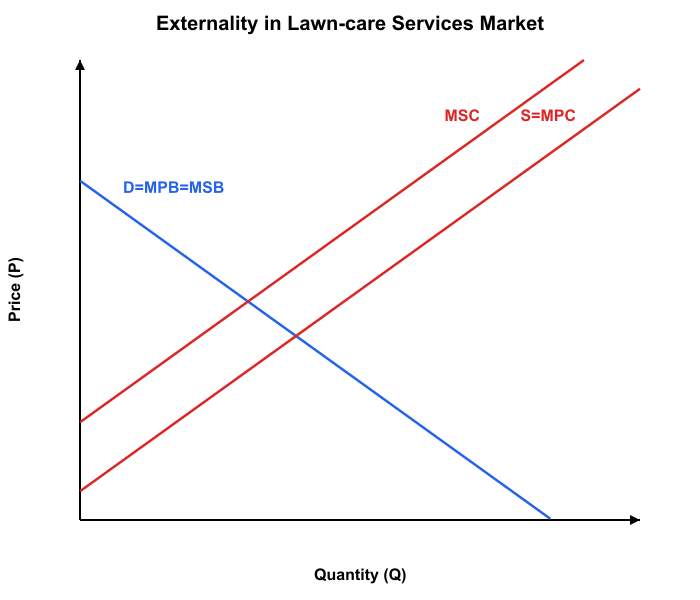
A market for lawn-care services is illustrated in the graph. Gas-powered mowing creates noise that affects neighbors, a negative externality. Based on the externality shown in the graph, is the market outcome socially efficient?
No; the externality is only a transfer, so efficiency is unchanged
No; the market overproduces because $MSC$ lies above $MPC$, so $Q_m>Q^*$
No; the market underproduces because $MSC$ lies above $MPC$, so $Q_m<Q^*$
Yes; the market outcome is efficient because $S=MPC$ already includes all costs
Yes; the market outcome is efficient because $Q_m$ occurs where $MSC$ intersects $D=MSB$
Explanation
This question tests your understanding of externalities and efficiency in markets. A negative externality occurs when production imposes uncompensated costs on third parties, like noise pollution, while a positive externality provides uncompensated benefits; marginal social cost (MSC) equals marginal private cost (MPC) plus external costs, and marginal social benefit (MSB) equals marginal private benefit (MPB) plus external benefits. The graph shows the MSC curve above the S=MPC supply curve due to the noise externality, with demand as D=MPB=MSB. The market outcome is not socially efficient because it overproduces, as MSC lies above MPC leading to Qm > Q* where social costs exceed benefits beyond the optimum. A common misconception is that the market equilibrium equals the social optimum, but negative externalities cause inefficiency through overproduction ignoring external costs. To analyze similar problems, compare MSC to MSB on the graph. The efficient outcome occurs where MSC equals MSB.
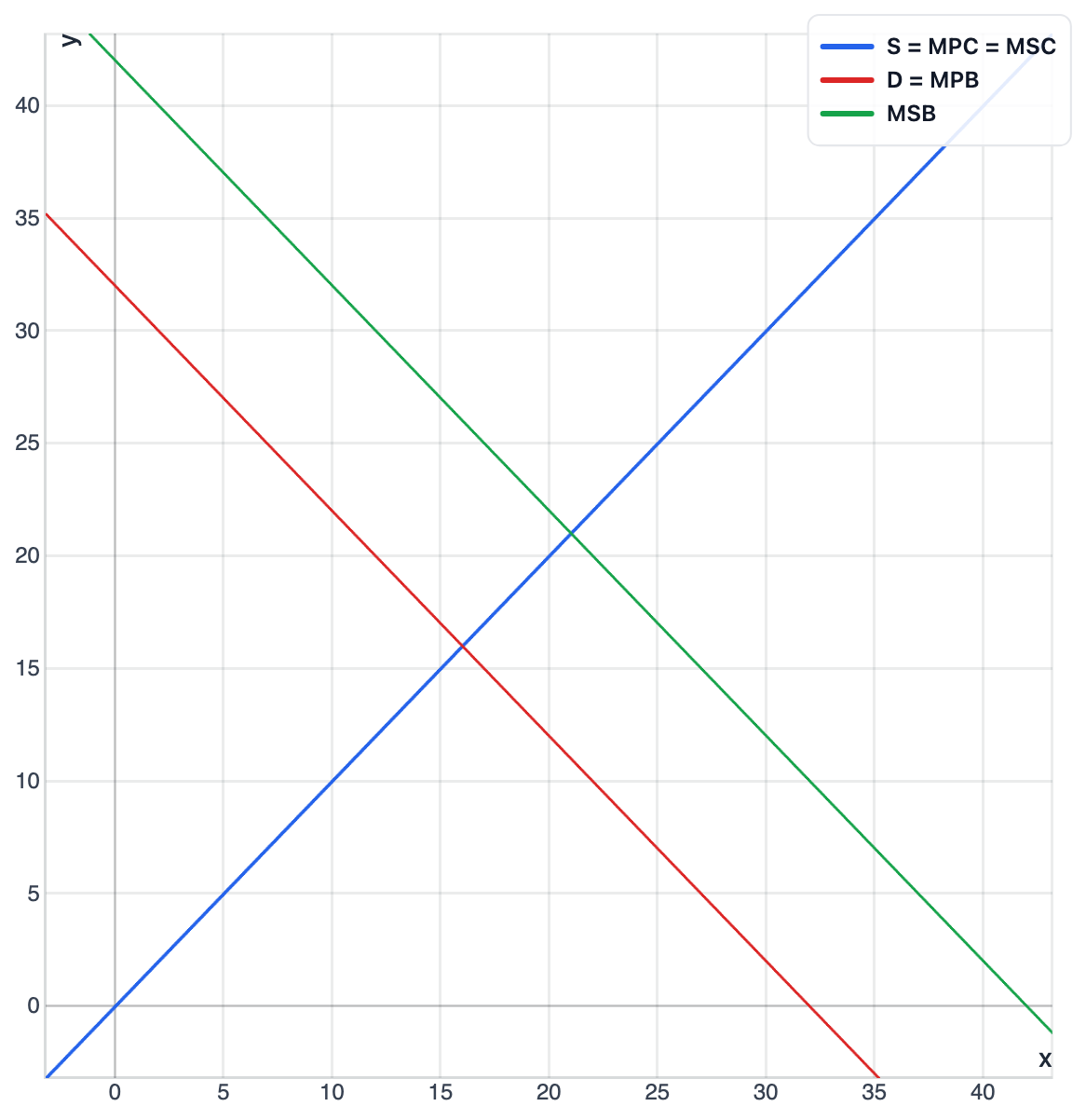
A market for home insulation reduces energy use, which lowers local air pollution (a positive externality). Based on the externality shown in the graph, what is the socially optimal quantity of insulation installations (in thousands per year)?
$Q = 20$ thousand, because it is where $S=MPC$ intersects $D=MPB$.
$Q = 30$ thousand, because it is where $S=MPC$ intersects $MSB$.
$Q = 10$ thousand, because it is where $D=MPB$ intersects $MSB$.
$Q = 15$ thousand, because it is where $S=MPC$ intersects $MSB$.
$Q = 20$ thousand, because it is where $S=MPC$ intersects $MSC$.
Explanation
This question tests your understanding of externalities and efficiency in markets with positive externalities. A positive externality occurs when production or consumption creates benefits for third parties not involved in the transaction, while a negative externality imposes costs; here, home insulation reduces energy use and air pollution, benefiting the community beyond the homeowner, making the marginal social benefit (MSB) higher than the marginal private benefit (MPB). The graph shows MSB above the demand curve (D=MPB), indicating the true benefit to society exceeds what buyers consider. The socially optimal quantity occurs where marginal social cost equals marginal social benefit (MSC = MSB), which happens at Q = 30 thousand installations where S=MPC intersects MSB (since there's no production externality, MSC = MPC). A common misconception is that the market equilibrium (where S=MPC intersects D=MPB at Q = 20 thousand) represents the efficient outcome, but this ignores the external benefits to the community. To find the efficient quantity with any externality, compare MSC to MSB—the efficient point is where they're equal. With positive consumption externalities, this means finding where the supply curve intersects the higher MSB curve.
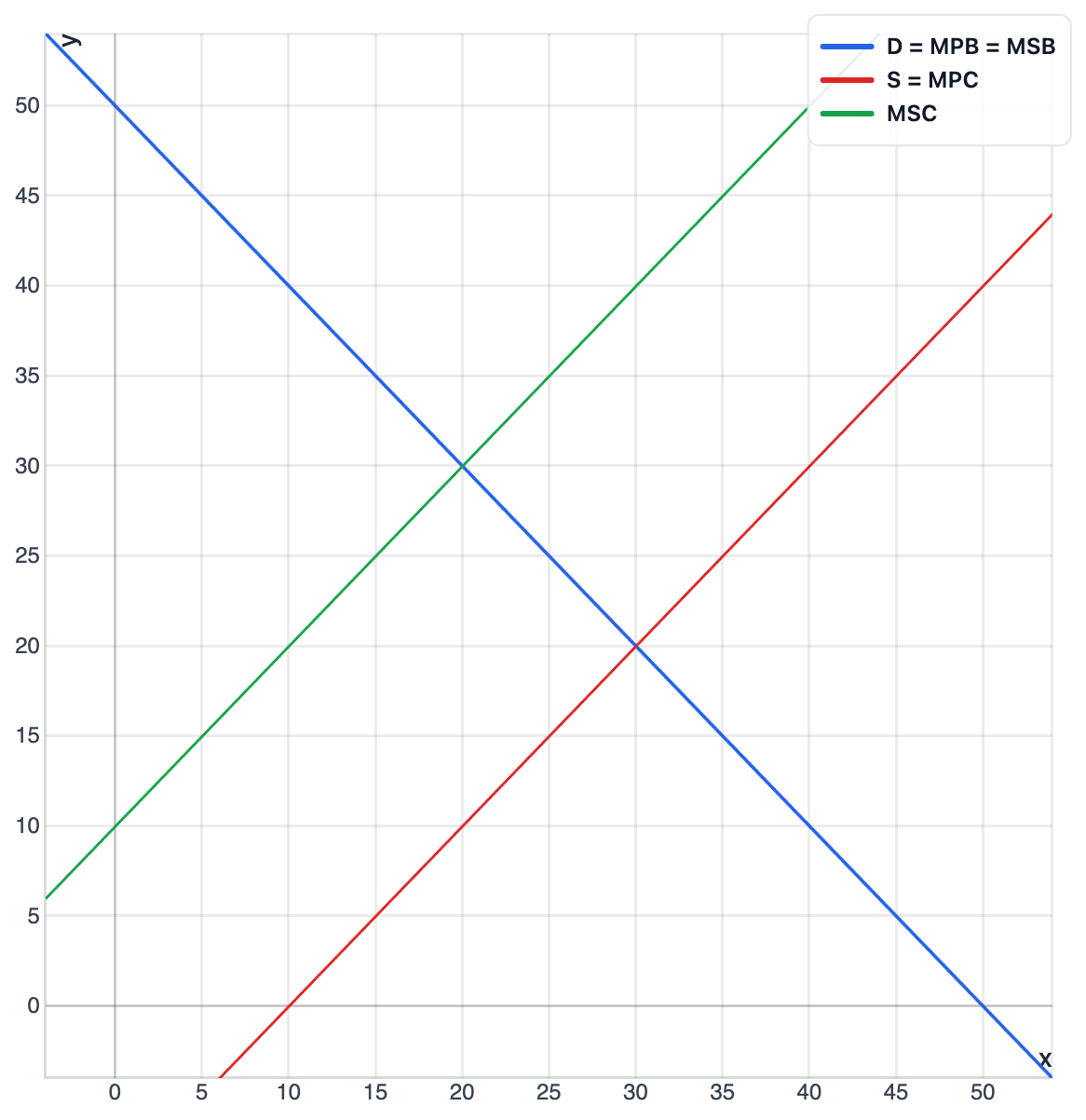
A city market for electricity from coal-fired power plants generates air pollution that harms nearby residents (a negative externality). Based on the externality shown in the graph, what is the socially optimal quantity of electricity (in million kWh per month)?
$Q = 10$ million kWh, because it is where $S=MPC$ intersects $MSC$.
$Q = 30$ million kWh, because it is where $MSC$ intersects $D=MSB$.
$Q = 30$ million kWh, because it is where $S=MPC$ intersects $D=MPB$.
$Q = 40$ million kWh, because it is where $MSC$ intersects the quantity axis.
$Q = 20$ million kWh, because it is where $MSC$ intersects $D=MSB$.
Explanation
This question tests your understanding of externalities and efficiency in markets with negative externalities. A negative externality occurs when production or consumption imposes costs on third parties not involved in the transaction, while a positive externality creates benefits for third parties; here, coal-fired electricity creates air pollution harming residents, making the marginal social cost (MSC) higher than the marginal private cost (MPC). The graph shows MSC above the supply curve (S=MPC), indicating the true cost to society exceeds what producers consider. The socially optimal quantity occurs where marginal social cost equals marginal social benefit (MSC = MSB), which happens at Q = 20 million kWh where these curves intersect. A common misconception is that the market equilibrium (where S=MPC intersects D=MPB at Q = 30) represents the efficient outcome, but this ignores the external costs. To find the efficient quantity with any externality, locate where MSC intersects MSB (which equals D=MPB when there's no consumption externality). This transferable strategy ensures you account for all social costs and benefits, not just private ones.
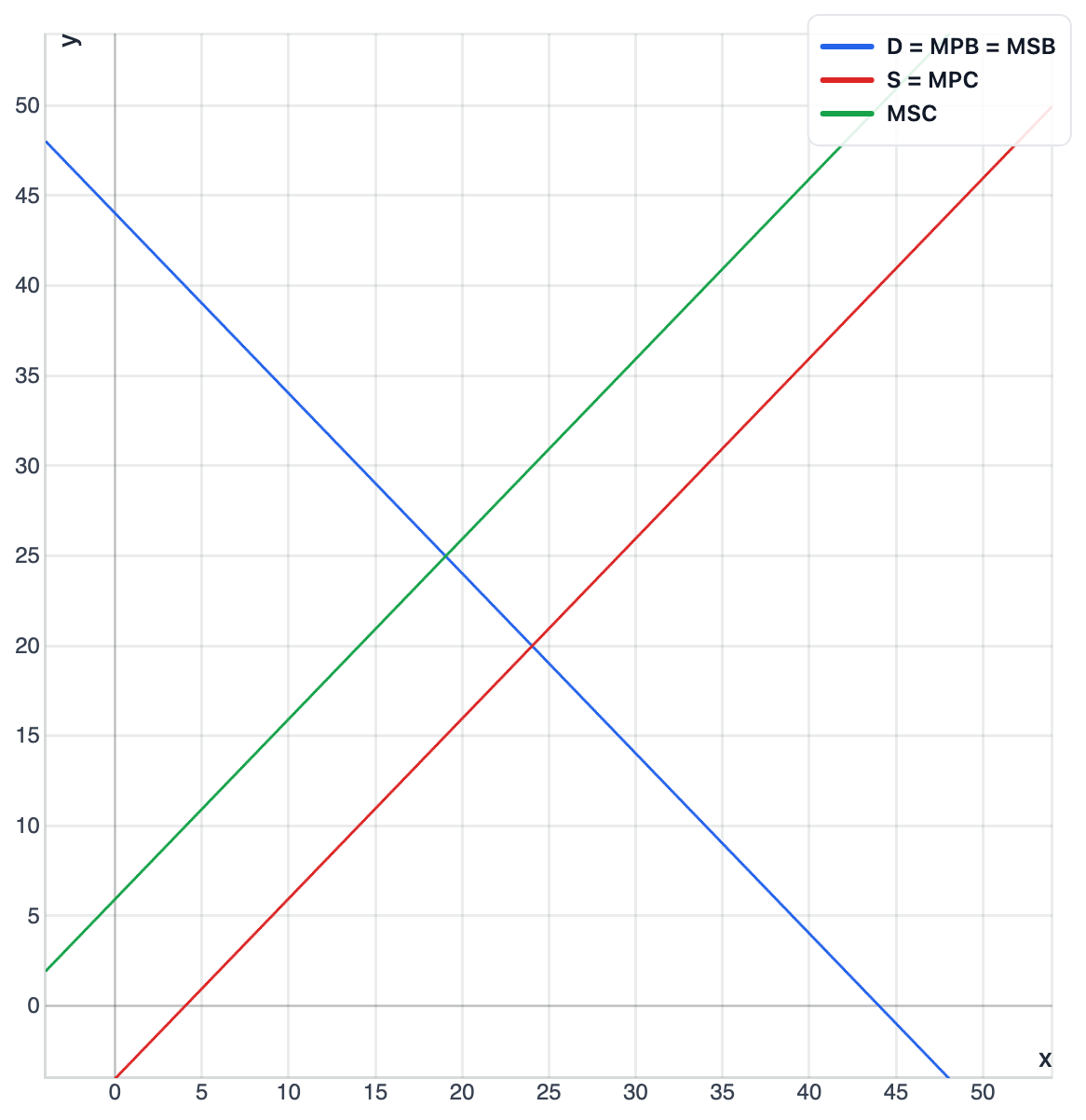
A market for bottled water generates plastic waste that harms wildlife (a negative externality). Based on the externality shown in the graph, is the market outcome socially efficient?
Yes; the market equilibrium is efficient because $S=MPC$ is upward sloping.
No; the market equilibrium overproduces because $MSC$ lies above $S=MPC$, so $Q_{market} > Q^*$.
Yes; the market equilibrium is efficient because the externality is a transfer and does not change $MSC$.
No; the market equilibrium underproduces because $MSC$ lies above $S=MPC$, so $Q_{market} < Q^*$.
Yes; the market equilibrium is efficient because $MSC$ intersects $D=MPB$ at the market quantity.
Explanation
This question tests your understanding of externalities and efficiency by asking whether a market with negative externalities achieves social efficiency. A negative externality occurs when production or consumption imposes costs on third parties (here, plastic waste harming wildlife), while a positive externality creates benefits; this makes the marginal social cost (MSC) higher than the marginal private cost (MPC). The graph shows MSC lying above S=MPC, indicating that the true cost to society exceeds what bottled water producers consider in their decisions. The market equilibrium occurs where S=MPC intersects D=MPB, but the socially optimal quantity occurs where MSC intersects MSB (which equals D=MPB when there's no consumption externality)—since MSC > MPC at the market quantity, the market overproduces relative to the social optimum (Qmarket > Q*). A common misconception is that externalities might be just transfers that don't affect efficiency, but they represent real costs or benefits to society. To determine efficiency with externalities, check if MSC equals MSB at the market quantity. When MSC lies above MPC due to negative externalities, the market will overproduce because producers don't internalize the environmental damage.
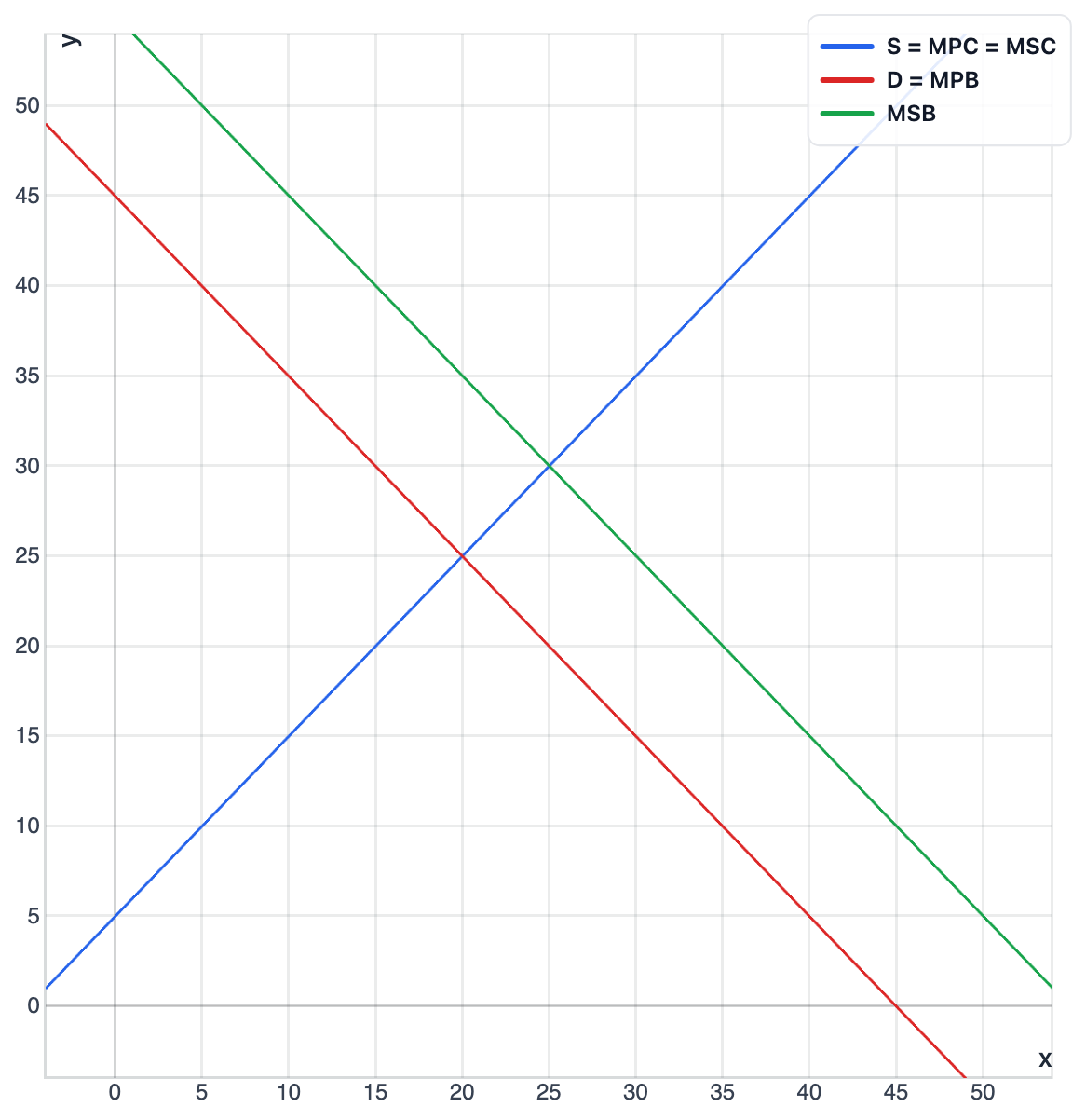
A market for flu vaccinations reduces the spread of illness to others (a positive externality). Based on the externality shown in the graph, is the market outcome socially efficient?
Yes; the market equilibrium is efficient because positive externalities do not affect efficiency.
No; the market equilibrium underproduces because $MSB$ lies above $D=MPB$, so $Q_{market} < Q^*$.
Yes; the market equilibrium is efficient because $S=MPC$ intersects $MSB$ at the same quantity as $D=MPB$.
No; the market equilibrium is inefficient because $MSC$ lies above $S=MPC$, so $Q_{market} > Q^*$.
No; the market equilibrium overproduces because $MSB$ lies below $D=MPB$, so $Q_{market} > Q^*$.
Explanation
This question tests your understanding of externalities and efficiency by asking whether a market with positive externalities achieves social efficiency. A positive externality occurs when production or consumption creates benefits for third parties (here, flu vaccinations reducing illness spread), while a negative externality imposes costs; this makes the marginal social benefit (MSB) higher than the marginal private benefit (MPB). The graph shows MSB lying above D=MPB, indicating that the true benefit to society exceeds what buyers consider in their decisions. The market equilibrium occurs where S=MPC intersects D=MPB, but the socially optimal quantity occurs where MSC (which equals S=MPC when there's no production externality) intersects MSB—since MSB > MPB at the market quantity, the market underproduces relative to the social optimum (Qmarket < Q*). A common misconception is that positive externalities don't affect efficiency, but they cause markets to produce less than the socially optimal amount. To determine efficiency with externalities, compare the market quantity to where MSC equals MSB. When MSB lies above MPB, the market will underproduce because buyers don't capture the full social benefit.
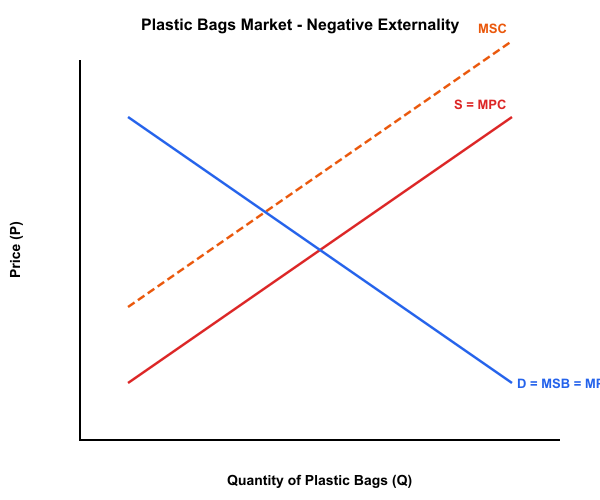
A market for plastic shopping bags creates a negative externality because litter harms wildlife and increases cleanup costs. Based on the externality shown in the graph, what is the socially optimal quantity of plastic bags (in thousands per week)?
Curves (linear):
- Demand: $D=MSB=MPB: P=60-2Q$
- Private supply: $S=MPC: P=0+Q$
- Social cost: $MSC: P=10+Q$
(Price/Cost on vertical axis; Quantity in thousands per week on horizontal axis.)
$Q=16.7$ thousand bags per week
$Q=30$ thousand bags per week
$Q=25$ thousand bags per week
$Q=15$ thousand bags per week
$Q=20$ thousand bags per week
Explanation
This question tests your understanding of externalities and market efficiency in AP Microeconomics. A negative externality occurs when production or consumption imposes unaccounted costs on third parties, making marginal social cost (MSC) greater than marginal private cost (MPC), while a positive externality provides unaccounted benefits, making marginal social benefit (MSB) greater than marginal private benefit (MPB). In the graph, the MSC curve is above the MPC curve, indicating the negative externality from plastic bag litter, with MSB equal to MPB. The socially optimal quantity is where MSB equals MSC, solving 60 - 2Q = 10 + Q to get Q = 50/3 ≈ 16.7 thousand bags per week, justifying lower output to internalize external costs. A common misconception is that the market equilibrium equals the social optimum, but with negative externalities, the market overproduces by ignoring external costs. To analyze such problems, always compare marginal social costs to marginal social benefits. The efficient outcome occurs where MSC equals MSB, maximizing net social welfare.