Calculating Current - AP Physics C: Electricity and Magnetism
Card 0 of 22
A lamp has a  bulb. If the house wiring provides
  to light up that bulb, how much current does the bulb draw?
A lamp has a
Tap to see back →
The formula for power is , and we are given the following values.


Solve for the current,  .
.

The formula for power is ,
Solve for the current,
A particle accelerator with a radius of 500 meters can have up to  protons circulating within it at once.

How fast must the protons in the accelerator move in order to produce a current of 1A?
A particle accelerator with a radius of 500 meters can have up to
How fast must the protons in the accelerator move in order to produce a current of 1A?
Tap to see back →
The current produced is the total charge that circulates the particle accelerator per unit time.

We calculate this by the equation:

 is the number of protons,
  is the charge per proton,
  is the velocity of each proton, and
  is the radius of the particle accelerator.
Using the given current, we then solve for the velocity:
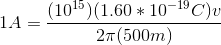

The current produced is the total charge that circulates the particle accelerator per unit time.
We calculate this by the equation:
Using the given current, we then solve for the velocity:
A lamp has a bulb. If the house wiring provides to light up that bulb, how much current does the bulb draw?
A lamp has a
Tap to see back →
The formula for power is ,and we are given the following values.
Solve for the current, .
The formula for power is ,
Solve for the current,
A particle accelerator with a radius of 500 meters can have up to protons circulating within it at once.
How fast must the protons in the accelerator move in order to produce a current of 1A?
A particle accelerator with a radius of 500 meters can have up to
How fast must the protons in the accelerator move in order to produce a current of 1A?
Tap to see back →
The current produced is the total charge that circulates the particle accelerator per unit time.
We calculate this by the equation:
is the number of protons, is the charge per proton, is the velocity of each proton, and is the radius of the particle accelerator.
Using the given current, we then solve for the velocity:
The current produced is the total charge that circulates the particle accelerator per unit time.
We calculate this by the equation:
Using the given current, we then solve for the velocity:
A lamp has a bulb. If the house wiring provides to light up that bulb, how much current does the bulb draw?
A lamp has a
Tap to see back →
The formula for power is ,and we are given the following values.
Solve for the current, .
The formula for power is ,
Solve for the current,
A particle accelerator with a radius of 500 meters can have up to protons circulating within it at once.
How fast must the protons in the accelerator move in order to produce a current of 1A?
A particle accelerator with a radius of 500 meters can have up to
How fast must the protons in the accelerator move in order to produce a current of 1A?
Tap to see back →
The current produced is the total charge that circulates the particle accelerator per unit time.
We calculate this by the equation:
is the number of protons, is the charge per proton, is the velocity of each proton, and is the radius of the particle accelerator.
Using the given current, we then solve for the velocity:
The current produced is the total charge that circulates the particle accelerator per unit time.
We calculate this by the equation:
Using the given current, we then solve for the velocity:
A lamp has a bulb. If the house wiring provides to light up that bulb, how much current does the bulb draw?
A lamp has a
Tap to see back →
The formula for power is ,and we are given the following values.
Solve for the current, .
The formula for power is ,
Solve for the current,
A particle accelerator with a radius of 500 meters can have up to protons circulating within it at once.
How fast must the protons in the accelerator move in order to produce a current of 1A?
A particle accelerator with a radius of 500 meters can have up to
How fast must the protons in the accelerator move in order to produce a current of 1A?
Tap to see back →
The current produced is the total charge that circulates the particle accelerator per unit time.
We calculate this by the equation:
is the number of protons, is the charge per proton, is the velocity of each proton, and is the radius of the particle accelerator.
Using the given current, we then solve for the velocity:
The current produced is the total charge that circulates the particle accelerator per unit time.
We calculate this by the equation:
Using the given current, we then solve for the velocity:
A lamp has a bulb. If the house wiring provides to light up that bulb, how much current does the bulb draw?
A lamp has a
Tap to see back →
The formula for power is ,and we are given the following values.
Solve for the current, .
The formula for power is ,
Solve for the current,
A particle accelerator with a radius of 500 meters can have up to protons circulating within it at once.
How fast must the protons in the accelerator move in order to produce a current of 1A?
A particle accelerator with a radius of 500 meters can have up to
How fast must the protons in the accelerator move in order to produce a current of 1A?
Tap to see back →
The current produced is the total charge that circulates the particle accelerator per unit time.
We calculate this by the equation:
is the number of protons, is the charge per proton, is the velocity of each proton, and is the radius of the particle accelerator.
Using the given current, we then solve for the velocity:
The current produced is the total charge that circulates the particle accelerator per unit time.
We calculate this by the equation:
Using the given current, we then solve for the velocity:
A lamp has a bulb. If the house wiring provides to light up that bulb, how much current does the bulb draw?
A lamp has a
Tap to see back →
The formula for power is ,and we are given the following values.
Solve for the current, .
The formula for power is ,
Solve for the current,
A particle accelerator with a radius of 500 meters can have up to protons circulating within it at once.
How fast must the protons in the accelerator move in order to produce a current of 1A?
A particle accelerator with a radius of 500 meters can have up to
How fast must the protons in the accelerator move in order to produce a current of 1A?
Tap to see back →
The current produced is the total charge that circulates the particle accelerator per unit time.
We calculate this by the equation:
is the number of protons, is the charge per proton, is the velocity of each proton, and is the radius of the particle accelerator.
Using the given current, we then solve for the velocity:
The current produced is the total charge that circulates the particle accelerator per unit time.
We calculate this by the equation:
Using the given current, we then solve for the velocity:
A lamp has a bulb. If the house wiring provides to light up that bulb, how much current does the bulb draw?
A lamp has a
Tap to see back →
The formula for power is ,and we are given the following values.
Solve for the current, .
The formula for power is ,
Solve for the current,
A particle accelerator with a radius of 500 meters can have up to protons circulating within it at once.
How fast must the protons in the accelerator move in order to produce a current of 1A?
A particle accelerator with a radius of 500 meters can have up to
How fast must the protons in the accelerator move in order to produce a current of 1A?
Tap to see back →
The current produced is the total charge that circulates the particle accelerator per unit time.
We calculate this by the equation:
is the number of protons, is the charge per proton, is the velocity of each proton, and is the radius of the particle accelerator.
Using the given current, we then solve for the velocity:
The current produced is the total charge that circulates the particle accelerator per unit time.
We calculate this by the equation:
Using the given current, we then solve for the velocity:
A lamp has a bulb. If the house wiring provides to light up that bulb, how much current does the bulb draw?
A lamp has a
Tap to see back →
The formula for power is ,and we are given the following values.
Solve for the current, .
The formula for power is ,
Solve for the current,
A particle accelerator with a radius of 500 meters can have up to protons circulating within it at once.
How fast must the protons in the accelerator move in order to produce a current of 1A?
A particle accelerator with a radius of 500 meters can have up to
How fast must the protons in the accelerator move in order to produce a current of 1A?
Tap to see back →
The current produced is the total charge that circulates the particle accelerator per unit time.
We calculate this by the equation:
is the number of protons, is the charge per proton, is the velocity of each proton, and is the radius of the particle accelerator.
Using the given current, we then solve for the velocity:
The current produced is the total charge that circulates the particle accelerator per unit time.
We calculate this by the equation:
Using the given current, we then solve for the velocity:
A lamp has a bulb. If the house wiring provides to light up that bulb, how much current does the bulb draw?
A lamp has a
Tap to see back →
The formula for power is ,and we are given the following values.
Solve for the current, .
The formula for power is ,
Solve for the current,
A particle accelerator with a radius of 500 meters can have up to protons circulating within it at once.
How fast must the protons in the accelerator move in order to produce a current of 1A?
A particle accelerator with a radius of 500 meters can have up to
How fast must the protons in the accelerator move in order to produce a current of 1A?
Tap to see back →
The current produced is the total charge that circulates the particle accelerator per unit time.
We calculate this by the equation:
is the number of protons, is the charge per proton, is the velocity of each proton, and is the radius of the particle accelerator.
Using the given current, we then solve for the velocity:
The current produced is the total charge that circulates the particle accelerator per unit time.
We calculate this by the equation:
Using the given current, we then solve for the velocity:
A lamp has a bulb. If the house wiring provides to light up that bulb, how much current does the bulb draw?
A lamp has a
Tap to see back →
The formula for power is ,and we are given the following values.
Solve for the current, .
The formula for power is ,
Solve for the current,
A particle accelerator with a radius of 500 meters can have up to protons circulating within it at once.
How fast must the protons in the accelerator move in order to produce a current of 1A?
A particle accelerator with a radius of 500 meters can have up to
How fast must the protons in the accelerator move in order to produce a current of 1A?
Tap to see back →
The current produced is the total charge that circulates the particle accelerator per unit time.
We calculate this by the equation:
is the number of protons, is the charge per proton, is the velocity of each proton, and is the radius of the particle accelerator.
Using the given current, we then solve for the velocity:
The current produced is the total charge that circulates the particle accelerator per unit time.
We calculate this by the equation:
Using the given current, we then solve for the velocity: