Understanding Gravity - AP Physics C: Electricity and Magnetism
Card 0 of 44
A block with a mass of  is traveling at
  when it impacts the ground. From how many meters off the ground was the block dropped?
Round to the nearest whole number.
A block with a mass of
Round to the nearest whole number.
Tap to see back →
Set the gravitational potential energy and kinetic energy equal to each other and solve for the height.
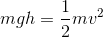
Mass cancels.

Isolate the height and plug in our values.

Rounding this gives  .
.
Set the gravitational potential energy and kinetic energy equal to each other and solve for the height.
Mass cancels.
Isolate the height and plug in our values.
Rounding this gives
A spherical asteroid has a hole drilled through the center as diagrammed below:
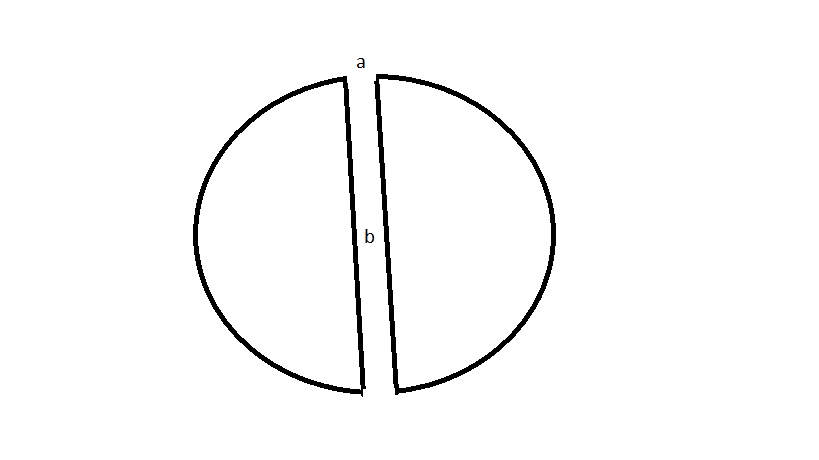
Refer to the diagram above. An object that is much smaller than the asteroid is released from rest at the surface of the asteroid, at point a. How do the velocity and acceleration of the object compare at point b at the surface, and point a, located at the center of the asteroid?
A spherical asteroid has a hole drilled through the center as diagrammed below:
Refer to the diagram above. An object that is much smaller than the asteroid is released from rest at the surface of the asteroid, at point a. How do the velocity and acceleration of the object compare at point b at the surface, and point a, located at the center of the asteroid?
Tap to see back →
Because the gravitational force depends only on the mass beneath the object (which is the gravitational version of Gauss's Law for charge), the acceleration steadily decreases as the object falls, and drops to zero at the center. Nevertheless, the velocity keeps increasing as the object falls, it just does so more slowly.
Because the gravitational force depends only on the mass beneath the object (which is the gravitational version of Gauss's Law for charge), the acceleration steadily decreases as the object falls, and drops to zero at the center. Nevertheless, the velocity keeps increasing as the object falls, it just does so more slowly.
An object of mass  is dropped from a tower. The object's drag force is given by
  where
where  is a positive constant. What will the objects terminal velocity be?
An object of mass
Tap to see back →
To find terminal velocity, set the magnitude of the drag force equal to the magnitude of the force of gravity since when these forces are equal and opposite, the object will stop accelerating:


Solve for 

To find terminal velocity, set the magnitude of the drag force equal to the magnitude of the force of gravity since when these forces are equal and opposite, the object will stop accelerating:
Solve for
A ship of mass  and an initial velocity of
  is coasting to a stop. The water exerts a drag force on the ship. The drag force is proportional to the velocity:
 where the negative sign indicates that the drag force acts in a direction opposite the motion. After the ship has coasted for a time equal to
  , how fast (in terms of
  ) will the ship be moving?
A ship of mass
Tap to see back →
The ship's equation of velocity (found by solving the first-order differential equation) is 
Substitute  and solve.
The ship's equation of velocity (found by solving the first-order differential equation) is
Substitute
A block with a mass of is traveling at when it impacts the ground. From how many meters off the ground was the block dropped?
Round to the nearest whole number.
A block with a mass of
Round to the nearest whole number.
Tap to see back →
Set the gravitational potential energy and kinetic energy equal to each other and solve for the height.
Mass cancels.
Isolate the height and plug in our values.
Rounding this gives .
Set the gravitational potential energy and kinetic energy equal to each other and solve for the height.
Mass cancels.
Isolate the height and plug in our values.
Rounding this gives
A spherical asteroid has a hole drilled through the center as diagrammed below:
Refer to the diagram above. An object that is much smaller than the asteroid is released from rest at the surface of the asteroid, at point a. How do the velocity and acceleration of the object compare at point b at the surface, and point a, located at the center of the asteroid?
A spherical asteroid has a hole drilled through the center as diagrammed below:
Refer to the diagram above. An object that is much smaller than the asteroid is released from rest at the surface of the asteroid, at point a. How do the velocity and acceleration of the object compare at point b at the surface, and point a, located at the center of the asteroid?
Tap to see back →
Because the gravitational force depends only on the mass beneath the object (which is the gravitational version of Gauss's Law for charge), the acceleration steadily decreases as the object falls, and drops to zero at the center. Nevertheless, the velocity keeps increasing as the object falls, it just does so more slowly.
Because the gravitational force depends only on the mass beneath the object (which is the gravitational version of Gauss's Law for charge), the acceleration steadily decreases as the object falls, and drops to zero at the center. Nevertheless, the velocity keeps increasing as the object falls, it just does so more slowly.
An object of mass is dropped from a tower. The object's drag force is given by where is a positive constant. What will the objects terminal velocity be?
An object of mass
Tap to see back →
To find terminal velocity, set the magnitude of the drag force equal to the magnitude of the force of gravity since when these forces are equal and opposite, the object will stop accelerating:
Solve for
To find terminal velocity, set the magnitude of the drag force equal to the magnitude of the force of gravity since when these forces are equal and opposite, the object will stop accelerating:
Solve for
A ship of mass and an initial velocity of is coasting to a stop. The water exerts a drag force on the ship. The drag force is proportional to the velocity:
where the negative sign indicates that the drag force acts in a direction opposite the motion. After the ship has coasted for a time equal to , how fast (in terms of ) will the ship be moving?
A ship of mass
Tap to see back →
The ship's equation of velocity (found by solving the first-order differential equation) is
Substitute and solve.
The ship's equation of velocity (found by solving the first-order differential equation) is
Substitute
A block with a mass of is traveling at when it impacts the ground. From how many meters off the ground was the block dropped?
Round to the nearest whole number.
A block with a mass of
Round to the nearest whole number.
Tap to see back →
Set the gravitational potential energy and kinetic energy equal to each other and solve for the height.
Mass cancels.
Isolate the height and plug in our values.
Rounding this gives .
Set the gravitational potential energy and kinetic energy equal to each other and solve for the height.
Mass cancels.
Isolate the height and plug in our values.
Rounding this gives
A spherical asteroid has a hole drilled through the center as diagrammed below:
Refer to the diagram above. An object that is much smaller than the asteroid is released from rest at the surface of the asteroid, at point a. How do the velocity and acceleration of the object compare at point b at the surface, and point a, located at the center of the asteroid?
A spherical asteroid has a hole drilled through the center as diagrammed below:
Refer to the diagram above. An object that is much smaller than the asteroid is released from rest at the surface of the asteroid, at point a. How do the velocity and acceleration of the object compare at point b at the surface, and point a, located at the center of the asteroid?
Tap to see back →
Because the gravitational force depends only on the mass beneath the object (which is the gravitational version of Gauss's Law for charge), the acceleration steadily decreases as the object falls, and drops to zero at the center. Nevertheless, the velocity keeps increasing as the object falls, it just does so more slowly.
Because the gravitational force depends only on the mass beneath the object (which is the gravitational version of Gauss's Law for charge), the acceleration steadily decreases as the object falls, and drops to zero at the center. Nevertheless, the velocity keeps increasing as the object falls, it just does so more slowly.
An object of mass is dropped from a tower. The object's drag force is given by where is a positive constant. What will the objects terminal velocity be?
An object of mass
Tap to see back →
To find terminal velocity, set the magnitude of the drag force equal to the magnitude of the force of gravity since when these forces are equal and opposite, the object will stop accelerating:
Solve for
To find terminal velocity, set the magnitude of the drag force equal to the magnitude of the force of gravity since when these forces are equal and opposite, the object will stop accelerating:
Solve for
A ship of mass and an initial velocity of is coasting to a stop. The water exerts a drag force on the ship. The drag force is proportional to the velocity:
where the negative sign indicates that the drag force acts in a direction opposite the motion. After the ship has coasted for a time equal to , how fast (in terms of ) will the ship be moving?
A ship of mass
Tap to see back →
The ship's equation of velocity (found by solving the first-order differential equation) is
Substitute and solve.
The ship's equation of velocity (found by solving the first-order differential equation) is
Substitute
A block with a mass of is traveling at when it impacts the ground. From how many meters off the ground was the block dropped?
Round to the nearest whole number.
A block with a mass of
Round to the nearest whole number.
Tap to see back →
Set the gravitational potential energy and kinetic energy equal to each other and solve for the height.
Mass cancels.
Isolate the height and plug in our values.
Rounding this gives .
Set the gravitational potential energy and kinetic energy equal to each other and solve for the height.
Mass cancels.
Isolate the height and plug in our values.
Rounding this gives
A spherical asteroid has a hole drilled through the center as diagrammed below:
Refer to the diagram above. An object that is much smaller than the asteroid is released from rest at the surface of the asteroid, at point a. How do the velocity and acceleration of the object compare at point b at the surface, and point a, located at the center of the asteroid?
A spherical asteroid has a hole drilled through the center as diagrammed below:
Refer to the diagram above. An object that is much smaller than the asteroid is released from rest at the surface of the asteroid, at point a. How do the velocity and acceleration of the object compare at point b at the surface, and point a, located at the center of the asteroid?
Tap to see back →
Because the gravitational force depends only on the mass beneath the object (which is the gravitational version of Gauss's Law for charge), the acceleration steadily decreases as the object falls, and drops to zero at the center. Nevertheless, the velocity keeps increasing as the object falls, it just does so more slowly.
Because the gravitational force depends only on the mass beneath the object (which is the gravitational version of Gauss's Law for charge), the acceleration steadily decreases as the object falls, and drops to zero at the center. Nevertheless, the velocity keeps increasing as the object falls, it just does so more slowly.
An object of mass is dropped from a tower. The object's drag force is given by where is a positive constant. What will the objects terminal velocity be?
An object of mass
Tap to see back →
To find terminal velocity, set the magnitude of the drag force equal to the magnitude of the force of gravity since when these forces are equal and opposite, the object will stop accelerating:
Solve for
To find terminal velocity, set the magnitude of the drag force equal to the magnitude of the force of gravity since when these forces are equal and opposite, the object will stop accelerating:
Solve for
A ship of mass and an initial velocity of is coasting to a stop. The water exerts a drag force on the ship. The drag force is proportional to the velocity:
where the negative sign indicates that the drag force acts in a direction opposite the motion. After the ship has coasted for a time equal to , how fast (in terms of ) will the ship be moving?
A ship of mass
Tap to see back →
The ship's equation of velocity (found by solving the first-order differential equation) is
Substitute and solve.
The ship's equation of velocity (found by solving the first-order differential equation) is
Substitute
A block with a mass of is traveling at when it impacts the ground. From how many meters off the ground was the block dropped?
Round to the nearest whole number.
A block with a mass of
Round to the nearest whole number.
Tap to see back →
Set the gravitational potential energy and kinetic energy equal to each other and solve for the height.
Mass cancels.
Isolate the height and plug in our values.
Rounding this gives .
Set the gravitational potential energy and kinetic energy equal to each other and solve for the height.
Mass cancels.
Isolate the height and plug in our values.
Rounding this gives
A spherical asteroid has a hole drilled through the center as diagrammed below:
Refer to the diagram above. An object that is much smaller than the asteroid is released from rest at the surface of the asteroid, at point a. How do the velocity and acceleration of the object compare at point b at the surface, and point a, located at the center of the asteroid?
A spherical asteroid has a hole drilled through the center as diagrammed below:
Refer to the diagram above. An object that is much smaller than the asteroid is released from rest at the surface of the asteroid, at point a. How do the velocity and acceleration of the object compare at point b at the surface, and point a, located at the center of the asteroid?
Tap to see back →
Because the gravitational force depends only on the mass beneath the object (which is the gravitational version of Gauss's Law for charge), the acceleration steadily decreases as the object falls, and drops to zero at the center. Nevertheless, the velocity keeps increasing as the object falls, it just does so more slowly.
Because the gravitational force depends only on the mass beneath the object (which is the gravitational version of Gauss's Law for charge), the acceleration steadily decreases as the object falls, and drops to zero at the center. Nevertheless, the velocity keeps increasing as the object falls, it just does so more slowly.
An object of mass is dropped from a tower. The object's drag force is given by where is a positive constant. What will the objects terminal velocity be?
An object of mass
Tap to see back →
To find terminal velocity, set the magnitude of the drag force equal to the magnitude of the force of gravity since when these forces are equal and opposite, the object will stop accelerating:
Solve for
To find terminal velocity, set the magnitude of the drag force equal to the magnitude of the force of gravity since when these forces are equal and opposite, the object will stop accelerating:
Solve for
A ship of mass and an initial velocity of is coasting to a stop. The water exerts a drag force on the ship. The drag force is proportional to the velocity:
where the negative sign indicates that the drag force acts in a direction opposite the motion. After the ship has coasted for a time equal to , how fast (in terms of ) will the ship be moving?
A ship of mass
Tap to see back →
The ship's equation of velocity (found by solving the first-order differential equation) is
Substitute and solve.
The ship's equation of velocity (found by solving the first-order differential equation) is
Substitute