Understanding Linear-Rotational Equivalents - AP Physics C: Electricity and Magnetism
Card 0 of 44
What is the rotational equivalent of mass?
What is the rotational equivalent of mass?
Tap to see back →
The correct answer is moment of inertia. For linear equations, mass is what resists force and causes lower linear accelerations. Similarly, in rotational equations, moment of inertia resists torque and causes lower angular accelerations.
The correct answer is moment of inertia. For linear equations, mass is what resists force and causes lower linear accelerations. Similarly, in rotational equations, moment of inertia resists torque and causes lower angular accelerations.
In rotational kinematics equations, what quantity is analogous to force in linear kinematics equations?
In rotational kinematics equations, what quantity is analogous to force in linear kinematics equations?
Tap to see back →
Just as force causes linear acceleration, torque causes angular acceleration. This can be seen most in the linear-rotational comparison of Newton's second law:


Just as force causes linear acceleration, torque causes angular acceleration. This can be seen most in the linear-rotational comparison of Newton's second law:
A boot is put in a  stick which is attached to a rotor. The rotor turns with an angular velocity of
  . What is the linear velocity of the boot?
A boot is put in a
Tap to see back →
Linear (tangential) velocity,  is given by the following equation:

Here,  is the angular velocity in radians per second and
  is the radius in meters.

Solve.


Linear (tangential) velocity,
Here,
Solve.
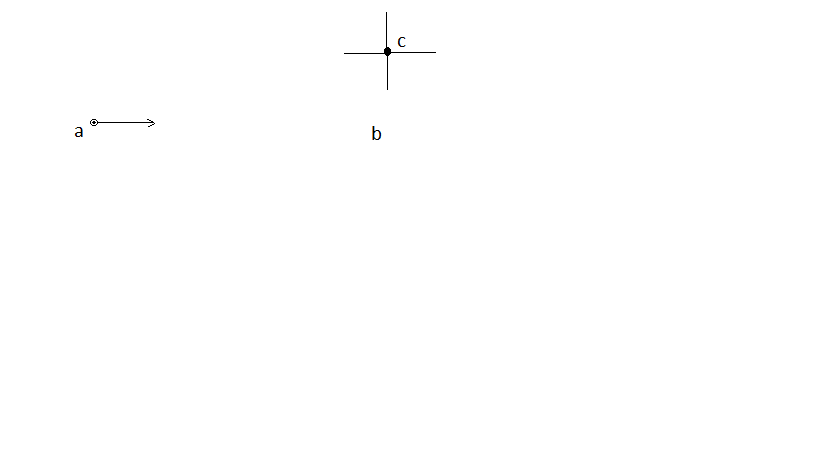
A particle is moving at constant speed in a straight line past a fixed point in space, c. How does the angular momentum of the particle about the fixed point in space change as the particle moves from point a to point b?
A particle is moving at constant speed in a straight line past a fixed point in space, c. How does the angular momentum of the particle about the fixed point in space change as the particle moves from point a to point b?
Tap to see back →
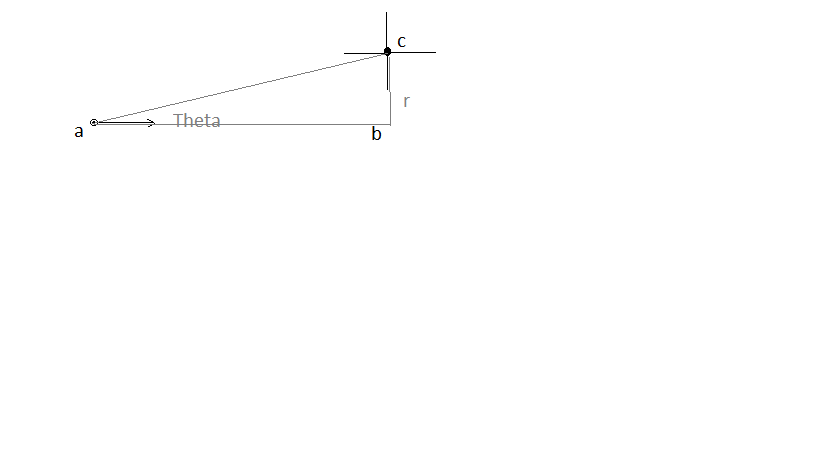
The angular momentum of a particle about a fixed axis is  . As the particle draws nearer the fixed axis, both
  and
and  change. However, the product
  remains constant. If you imagine a triangle connecting the three points, the product
  represents the
  "of closest approach", labeled "
 " in the diagram.
The angular momentum of a particle about a fixed axis is
What is the rotational equivalent of mass?
What is the rotational equivalent of mass?
Tap to see back →
The correct answer is moment of inertia. For linear equations, mass is what resists force and causes lower linear accelerations. Similarly, in rotational equations, moment of inertia resists torque and causes lower angular accelerations.
The correct answer is moment of inertia. For linear equations, mass is what resists force and causes lower linear accelerations. Similarly, in rotational equations, moment of inertia resists torque and causes lower angular accelerations.
In rotational kinematics equations, what quantity is analogous to force in linear kinematics equations?
In rotational kinematics equations, what quantity is analogous to force in linear kinematics equations?
Tap to see back →
Just as force causes linear acceleration, torque causes angular acceleration. This can be seen most in the linear-rotational comparison of Newton's second law:
Just as force causes linear acceleration, torque causes angular acceleration. This can be seen most in the linear-rotational comparison of Newton's second law:
A boot is put in a stick which is attached to a rotor. The rotor turns with an angular velocity of . What is the linear velocity of the boot?
A boot is put in a
Tap to see back →
Linear (tangential) velocity, is given by the following equation:
Here, is the angular velocity in radians per second and is the radius in meters.
Solve.
Linear (tangential) velocity,
Here,
Solve.
A particle is moving at constant speed in a straight line past a fixed point in space, c. How does the angular momentum of the particle about the fixed point in space change as the particle moves from point a to point b?
A particle is moving at constant speed in a straight line past a fixed point in space, c. How does the angular momentum of the particle about the fixed point in space change as the particle moves from point a to point b?
Tap to see back →
The angular momentum of a particle about a fixed axis is . As the particle draws nearer the fixed axis, both and change. However, the product remains constant. If you imagine a triangle connecting the three points, the product represents the "of closest approach", labeled "" in the diagram.
The angular momentum of a particle about a fixed axis is
What is the rotational equivalent of mass?
What is the rotational equivalent of mass?
Tap to see back →
The correct answer is moment of inertia. For linear equations, mass is what resists force and causes lower linear accelerations. Similarly, in rotational equations, moment of inertia resists torque and causes lower angular accelerations.
The correct answer is moment of inertia. For linear equations, mass is what resists force and causes lower linear accelerations. Similarly, in rotational equations, moment of inertia resists torque and causes lower angular accelerations.
In rotational kinematics equations, what quantity is analogous to force in linear kinematics equations?
In rotational kinematics equations, what quantity is analogous to force in linear kinematics equations?
Tap to see back →
Just as force causes linear acceleration, torque causes angular acceleration. This can be seen most in the linear-rotational comparison of Newton's second law:
Just as force causes linear acceleration, torque causes angular acceleration. This can be seen most in the linear-rotational comparison of Newton's second law:
A boot is put in a stick which is attached to a rotor. The rotor turns with an angular velocity of . What is the linear velocity of the boot?
A boot is put in a
Tap to see back →
Linear (tangential) velocity, is given by the following equation:
Here, is the angular velocity in radians per second and is the radius in meters.
Solve.
Linear (tangential) velocity,
Here,
Solve.
A particle is moving at constant speed in a straight line past a fixed point in space, c. How does the angular momentum of the particle about the fixed point in space change as the particle moves from point a to point b?
A particle is moving at constant speed in a straight line past a fixed point in space, c. How does the angular momentum of the particle about the fixed point in space change as the particle moves from point a to point b?
Tap to see back →
The angular momentum of a particle about a fixed axis is . As the particle draws nearer the fixed axis, both and change. However, the product remains constant. If you imagine a triangle connecting the three points, the product represents the "of closest approach", labeled "" in the diagram.
The angular momentum of a particle about a fixed axis is
What is the rotational equivalent of mass?
What is the rotational equivalent of mass?
Tap to see back →
The correct answer is moment of inertia. For linear equations, mass is what resists force and causes lower linear accelerations. Similarly, in rotational equations, moment of inertia resists torque and causes lower angular accelerations.
The correct answer is moment of inertia. For linear equations, mass is what resists force and causes lower linear accelerations. Similarly, in rotational equations, moment of inertia resists torque and causes lower angular accelerations.
In rotational kinematics equations, what quantity is analogous to force in linear kinematics equations?
In rotational kinematics equations, what quantity is analogous to force in linear kinematics equations?
Tap to see back →
Just as force causes linear acceleration, torque causes angular acceleration. This can be seen most in the linear-rotational comparison of Newton's second law:
Just as force causes linear acceleration, torque causes angular acceleration. This can be seen most in the linear-rotational comparison of Newton's second law:
A boot is put in a stick which is attached to a rotor. The rotor turns with an angular velocity of . What is the linear velocity of the boot?
A boot is put in a
Tap to see back →
Linear (tangential) velocity, is given by the following equation:
Here, is the angular velocity in radians per second and is the radius in meters.
Solve.
Linear (tangential) velocity,
Here,
Solve.
A particle is moving at constant speed in a straight line past a fixed point in space, c. How does the angular momentum of the particle about the fixed point in space change as the particle moves from point a to point b?
A particle is moving at constant speed in a straight line past a fixed point in space, c. How does the angular momentum of the particle about the fixed point in space change as the particle moves from point a to point b?
Tap to see back →
The angular momentum of a particle about a fixed axis is . As the particle draws nearer the fixed axis, both and change. However, the product remains constant. If you imagine a triangle connecting the three points, the product represents the "of closest approach", labeled "" in the diagram.
The angular momentum of a particle about a fixed axis is
What is the rotational equivalent of mass?
What is the rotational equivalent of mass?
Tap to see back →
The correct answer is moment of inertia. For linear equations, mass is what resists force and causes lower linear accelerations. Similarly, in rotational equations, moment of inertia resists torque and causes lower angular accelerations.
The correct answer is moment of inertia. For linear equations, mass is what resists force and causes lower linear accelerations. Similarly, in rotational equations, moment of inertia resists torque and causes lower angular accelerations.
In rotational kinematics equations, what quantity is analogous to force in linear kinematics equations?
In rotational kinematics equations, what quantity is analogous to force in linear kinematics equations?
Tap to see back →
Just as force causes linear acceleration, torque causes angular acceleration. This can be seen most in the linear-rotational comparison of Newton's second law:
Just as force causes linear acceleration, torque causes angular acceleration. This can be seen most in the linear-rotational comparison of Newton's second law:
A boot is put in a stick which is attached to a rotor. The rotor turns with an angular velocity of . What is the linear velocity of the boot?
A boot is put in a
Tap to see back →
Linear (tangential) velocity, is given by the following equation:
Here, is the angular velocity in radians per second and is the radius in meters.
Solve.
Linear (tangential) velocity,
Here,
Solve.
A particle is moving at constant speed in a straight line past a fixed point in space, c. How does the angular momentum of the particle about the fixed point in space change as the particle moves from point a to point b?
A particle is moving at constant speed in a straight line past a fixed point in space, c. How does the angular momentum of the particle about the fixed point in space change as the particle moves from point a to point b?
Tap to see back →
The angular momentum of a particle about a fixed axis is . As the particle draws nearer the fixed axis, both and change. However, the product remains constant. If you imagine a triangle connecting the three points, the product represents the "of closest approach", labeled "" in the diagram.
The angular momentum of a particle about a fixed axis is