How to do one-sided tests of significance - AP Statistics
Card 0 of 8
A pretzel company advertises that their pretzels contain less than 1.0g of of sodium per serving. You take a simple random sample of 10 pretzel servings, and calculate that the mean amount of sodium is 1.20 g, with a standard deviation of 0.1 g.
At the 95% confidence level, does your sample suggest that the pretzels actually have higher than 1.0g of sodium per serving?
A pretzel company advertises that their pretzels contain less than 1.0g of of sodium per serving. You take a simple random sample of 10 pretzel servings, and calculate that the mean amount of sodium is 1.20 g, with a standard deviation of 0.1 g.
At the 95% confidence level, does your sample suggest that the pretzels actually have higher than 1.0g of sodium per serving?
Tap to see back →
This is a one- tailed t-test. It is one-tailed because the question asks whether the pretzel's mean is actually higher, so we are only interested in the right hand tail. We will be using the t-distribution because the population standard deviation is not known.
First we write our hypotheses:


Now we need the appropriate formula for a t-test. We will be using standard error because we are working with the standard deviation of a sampling distribution.

Now we fill in the values from our problem



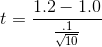

Now we must look up the t-critical value, or use technology to find the p-value.
We must find the t-critcal value by finding 

Because our test statistic 6.32 is more extreme than our critical value, we reject our null hypothesis and conclude that the pretzels do have a higher mean than 1.0.
If you calculated a p-value using technology, p=0.00006884.
Because  , we reject our null hypothesis and conclude that the pretzels do have a higher mean than 1.0 g.
This is a one- tailed t-test. It is one-tailed because the question asks whether the pretzel's mean is actually higher, so we are only interested in the right hand tail. We will be using the t-distribution because the population standard deviation is not known.
First we write our hypotheses:
Now we need the appropriate formula for a t-test. We will be using standard error because we are working with the standard deviation of a sampling distribution.
Now we fill in the values from our problem
Now we must look up the t-critical value, or use technology to find the p-value.
We must find the t-critcal value by finding
Because our test statistic 6.32 is more extreme than our critical value, we reject our null hypothesis and conclude that the pretzels do have a higher mean than 1.0.
If you calculated a p-value using technology, p=0.00006884.
Because
James goes to UCLA, and he believes that the atheletes of UCLA are better runners, than the country average. He did a bit of a research and found that the national average time for a two-mile run for college atheletes is  min with a standard deviation of
  minute. He then sampled
  UCLA atheletes and found that their average two-mile time was
  minutes.
Is James' data statistically significant? Can we confirm that UCLA atheletes are better than average runners? And if so, to which level of certainty:  ,
,  ,
,  ,
, 
James goes to UCLA, and he believes that the atheletes of UCLA are better runners, than the country average. He did a bit of a research and found that the national average time for a two-mile run for college atheletes is
Is James' data statistically significant? Can we confirm that UCLA atheletes are better than average runners? And if so, to which level of certainty:
Tap to see back →
Using a Z-test (we have population SD, not sample SD) and a population of  , we arrive at a P-value of
  , which is lower than
  , but above
  .
.
Using a Z-test (we have population SD, not sample SD) and a population of
A pretzel company advertises that their pretzels contain less than 1.0g of of sodium per serving. You take a simple random sample of 10 pretzel servings, and calculate that the mean amount of sodium is 1.20 g, with a standard deviation of 0.1 g.
At the 95% confidence level, does your sample suggest that the pretzels actually have higher than 1.0g of sodium per serving?
A pretzel company advertises that their pretzels contain less than 1.0g of of sodium per serving. You take a simple random sample of 10 pretzel servings, and calculate that the mean amount of sodium is 1.20 g, with a standard deviation of 0.1 g.
At the 95% confidence level, does your sample suggest that the pretzels actually have higher than 1.0g of sodium per serving?
Tap to see back →
This is a one- tailed t-test. It is one-tailed because the question asks whether the pretzel's mean is actually higher, so we are only interested in the right hand tail. We will be using the t-distribution because the population standard deviation is not known.
First we write our hypotheses:
Now we need the appropriate formula for a t-test. We will be using standard error because we are working with the standard deviation of a sampling distribution.
Now we fill in the values from our problem
Now we must look up the t-critical value, or use technology to find the p-value.
We must find the t-critcal value by finding
Because our test statistic 6.32 is more extreme than our critical value, we reject our null hypothesis and conclude that the pretzels do have a higher mean than 1.0.
If you calculated a p-value using technology, p=0.00006884.
Because , we reject our null hypothesis and conclude that the pretzels do have a higher mean than 1.0 g.
This is a one- tailed t-test. It is one-tailed because the question asks whether the pretzel's mean is actually higher, so we are only interested in the right hand tail. We will be using the t-distribution because the population standard deviation is not known.
First we write our hypotheses:
Now we need the appropriate formula for a t-test. We will be using standard error because we are working with the standard deviation of a sampling distribution.
Now we fill in the values from our problem
Now we must look up the t-critical value, or use technology to find the p-value.
We must find the t-critcal value by finding
Because our test statistic 6.32 is more extreme than our critical value, we reject our null hypothesis and conclude that the pretzels do have a higher mean than 1.0.
If you calculated a p-value using technology, p=0.00006884.
Because
James goes to UCLA, and he believes that the atheletes of UCLA are better runners, than the country average. He did a bit of a research and found that the national average time for a two-mile run for college atheletes is min with a standard deviation of minute. He then sampled UCLA atheletes and found that their average two-mile time was minutes.
Is James' data statistically significant? Can we confirm that UCLA atheletes are better than average runners? And if so, to which level of certainty: , , ,
James goes to UCLA, and he believes that the atheletes of UCLA are better runners, than the country average. He did a bit of a research and found that the national average time for a two-mile run for college atheletes is
Is James' data statistically significant? Can we confirm that UCLA atheletes are better than average runners? And if so, to which level of certainty:
Tap to see back →
Using a Z-test (we have population SD, not sample SD) and a population of , we arrive at a P-value of , which is lower than , but above .
Using a Z-test (we have population SD, not sample SD) and a population of
A pretzel company advertises that their pretzels contain less than 1.0g of of sodium per serving. You take a simple random sample of 10 pretzel servings, and calculate that the mean amount of sodium is 1.20 g, with a standard deviation of 0.1 g.
At the 95% confidence level, does your sample suggest that the pretzels actually have higher than 1.0g of sodium per serving?
A pretzel company advertises that their pretzels contain less than 1.0g of of sodium per serving. You take a simple random sample of 10 pretzel servings, and calculate that the mean amount of sodium is 1.20 g, with a standard deviation of 0.1 g.
At the 95% confidence level, does your sample suggest that the pretzels actually have higher than 1.0g of sodium per serving?
Tap to see back →
This is a one- tailed t-test. It is one-tailed because the question asks whether the pretzel's mean is actually higher, so we are only interested in the right hand tail. We will be using the t-distribution because the population standard deviation is not known.
First we write our hypotheses:
Now we need the appropriate formula for a t-test. We will be using standard error because we are working with the standard deviation of a sampling distribution.
Now we fill in the values from our problem
Now we must look up the t-critical value, or use technology to find the p-value.
We must find the t-critcal value by finding
Because our test statistic 6.32 is more extreme than our critical value, we reject our null hypothesis and conclude that the pretzels do have a higher mean than 1.0.
If you calculated a p-value using technology, p=0.00006884.
Because , we reject our null hypothesis and conclude that the pretzels do have a higher mean than 1.0 g.
This is a one- tailed t-test. It is one-tailed because the question asks whether the pretzel's mean is actually higher, so we are only interested in the right hand tail. We will be using the t-distribution because the population standard deviation is not known.
First we write our hypotheses:
Now we need the appropriate formula for a t-test. We will be using standard error because we are working with the standard deviation of a sampling distribution.
Now we fill in the values from our problem
Now we must look up the t-critical value, or use technology to find the p-value.
We must find the t-critcal value by finding
Because our test statistic 6.32 is more extreme than our critical value, we reject our null hypothesis and conclude that the pretzels do have a higher mean than 1.0.
If you calculated a p-value using technology, p=0.00006884.
Because
James goes to UCLA, and he believes that the atheletes of UCLA are better runners, than the country average. He did a bit of a research and found that the national average time for a two-mile run for college atheletes is min with a standard deviation of minute. He then sampled UCLA atheletes and found that their average two-mile time was minutes.
Is James' data statistically significant? Can we confirm that UCLA atheletes are better than average runners? And if so, to which level of certainty: , , ,
James goes to UCLA, and he believes that the atheletes of UCLA are better runners, than the country average. He did a bit of a research and found that the national average time for a two-mile run for college atheletes is
Is James' data statistically significant? Can we confirm that UCLA atheletes are better than average runners? And if so, to which level of certainty:
Tap to see back →
Using a Z-test (we have population SD, not sample SD) and a population of , we arrive at a P-value of , which is lower than , but above .
Using a Z-test (we have population SD, not sample SD) and a population of
A pretzel company advertises that their pretzels contain less than 1.0g of of sodium per serving. You take a simple random sample of 10 pretzel servings, and calculate that the mean amount of sodium is 1.20 g, with a standard deviation of 0.1 g.
At the 95% confidence level, does your sample suggest that the pretzels actually have higher than 1.0g of sodium per serving?
A pretzel company advertises that their pretzels contain less than 1.0g of of sodium per serving. You take a simple random sample of 10 pretzel servings, and calculate that the mean amount of sodium is 1.20 g, with a standard deviation of 0.1 g.
At the 95% confidence level, does your sample suggest that the pretzels actually have higher than 1.0g of sodium per serving?
Tap to see back →
This is a one- tailed t-test. It is one-tailed because the question asks whether the pretzel's mean is actually higher, so we are only interested in the right hand tail. We will be using the t-distribution because the population standard deviation is not known.
First we write our hypotheses:
Now we need the appropriate formula for a t-test. We will be using standard error because we are working with the standard deviation of a sampling distribution.
Now we fill in the values from our problem
Now we must look up the t-critical value, or use technology to find the p-value.
We must find the t-critcal value by finding
Because our test statistic 6.32 is more extreme than our critical value, we reject our null hypothesis and conclude that the pretzels do have a higher mean than 1.0.
If you calculated a p-value using technology, p=0.00006884.
Because , we reject our null hypothesis and conclude that the pretzels do have a higher mean than 1.0 g.
This is a one- tailed t-test. It is one-tailed because the question asks whether the pretzel's mean is actually higher, so we are only interested in the right hand tail. We will be using the t-distribution because the population standard deviation is not known.
First we write our hypotheses:
Now we need the appropriate formula for a t-test. We will be using standard error because we are working with the standard deviation of a sampling distribution.
Now we fill in the values from our problem
Now we must look up the t-critical value, or use technology to find the p-value.
We must find the t-critcal value by finding
Because our test statistic 6.32 is more extreme than our critical value, we reject our null hypothesis and conclude that the pretzels do have a higher mean than 1.0.
If you calculated a p-value using technology, p=0.00006884.
Because
James goes to UCLA, and he believes that the atheletes of UCLA are better runners, than the country average. He did a bit of a research and found that the national average time for a two-mile run for college atheletes is min with a standard deviation of minute. He then sampled UCLA atheletes and found that their average two-mile time was minutes.
Is James' data statistically significant? Can we confirm that UCLA atheletes are better than average runners? And if so, to which level of certainty: , , ,
James goes to UCLA, and he believes that the atheletes of UCLA are better runners, than the country average. He did a bit of a research and found that the national average time for a two-mile run for college atheletes is
Is James' data statistically significant? Can we confirm that UCLA atheletes are better than average runners? And if so, to which level of certainty:
Tap to see back →
Using a Z-test (we have population SD, not sample SD) and a population of , we arrive at a P-value of , which is lower than , but above .
Using a Z-test (we have population SD, not sample SD) and a population of