How to estimate margins of errors - AP Statistics
Card 0 of 8
The next local election is predicted to have a  split in votes for the top two candidates. How many people should be polled to obtain a margin of error of 3% at the 95% confidence level?
The next local election is predicted to have a
Tap to see back →
If you remember the required formula, this problem is rather simple. Plug in the given numbers and simplify:
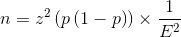


If you don't remember the formula, this problem is more challenging. Your best bet in this case is to construct the confidence interval and rearrange to solve for the required sample size.
If you remember the required formula, this problem is rather simple. Plug in the given numbers and simplify:
If you don't remember the formula, this problem is more challenging. Your best bet in this case is to construct the confidence interval and rearrange to solve for the required sample size.
When dealing with confidence intervals, the margin of error gets smaller when z* gets and n gets .
When dealing with confidence intervals, the margin of error gets smaller when z* gets and n gets .
Tap to see back →
For confidence intervals, a small margin of error is preferred, as it indicates that the parameter of interest has been narrowed down to a precise interval. Having a large sample population to work from as well as a small z* (z* gets smaller as the confidence level percent gets lower) can help obtain a small margin of error.
For confidence intervals, a small margin of error is preferred, as it indicates that the parameter of interest has been narrowed down to a precise interval. Having a large sample population to work from as well as a small z* (z* gets smaller as the confidence level percent gets lower) can help obtain a small margin of error.
The next local election is predicted to have a split in votes for the top two candidates. How many people should be polled to obtain a margin of error of 3% at the 95% confidence level?
The next local election is predicted to have a
Tap to see back →
If you remember the required formula, this problem is rather simple. Plug in the given numbers and simplify:
If you don't remember the formula, this problem is more challenging. Your best bet in this case is to construct the confidence interval and rearrange to solve for the required sample size.
If you remember the required formula, this problem is rather simple. Plug in the given numbers and simplify:
If you don't remember the formula, this problem is more challenging. Your best bet in this case is to construct the confidence interval and rearrange to solve for the required sample size.
When dealing with confidence intervals, the margin of error gets smaller when z* gets and n gets .
When dealing with confidence intervals, the margin of error gets smaller when z* gets and n gets .
Tap to see back →
For confidence intervals, a small margin of error is preferred, as it indicates that the parameter of interest has been narrowed down to a precise interval. Having a large sample population to work from as well as a small z* (z* gets smaller as the confidence level percent gets lower) can help obtain a small margin of error.
For confidence intervals, a small margin of error is preferred, as it indicates that the parameter of interest has been narrowed down to a precise interval. Having a large sample population to work from as well as a small z* (z* gets smaller as the confidence level percent gets lower) can help obtain a small margin of error.
The next local election is predicted to have a split in votes for the top two candidates. How many people should be polled to obtain a margin of error of 3% at the 95% confidence level?
The next local election is predicted to have a
Tap to see back →
If you remember the required formula, this problem is rather simple. Plug in the given numbers and simplify:
If you don't remember the formula, this problem is more challenging. Your best bet in this case is to construct the confidence interval and rearrange to solve for the required sample size.
If you remember the required formula, this problem is rather simple. Plug in the given numbers and simplify:
If you don't remember the formula, this problem is more challenging. Your best bet in this case is to construct the confidence interval and rearrange to solve for the required sample size.
When dealing with confidence intervals, the margin of error gets smaller when z* gets and n gets .
When dealing with confidence intervals, the margin of error gets smaller when z* gets and n gets .
Tap to see back →
For confidence intervals, a small margin of error is preferred, as it indicates that the parameter of interest has been narrowed down to a precise interval. Having a large sample population to work from as well as a small z* (z* gets smaller as the confidence level percent gets lower) can help obtain a small margin of error.
For confidence intervals, a small margin of error is preferred, as it indicates that the parameter of interest has been narrowed down to a precise interval. Having a large sample population to work from as well as a small z* (z* gets smaller as the confidence level percent gets lower) can help obtain a small margin of error.
The next local election is predicted to have a split in votes for the top two candidates. How many people should be polled to obtain a margin of error of 3% at the 95% confidence level?
The next local election is predicted to have a
Tap to see back →
If you remember the required formula, this problem is rather simple. Plug in the given numbers and simplify:
If you don't remember the formula, this problem is more challenging. Your best bet in this case is to construct the confidence interval and rearrange to solve for the required sample size.
If you remember the required formula, this problem is rather simple. Plug in the given numbers and simplify:
If you don't remember the formula, this problem is more challenging. Your best bet in this case is to construct the confidence interval and rearrange to solve for the required sample size.
When dealing with confidence intervals, the margin of error gets smaller when z* gets and n gets .
When dealing with confidence intervals, the margin of error gets smaller when z* gets and n gets .
Tap to see back →
For confidence intervals, a small margin of error is preferred, as it indicates that the parameter of interest has been narrowed down to a precise interval. Having a large sample population to work from as well as a small z* (z* gets smaller as the confidence level percent gets lower) can help obtain a small margin of error.
For confidence intervals, a small margin of error is preferred, as it indicates that the parameter of interest has been narrowed down to a precise interval. Having a large sample population to work from as well as a small z* (z* gets smaller as the confidence level percent gets lower) can help obtain a small margin of error.