How to find confidence intervals for a difference between two proportions - AP Statistics
Card 0 of 8
Tap to see back →
No explanation available
No explanation available
In a simple random sample of  people,
  are left-handed. Find a
  confidence interval for the true proportion of left-handed people in the entire population.
In a simple random sample of
Tap to see back →
Step 1: Determine the approporiate formula. In this case, the statistic is a proportion because the question says 261 people out of 1000 are left-handed. We want to use a confidence interval for proportions. The equation is
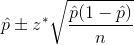
Step 2:  , or the sample proportion is equal to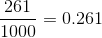
Step 3: The questions asks for a 95% confidence interval. You can assume a normal distribution because of the large sample size. Therefore, in a normal distribution, 95% of the data is contained within  .
.

Step 4: Substitue all the values into the equation to get the answer.

Step 1: Determine the approporiate formula. In this case, the statistic is a proportion because the question says 261 people out of 1000 are left-handed. We want to use a confidence interval for proportions. The equation is
Step 2:
Step 3: The questions asks for a 95% confidence interval. You can assume a normal distribution because of the large sample size. Therefore, in a normal distribution, 95% of the data is contained within
Step 4: Substitue all the values into the equation to get the answer.
Tap to see back →
No explanation available
No explanation available
In a simple random sample of people, are left-handed. Find a confidence interval for the true proportion of left-handed people in the entire population.
In a simple random sample of
Tap to see back →
Step 1: Determine the approporiate formula. In this case, the statistic is a proportion because the question says 261 people out of 1000 are left-handed. We want to use a confidence interval for proportions. The equation is
Step 2: , or the sample proportion is equal to
Step 3: The questions asks for a 95% confidence interval. You can assume a normal distribution because of the large sample size. Therefore, in a normal distribution, 95% of the data is contained within .
Step 4: Substitue all the values into the equation to get the answer.
Step 1: Determine the approporiate formula. In this case, the statistic is a proportion because the question says 261 people out of 1000 are left-handed. We want to use a confidence interval for proportions. The equation is
Step 2:
Step 3: The questions asks for a 95% confidence interval. You can assume a normal distribution because of the large sample size. Therefore, in a normal distribution, 95% of the data is contained within
Step 4: Substitue all the values into the equation to get the answer.
Tap to see back →
No explanation available
No explanation available
In a simple random sample of people, are left-handed. Find a confidence interval for the true proportion of left-handed people in the entire population.
In a simple random sample of
Tap to see back →
Step 1: Determine the approporiate formula. In this case, the statistic is a proportion because the question says 261 people out of 1000 are left-handed. We want to use a confidence interval for proportions. The equation is
Step 2: , or the sample proportion is equal to
Step 3: The questions asks for a 95% confidence interval. You can assume a normal distribution because of the large sample size. Therefore, in a normal distribution, 95% of the data is contained within .
Step 4: Substitue all the values into the equation to get the answer.
Step 1: Determine the approporiate formula. In this case, the statistic is a proportion because the question says 261 people out of 1000 are left-handed. We want to use a confidence interval for proportions. The equation is
Step 2:
Step 3: The questions asks for a 95% confidence interval. You can assume a normal distribution because of the large sample size. Therefore, in a normal distribution, 95% of the data is contained within
Step 4: Substitue all the values into the equation to get the answer.
Tap to see back →
No explanation available
No explanation available
In a simple random sample of people, are left-handed. Find a confidence interval for the true proportion of left-handed people in the entire population.
In a simple random sample of
Tap to see back →
Step 1: Determine the approporiate formula. In this case, the statistic is a proportion because the question says 261 people out of 1000 are left-handed. We want to use a confidence interval for proportions. The equation is
Step 2: , or the sample proportion is equal to
Step 3: The questions asks for a 95% confidence interval. You can assume a normal distribution because of the large sample size. Therefore, in a normal distribution, 95% of the data is contained within .
Step 4: Substitue all the values into the equation to get the answer.
Step 1: Determine the approporiate formula. In this case, the statistic is a proportion because the question says 261 people out of 1000 are left-handed. We want to use a confidence interval for proportions. The equation is
Step 2:
Step 3: The questions asks for a 95% confidence interval. You can assume a normal distribution because of the large sample size. Therefore, in a normal distribution, 95% of the data is contained within
Step 4: Substitue all the values into the equation to get the answer.