How to identify independent events - AP Statistics
Card 0 of 48
What is the probability of getting a sum of  when rolling two six-sided fair dice?
What is the probability of getting a sum of
Tap to see back →
The sample space, or total possible outcomes, when rolling two six-sided dice is  .
.
Ways to get what you want:



So there are  ways to get a
  .
.
So the probability becomes 
The sample space, or total possible outcomes, when rolling two six-sided dice is
Ways to get what you want:
So there are
So the probability becomes
Mary randomly selects the king of hearts from a deck of cards. She then replaces the card and again selects one card from the deck. The selection of the second card is a(n) event.
Mary randomly selects the king of hearts from a deck of cards. She then replaces the card and again selects one card from the deck. The selection of the second card is a(n) event.
Tap to see back →
The selection of the second card is an independent event because it is unaffected by the first event. If the king of hearts had not been replaced, then the probability of selecting a particular card would have been affected by the first event, and the second selection would have been dependent. This, however, is not the case in this question.
The selection of the second card is an independent event because it is unaffected by the first event. If the king of hearts had not been replaced, then the probability of selecting a particular card would have been affected by the first event, and the second selection would have been dependent. This, however, is not the case in this question.
Given a pair of fair dice, what is the probability of rolling a 7 in one throw?
Given a pair of fair dice, what is the probability of rolling a 7 in one throw?
Tap to see back →
There are 36 total outcomes for this experiment and there are six ways to roll a 7 with two dice: 1,6; 6,1; 2,5; 5,2; 3,4; and 4,3. Thus, 6/36 = 1/6.
There are 36 total outcomes for this experiment and there are six ways to roll a 7 with two dice: 1,6; 6,1; 2,5; 5,2; 3,4; and 4,3. Thus, 6/36 = 1/6.
A fair coin is tossed into the air a total of ten times and the result, heads or tails, is the face landing up. What is the total number of possible outcomes for this experiment?
A fair coin is tossed into the air a total of ten times and the result, heads or tails, is the face landing up. What is the total number of possible outcomes for this experiment?
Tap to see back →
There are two outcomes in each trial of this experiment, and there are ten total trials. Thus, 2 raised to the tenth power yields an answer of 1024.
There are two outcomes in each trial of this experiment, and there are ten total trials. Thus, 2 raised to the tenth power yields an answer of 1024.
Each answer choice describes two events. Which of the following describes independent events?
Each answer choice describes two events. Which of the following describes independent events?
Tap to see back →
Two events are independent of each other when the result of one does not affect the result of the other. In the case of the coin being flipped, the first result in no way influenced the result of the second coin flip. In contrast, when a card is removed from a deck of cards and set aside, that card cannot be selected when a second card is taken from the deck.
Two events are independent of each other when the result of one does not affect the result of the other. In the case of the coin being flipped, the first result in no way influenced the result of the second coin flip. In contrast, when a card is removed from a deck of cards and set aside, that card cannot be selected when a second card is taken from the deck.
Events  and
and  are known to be independent.
 while
while 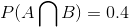 . What must
  be?
be?
Events
Tap to see back →
Because the two events are known to be independent, then the following is true by definition.
 .
.
This then becomes an algebra problem:


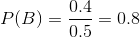
Because the two events are known to be independent, then the following is true by definition.
This then becomes an algebra problem:
Two events  and
and  are independent, and
  while
while  . What is
 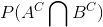 ?
?
Two events
Tap to see back →
Because the two are independent, the calculation becomes the product of the two by definition.
We need to recall that  respresents the compliment of A which is everything that is not in A or in mathematical terms:
 .
.
Likewise for the compliment of B:

Therefore to find the intersection of these two independent events we multiply them together.


Because the two are independent, the calculation becomes the product of the two by definition.
We need to recall that
Likewise for the compliment of B:
Therefore to find the intersection of these two independent events we multiply them together.
True or false: When drawing two cards with replacement, the event drawing a spade first is independent of the event drawing a heart second.
True or false: When drawing two cards with replacement, the event drawing a spade first is independent of the event drawing a heart second.
Tap to see back →
These two events are independent of one another. During sampling with replacement, the first card does not affect the second card being picked.
To illustrate, consider the probability of drawing a heart first
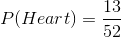
Assuming you first drew a heart and replaced it in the deck, does the probability of drawing a heart as the second card change?
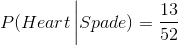
The probability remains the same, there are still 13 hearts and 52 total cards.
These two events are independent of one another. During sampling with replacement, the first card does not affect the second card being picked.
To illustrate, consider the probability of drawing a heart first
Assuming you first drew a heart and replaced it in the deck, does the probability of drawing a heart as the second card change?
The probability remains the same, there are still 13 hearts and 52 total cards.
True or False: When 2 cards are drawn without replacement from a regular deck of 52 cards, the event of drawing a heart first independent of the event of drawing a heart second.
True or False: When 2 cards are drawn without replacement from a regular deck of 52 cards, the event of drawing a heart first independent of the event of drawing a heart second.
Tap to see back →
These events are not independent, because if one event happens, it affects the probability of the other event happening. Consider the probability of drawing a heart and the probability of getting a heart given a heart was already drawn. If these two probabilities are the same, the events are independent. If the two probabilities are not the asme, the events are not independent.
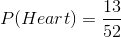
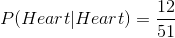
After a heart has already been drawn, there are now only 52 cards total and 12 hearts left. These two probabilities are not equal, therefore the events are not independent.
These events are not independent, because if one event happens, it affects the probability of the other event happening. Consider the probability of drawing a heart and the probability of getting a heart given a heart was already drawn. If these two probabilities are the same, the events are independent. If the two probabilities are not the asme, the events are not independent.
After a heart has already been drawn, there are now only 52 cards total and 12 hearts left. These two probabilities are not equal, therefore the events are not independent.
True or false: Two events which are mutually exclsuve are also independent events.
True or false: Two events which are mutually exclsuve are also independent events.
Tap to see back →
Events which are mutually exclusive are dependent events. This is becauce if one event happens, it affects the probability that the other event will happen.
Example- Tonight you may attend a soccer game or a basketball game. These events are mutually exclusive because they share no overlap. However, if you go to the basketball game, it changes the probability of you going to the soccer game to zero. Therefore, mutually exclusive events are not independent.
Events which are mutually exclusive are dependent events. This is becauce if one event happens, it affects the probability that the other event will happen.
Example- Tonight you may attend a soccer game or a basketball game. These events are mutually exclusive because they share no overlap. However, if you go to the basketball game, it changes the probability of you going to the soccer game to zero. Therefore, mutually exclusive events are not independent.
True or false:
A family has 3 boys. The probability that the fourth child will also be a boy is less than 50%
True or false:
A family has 3 boys. The probability that the fourth child will also be a boy is less than 50%
Tap to see back →
The gender of each child can be considered an independent event. Each child has a 50% chance of being a boy, and whether a boy was already born previously does not affect the next child's gender.
The gender of each child can be considered an independent event. Each child has a 50% chance of being a boy, and whether a boy was already born previously does not affect the next child's gender.
A bag is set in front of you with three different colored marbles inside. There are 9 red marbles, 10 blue marbles, and 7 yellow marbles. What is the probability that you draw a marble that is not yellow?
A bag is set in front of you with three different colored marbles inside. There are 9 red marbles, 10 blue marbles, and 7 yellow marbles. What is the probability that you draw a marble that is not yellow?
Tap to see back →
First you find the total amount of marbles that are in the bag which is 26 ( ). Then you must add up all of the marbles that are not yellow which is 19 (9 red marbles + 10 blue marbles). Finally, you must divide the total marbles that are apart of you set (19) by the total marbles (26) and that gives you a probability of
  .
.
First you find the total amount of marbles that are in the bag which is 26 (
What is the probability of getting a sum of when rolling two six-sided fair dice?
What is the probability of getting a sum of
Tap to see back →
The sample space, or total possible outcomes, when rolling two six-sided dice is .
Ways to get what you want:
So there are ways to get a .
So the probability becomes
The sample space, or total possible outcomes, when rolling two six-sided dice is
Ways to get what you want:
So there are
So the probability becomes
Mary randomly selects the king of hearts from a deck of cards. She then replaces the card and again selects one card from the deck. The selection of the second card is a(n) event.
Mary randomly selects the king of hearts from a deck of cards. She then replaces the card and again selects one card from the deck. The selection of the second card is a(n) event.
Tap to see back →
The selection of the second card is an independent event because it is unaffected by the first event. If the king of hearts had not been replaced, then the probability of selecting a particular card would have been affected by the first event, and the second selection would have been dependent. This, however, is not the case in this question.
The selection of the second card is an independent event because it is unaffected by the first event. If the king of hearts had not been replaced, then the probability of selecting a particular card would have been affected by the first event, and the second selection would have been dependent. This, however, is not the case in this question.
Given a pair of fair dice, what is the probability of rolling a 7 in one throw?
Given a pair of fair dice, what is the probability of rolling a 7 in one throw?
Tap to see back →
There are 36 total outcomes for this experiment and there are six ways to roll a 7 with two dice: 1,6; 6,1; 2,5; 5,2; 3,4; and 4,3. Thus, 6/36 = 1/6.
There are 36 total outcomes for this experiment and there are six ways to roll a 7 with two dice: 1,6; 6,1; 2,5; 5,2; 3,4; and 4,3. Thus, 6/36 = 1/6.
A fair coin is tossed into the air a total of ten times and the result, heads or tails, is the face landing up. What is the total number of possible outcomes for this experiment?
A fair coin is tossed into the air a total of ten times and the result, heads or tails, is the face landing up. What is the total number of possible outcomes for this experiment?
Tap to see back →
There are two outcomes in each trial of this experiment, and there are ten total trials. Thus, 2 raised to the tenth power yields an answer of 1024.
There are two outcomes in each trial of this experiment, and there are ten total trials. Thus, 2 raised to the tenth power yields an answer of 1024.
Each answer choice describes two events. Which of the following describes independent events?
Each answer choice describes two events. Which of the following describes independent events?
Tap to see back →
Two events are independent of each other when the result of one does not affect the result of the other. In the case of the coin being flipped, the first result in no way influenced the result of the second coin flip. In contrast, when a card is removed from a deck of cards and set aside, that card cannot be selected when a second card is taken from the deck.
Two events are independent of each other when the result of one does not affect the result of the other. In the case of the coin being flipped, the first result in no way influenced the result of the second coin flip. In contrast, when a card is removed from a deck of cards and set aside, that card cannot be selected when a second card is taken from the deck.
Events and are known to be independent.
while . What must be?
Events
Tap to see back →
Because the two events are known to be independent, then the following is true by definition.
.
This then becomes an algebra problem:
Because the two events are known to be independent, then the following is true by definition.
This then becomes an algebra problem:
Two events and are independent, and while . What is ?
Two events
Tap to see back →
Because the two are independent, the calculation becomes the product of the two by definition.
We need to recall that respresents the compliment of A which is everything that is not in A or in mathematical terms:
.
Likewise for the compliment of B:
Therefore to find the intersection of these two independent events we multiply them together.
Because the two are independent, the calculation becomes the product of the two by definition.
We need to recall that
Likewise for the compliment of B:
Therefore to find the intersection of these two independent events we multiply them together.
True or false: When drawing two cards with replacement, the event drawing a spade first is independent of the event drawing a heart second.
True or false: When drawing two cards with replacement, the event drawing a spade first is independent of the event drawing a heart second.
Tap to see back →
These two events are independent of one another. During sampling with replacement, the first card does not affect the second card being picked.
To illustrate, consider the probability of drawing a heart first
Assuming you first drew a heart and replaced it in the deck, does the probability of drawing a heart as the second card change?
The probability remains the same, there are still 13 hearts and 52 total cards.
These two events are independent of one another. During sampling with replacement, the first card does not affect the second card being picked.
To illustrate, consider the probability of drawing a heart first
Assuming you first drew a heart and replaced it in the deck, does the probability of drawing a heart as the second card change?
The probability remains the same, there are still 13 hearts and 52 total cards.