How to identify independent variables - AP Statistics
Card 0 of 32
A fair coin is flipped three times and comes up heads each time. What is the probability that the fourth toss will also come up heads?
A fair coin is flipped three times and comes up heads each time. What is the probability that the fourth toss will also come up heads?
Tap to see back →
Remember, no matter what the previous trials' results, the probability of a head (or tail) does not change from  because each trial is independent of the others.
Remember, no matter what the previous trials' results, the probability of a head (or tail) does not change from
In a standard deck of cards, with replacement, what is the probability of drawing two Ace of Hearts?
In a standard deck of cards, with replacement, what is the probability of drawing two Ace of Hearts?
Tap to see back →
Probability of drawing first ace of hearts: 
Probability of drawing second ace of hearts: 
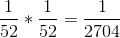
Multiply both probabilities by each other:
Probability of drawing first ace of hearts:
Probability of drawing second ace of hearts:
Multiply both probabilities by each other:
A dice is rolled five times in a row. Each time, a 6 is rolled. What is the probability that a 6 will be rolled on the sixth roll? Assume that the dice is fair and has six sides.
A dice is rolled five times in a row. Each time, a 6 is rolled. What is the probability that a 6 will be rolled on the sixth roll? Assume that the dice is fair and has six sides.
Tap to see back →
Regardless of the previous results of the dice rolls, the probability of each individual dice roll remains the same. Each time the dice is rolled, there is a 1/6 chance that it will land on a specific number. Therefore, there is a 1/6 chance that the dice will roll a 6 on the sixth roll.
Regardless of the previous results of the dice rolls, the probability of each individual dice roll remains the same. Each time the dice is rolled, there is a 1/6 chance that it will land on a specific number. Therefore, there is a 1/6 chance that the dice will roll a 6 on the sixth roll.
What is the probability that a person will flip a coin and land on heads eight times in a row? Assume that the coin is fair and can either land on heads or tails.
What is the probability that a person will flip a coin and land on heads eight times in a row? Assume that the coin is fair and can either land on heads or tails.
Tap to see back →
In this problem, it is important to identify that flipping a coin is an independent event. One coin flip does not affect the next coin flip. In each flip, there is a 50% chance of landing on heads and a 50% chance of landing on tails. By multiplying the probabilities with each other eight times, we get the following:

In this problem, it is important to identify that flipping a coin is an independent event. One coin flip does not affect the next coin flip. In each flip, there is a 50% chance of landing on heads and a 50% chance of landing on tails. By multiplying the probabilities with each other eight times, we get the following:
A dice is rolled four times in a row. What is the probability that every one of the four rolls will result in a result greater than 2? Assume the dice is fair and has six sides.
A dice is rolled four times in a row. What is the probability that every one of the four rolls will result in a result greater than 2? Assume the dice is fair and has six sides.
Tap to see back →
In this problem, each roll of the dice is independent from the previous roll. The probability of obtaining a result of greater than 2 on a single roll is 4/6 or 2/3 (since 3, 4, 5, and 6 are all greater than 2). In order to find the probability that this occurs four times in a row, we must multiply the following:

In this problem, each roll of the dice is independent from the previous roll. The probability of obtaining a result of greater than 2 on a single roll is 4/6 or 2/3 (since 3, 4, 5, and 6 are all greater than 2). In order to find the probability that this occurs four times in a row, we must multiply the following:
A coin is tossed 100 times and each time, the coin lands on tails. What is the expected probability of the coin landing on tails if it is rolled an infinite number of times? Assume that the coin is fair and has two sides - heads and tails.
A coin is tossed 100 times and each time, the coin lands on tails. What is the expected probability of the coin landing on tails if it is rolled an infinite number of times? Assume that the coin is fair and has two sides - heads and tails.
Tap to see back →
According to the Law of Large Numbers, the probability of the coin landing on tails after being rolled an infinite number of times is equal to the probability of the coin landing on tails in an individual roll: 50%.
According to the Law of Large Numbers, the probability of the coin landing on tails after being rolled an infinite number of times is equal to the probability of the coin landing on tails in an individual roll: 50%.
Four people are playing a card game and each of them has their own 52-card deck that has been randomly shuffled.
What is the probability that all four of the individuals will draw a face card at random?
Four people are playing a card game and each of them has their own 52-card deck that has been randomly shuffled.
What is the probability that all four of the individuals will draw a face card at random?
Tap to see back →
Since each deck of cards is separate and only one card is being drawn from each deck, the events are independent of each other. The probability of drawing a single face card (Jacks, Queens, or Kings) from a deck of cards is 12/52. We can multiply the probabilities as follows:
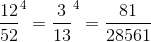
Since each deck of cards is separate and only one card is being drawn from each deck, the events are independent of each other. The probability of drawing a single face card (Jacks, Queens, or Kings) from a deck of cards is 12/52. We can multiply the probabilities as follows:
A student is conducting different experiments that include the rain fall totals in his town, the change in temperature, the tidal levels on the beach, and the humidity. These will all be measured over the next couple of months to figure out the current trends. What would the independent event be in these experiments?
A student is conducting different experiments that include the rain fall totals in his town, the change in temperature, the tidal levels on the beach, and the humidity. These will all be measured over the next couple of months to figure out the current trends. What would the independent event be in these experiments?
Tap to see back →
Time is the independent variable as time is not affected by the other variables but the other variables all change as time lapses.
Time is the independent variable as time is not affected by the other variables but the other variables all change as time lapses.
A fair coin is flipped three times and comes up heads each time. What is the probability that the fourth toss will also come up heads?
A fair coin is flipped three times and comes up heads each time. What is the probability that the fourth toss will also come up heads?
Tap to see back →
Remember, no matter what the previous trials' results, the probability of a head (or tail) does not change from because each trial is independent of the others.
Remember, no matter what the previous trials' results, the probability of a head (or tail) does not change from
In a standard deck of cards, with replacement, what is the probability of drawing two Ace of Hearts?
In a standard deck of cards, with replacement, what is the probability of drawing two Ace of Hearts?
Tap to see back →
Probability of drawing first ace of hearts:
Probability of drawing second ace of hearts:
Multiply both probabilities by each other:
Probability of drawing first ace of hearts:
Probability of drawing second ace of hearts:
Multiply both probabilities by each other:
A dice is rolled five times in a row. Each time, a 6 is rolled. What is the probability that a 6 will be rolled on the sixth roll? Assume that the dice is fair and has six sides.
A dice is rolled five times in a row. Each time, a 6 is rolled. What is the probability that a 6 will be rolled on the sixth roll? Assume that the dice is fair and has six sides.
Tap to see back →
Regardless of the previous results of the dice rolls, the probability of each individual dice roll remains the same. Each time the dice is rolled, there is a 1/6 chance that it will land on a specific number. Therefore, there is a 1/6 chance that the dice will roll a 6 on the sixth roll.
Regardless of the previous results of the dice rolls, the probability of each individual dice roll remains the same. Each time the dice is rolled, there is a 1/6 chance that it will land on a specific number. Therefore, there is a 1/6 chance that the dice will roll a 6 on the sixth roll.
What is the probability that a person will flip a coin and land on heads eight times in a row? Assume that the coin is fair and can either land on heads or tails.
What is the probability that a person will flip a coin and land on heads eight times in a row? Assume that the coin is fair and can either land on heads or tails.
Tap to see back →
In this problem, it is important to identify that flipping a coin is an independent event. One coin flip does not affect the next coin flip. In each flip, there is a 50% chance of landing on heads and a 50% chance of landing on tails. By multiplying the probabilities with each other eight times, we get the following:
In this problem, it is important to identify that flipping a coin is an independent event. One coin flip does not affect the next coin flip. In each flip, there is a 50% chance of landing on heads and a 50% chance of landing on tails. By multiplying the probabilities with each other eight times, we get the following:
A dice is rolled four times in a row. What is the probability that every one of the four rolls will result in a result greater than 2? Assume the dice is fair and has six sides.
A dice is rolled four times in a row. What is the probability that every one of the four rolls will result in a result greater than 2? Assume the dice is fair and has six sides.
Tap to see back →
In this problem, each roll of the dice is independent from the previous roll. The probability of obtaining a result of greater than 2 on a single roll is 4/6 or 2/3 (since 3, 4, 5, and 6 are all greater than 2). In order to find the probability that this occurs four times in a row, we must multiply the following:
In this problem, each roll of the dice is independent from the previous roll. The probability of obtaining a result of greater than 2 on a single roll is 4/6 or 2/3 (since 3, 4, 5, and 6 are all greater than 2). In order to find the probability that this occurs four times in a row, we must multiply the following:
A coin is tossed 100 times and each time, the coin lands on tails. What is the expected probability of the coin landing on tails if it is rolled an infinite number of times? Assume that the coin is fair and has two sides - heads and tails.
A coin is tossed 100 times and each time, the coin lands on tails. What is the expected probability of the coin landing on tails if it is rolled an infinite number of times? Assume that the coin is fair and has two sides - heads and tails.
Tap to see back →
According to the Law of Large Numbers, the probability of the coin landing on tails after being rolled an infinite number of times is equal to the probability of the coin landing on tails in an individual roll: 50%.
According to the Law of Large Numbers, the probability of the coin landing on tails after being rolled an infinite number of times is equal to the probability of the coin landing on tails in an individual roll: 50%.
Four people are playing a card game and each of them has their own 52-card deck that has been randomly shuffled.
What is the probability that all four of the individuals will draw a face card at random?
Four people are playing a card game and each of them has their own 52-card deck that has been randomly shuffled.
What is the probability that all four of the individuals will draw a face card at random?
Tap to see back →
Since each deck of cards is separate and only one card is being drawn from each deck, the events are independent of each other. The probability of drawing a single face card (Jacks, Queens, or Kings) from a deck of cards is 12/52. We can multiply the probabilities as follows:
Since each deck of cards is separate and only one card is being drawn from each deck, the events are independent of each other. The probability of drawing a single face card (Jacks, Queens, or Kings) from a deck of cards is 12/52. We can multiply the probabilities as follows:
A student is conducting different experiments that include the rain fall totals in his town, the change in temperature, the tidal levels on the beach, and the humidity. These will all be measured over the next couple of months to figure out the current trends. What would the independent event be in these experiments?
A student is conducting different experiments that include the rain fall totals in his town, the change in temperature, the tidal levels on the beach, and the humidity. These will all be measured over the next couple of months to figure out the current trends. What would the independent event be in these experiments?
Tap to see back →
Time is the independent variable as time is not affected by the other variables but the other variables all change as time lapses.
Time is the independent variable as time is not affected by the other variables but the other variables all change as time lapses.
In a standard deck of cards, with replacement, what is the probability of drawing two Ace of Hearts?
In a standard deck of cards, with replacement, what is the probability of drawing two Ace of Hearts?
Tap to see back →
Probability of drawing first ace of hearts:
Probability of drawing second ace of hearts:
Multiply both probabilities by each other:
Probability of drawing first ace of hearts:
Probability of drawing second ace of hearts:
Multiply both probabilities by each other:
A fair coin is flipped three times and comes up heads each time. What is the probability that the fourth toss will also come up heads?
A fair coin is flipped three times and comes up heads each time. What is the probability that the fourth toss will also come up heads?
Tap to see back →
Remember, no matter what the previous trials' results, the probability of a head (or tail) does not change from because each trial is independent of the others.
Remember, no matter what the previous trials' results, the probability of a head (or tail) does not change from
A dice is rolled five times in a row. Each time, a 6 is rolled. What is the probability that a 6 will be rolled on the sixth roll? Assume that the dice is fair and has six sides.
A dice is rolled five times in a row. Each time, a 6 is rolled. What is the probability that a 6 will be rolled on the sixth roll? Assume that the dice is fair and has six sides.
Tap to see back →
Regardless of the previous results of the dice rolls, the probability of each individual dice roll remains the same. Each time the dice is rolled, there is a 1/6 chance that it will land on a specific number. Therefore, there is a 1/6 chance that the dice will roll a 6 on the sixth roll.
Regardless of the previous results of the dice rolls, the probability of each individual dice roll remains the same. Each time the dice is rolled, there is a 1/6 chance that it will land on a specific number. Therefore, there is a 1/6 chance that the dice will roll a 6 on the sixth roll.
What is the probability that a person will flip a coin and land on heads eight times in a row? Assume that the coin is fair and can either land on heads or tails.
What is the probability that a person will flip a coin and land on heads eight times in a row? Assume that the coin is fair and can either land on heads or tails.
Tap to see back →
In this problem, it is important to identify that flipping a coin is an independent event. One coin flip does not affect the next coin flip. In each flip, there is a 50% chance of landing on heads and a 50% chance of landing on tails. By multiplying the probabilities with each other eight times, we get the following:
In this problem, it is important to identify that flipping a coin is an independent event. One coin flip does not affect the next coin flip. In each flip, there is a 50% chance of landing on heads and a 50% chance of landing on tails. By multiplying the probabilities with each other eight times, we get the following: