Laws of Exponents - Basic Math
Card 1 of 24
Simplify:

Simplify:
Tap to reveal answer
When dividing terms with the same bases, remember to subtract the exponents.
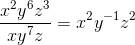
Keep in mind that when there is a negative exponent in the numerator, putting that term in the denominator will make the exponent positive.
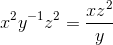
When dividing terms with the same bases, remember to subtract the exponents.
Keep in mind that when there is a negative exponent in the numerator, putting that term in the denominator will make the exponent positive.
← Didn't Know|Knew It →
Evaluate

Evaluate
Tap to reveal answer
We first need to apply the Exponent Rule to our two terms.
 and
and
 .
.
Then we do subtraction to obtain our final answer,
 .
.
We first need to apply the Exponent Rule to our two terms.
Then we do subtraction to obtain our final answer,
← Didn't Know|Knew It →
Which of the following is equivalent to  ?
?
Which of the following is equivalent to
Tap to reveal answer
Since all of the answer choices look like  , let's find
  in
in  .
.

Then,

When you have an exponent being raised to an exponent, multiply the exponents together.

Since all of the answer choices look like
Then,
When you have an exponent being raised to an exponent, multiply the exponents together.
← Didn't Know|Knew It →
Simplify the following expression:

Simplify the following expression:
Tap to reveal answer
The correct answer is  due to the law of exponents. When solving this type of problem, it is easiest to focus on like terms (i.e. terms containing x or terms containing y).
First we can start by simplifying the 'x' terms. We start with  which is equivalent to
  . We then are left with
  .
.
Now we can simplify the 'y' terms as follows: 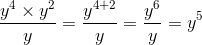 .
.
Last, the 'z' terms can be simplified as follows:  .
.
This leaves us with the final simplified answer of  .
.
The correct answer is
First we can start by simplifying the 'x' terms. We start with
Now we can simplify the 'y' terms as follows:
Last, the 'z' terms can be simplified as follows:
This leaves us with the final simplified answer of
← Didn't Know|Knew It →
What is  ?
?
What is
Tap to reveal answer
When terms with the same base are multiplied, multiply the coefficients together then add up all the exponents.
For the coefficients: 
For the exponents: 
Thus, the answer is 
When terms with the same base are multiplied, multiply the coefficients together then add up all the exponents.
For the coefficients:
For the exponents:
Thus, the answer is
← Didn't Know|Knew It →

Tap to reveal answer
Start by simplifying the numerator.
When an exponent is raised to another exponent, multiply the two exponents together.

Now, tackle the denominator. When two numbers of the same base are multiplied, you want to add the exponents.

Put the numerator and denominator together:

When you have a fraction with terms that have the same base, you want to subtract the exponent in the denominator from the exponent in the numerator.
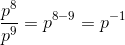
To make a term with a negative exponent in the numerator positive, put it in the denominator.

Start by simplifying the numerator.
When an exponent is raised to another exponent, multiply the two exponents together.
Now, tackle the denominator. When two numbers of the same base are multiplied, you want to add the exponents.
Put the numerator and denominator together:
When you have a fraction with terms that have the same base, you want to subtract the exponent in the denominator from the exponent in the numerator.
To make a term with a negative exponent in the numerator positive, put it in the denominator.
← Didn't Know|Knew It →
What is ?
What is
Tap to reveal answer
When terms with the same base are multiplied, multiply the coefficients together then add up all the exponents.
For the coefficients:
For the exponents:
Thus, the answer is
When terms with the same base are multiplied, multiply the coefficients together then add up all the exponents.
For the coefficients:
For the exponents:
Thus, the answer is
← Didn't Know|Knew It →
Simplify:
Simplify:
Tap to reveal answer
When dividing terms with the same bases, remember to subtract the exponents.
Keep in mind that when there is a negative exponent in the numerator, putting that term in the denominator will make the exponent positive.
When dividing terms with the same bases, remember to subtract the exponents.
Keep in mind that when there is a negative exponent in the numerator, putting that term in the denominator will make the exponent positive.
← Didn't Know|Knew It →
Evaluate
Evaluate
Tap to reveal answer
We first need to apply the Exponent Rule to our two terms.
and
.
Then we do subtraction to obtain our final answer,
.
We first need to apply the Exponent Rule to our two terms.
Then we do subtraction to obtain our final answer,
← Didn't Know|Knew It →
Which of the following is equivalent to ?
Which of the following is equivalent to
Tap to reveal answer
Since all of the answer choices look like , let's find in .
Then,
When you have an exponent being raised to an exponent, multiply the exponents together.
Since all of the answer choices look like
Then,
When you have an exponent being raised to an exponent, multiply the exponents together.
← Didn't Know|Knew It →
Simplify the following expression:
Simplify the following expression:
Tap to reveal answer
The correct answer is due to the law of exponents. When solving this type of problem, it is easiest to focus on like terms (i.e. terms containing x or terms containing y).
First we can start by simplifying the 'x' terms. We start with which is equivalent to . We then are left with .
Now we can simplify the 'y' terms as follows: .
Last, the 'z' terms can be simplified as follows: .
This leaves us with the final simplified answer of .
The correct answer is
First we can start by simplifying the 'x' terms. We start with
Now we can simplify the 'y' terms as follows:
Last, the 'z' terms can be simplified as follows:
This leaves us with the final simplified answer of
← Didn't Know|Knew It →
Tap to reveal answer
Start by simplifying the numerator.
When an exponent is raised to another exponent, multiply the two exponents together.
Now, tackle the denominator. When two numbers of the same base are multiplied, you want to add the exponents.
Put the numerator and denominator together:
When you have a fraction with terms that have the same base, you want to subtract the exponent in the denominator from the exponent in the numerator.
To make a term with a negative exponent in the numerator positive, put it in the denominator.
Start by simplifying the numerator.
When an exponent is raised to another exponent, multiply the two exponents together.
Now, tackle the denominator. When two numbers of the same base are multiplied, you want to add the exponents.
Put the numerator and denominator together:
When you have a fraction with terms that have the same base, you want to subtract the exponent in the denominator from the exponent in the numerator.
To make a term with a negative exponent in the numerator positive, put it in the denominator.
← Didn't Know|Knew It →
Simplify:
Simplify:
Tap to reveal answer
When dividing terms with the same bases, remember to subtract the exponents.
Keep in mind that when there is a negative exponent in the numerator, putting that term in the denominator will make the exponent positive.
When dividing terms with the same bases, remember to subtract the exponents.
Keep in mind that when there is a negative exponent in the numerator, putting that term in the denominator will make the exponent positive.
← Didn't Know|Knew It →
Evaluate
Evaluate
Tap to reveal answer
We first need to apply the Exponent Rule to our two terms.
and
.
Then we do subtraction to obtain our final answer,
.
We first need to apply the Exponent Rule to our two terms.
Then we do subtraction to obtain our final answer,
← Didn't Know|Knew It →
Which of the following is equivalent to ?
Which of the following is equivalent to
Tap to reveal answer
Since all of the answer choices look like , let's find in .
Then,
When you have an exponent being raised to an exponent, multiply the exponents together.
Since all of the answer choices look like
Then,
When you have an exponent being raised to an exponent, multiply the exponents together.
← Didn't Know|Knew It →
Simplify the following expression:
Simplify the following expression:
Tap to reveal answer
The correct answer is due to the law of exponents. When solving this type of problem, it is easiest to focus on like terms (i.e. terms containing x or terms containing y).
First we can start by simplifying the 'x' terms. We start with which is equivalent to . We then are left with .
Now we can simplify the 'y' terms as follows: .
Last, the 'z' terms can be simplified as follows: .
This leaves us with the final simplified answer of .
The correct answer is
First we can start by simplifying the 'x' terms. We start with
Now we can simplify the 'y' terms as follows:
Last, the 'z' terms can be simplified as follows:
This leaves us with the final simplified answer of
← Didn't Know|Knew It →
What is ?
What is
Tap to reveal answer
When terms with the same base are multiplied, multiply the coefficients together then add up all the exponents.
For the coefficients:
For the exponents:
Thus, the answer is
When terms with the same base are multiplied, multiply the coefficients together then add up all the exponents.
For the coefficients:
For the exponents:
Thus, the answer is
← Didn't Know|Knew It →
Tap to reveal answer
Start by simplifying the numerator.
When an exponent is raised to another exponent, multiply the two exponents together.
Now, tackle the denominator. When two numbers of the same base are multiplied, you want to add the exponents.
Put the numerator and denominator together:
When you have a fraction with terms that have the same base, you want to subtract the exponent in the denominator from the exponent in the numerator.
To make a term with a negative exponent in the numerator positive, put it in the denominator.
Start by simplifying the numerator.
When an exponent is raised to another exponent, multiply the two exponents together.
Now, tackle the denominator. When two numbers of the same base are multiplied, you want to add the exponents.
Put the numerator and denominator together:
When you have a fraction with terms that have the same base, you want to subtract the exponent in the denominator from the exponent in the numerator.
To make a term with a negative exponent in the numerator positive, put it in the denominator.
← Didn't Know|Knew It →
What is ?
What is
Tap to reveal answer
When terms with the same base are multiplied, multiply the coefficients together then add up all the exponents.
For the coefficients:
For the exponents:
Thus, the answer is
When terms with the same base are multiplied, multiply the coefficients together then add up all the exponents.
For the coefficients:
For the exponents:
Thus, the answer is
← Didn't Know|Knew It →
Simplify:
Simplify:
Tap to reveal answer
When dividing terms with the same bases, remember to subtract the exponents.
Keep in mind that when there is a negative exponent in the numerator, putting that term in the denominator will make the exponent positive.
When dividing terms with the same bases, remember to subtract the exponents.
Keep in mind that when there is a negative exponent in the numerator, putting that term in the denominator will make the exponent positive.
← Didn't Know|Knew It →