Pentagons - Math
Card 1 of 344
What is the interior angle measure of any regular pentagon?
What is the interior angle measure of any regular pentagon?
Tap to reveal answer
To find the angle of any regular polygon you find the number of sides  . For a pentagon,
  .
.
You then subtract 2 from the number of sides yielding 3.
Take 3 and multiply it by 180 degrees to yield the total number of degrees in the regular pentagon. 
Then to find one individual angle we divide 540 by the total number of angles 5, 
The answer is  .
.
To find the angle of any regular polygon you find the number of sides
You then subtract 2 from the number of sides yielding 3.
Take 3 and multiply it by 180 degrees to yield the total number of degrees in the regular pentagon.
Then to find one individual angle we divide 540 by the total number of angles 5,
The answer is
← Didn't Know|Knew It →
What is the measure of each interior angle of a regular pentagon?
What is the measure of each interior angle of a regular pentagon?
Tap to reveal answer
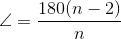
The following equation can be used to determine the measure of an interior angle of a regular polygon, where  equals the number of sides.
In a pentagon,  .
.
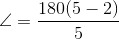
Now we can solve for the angle.

The following equation can be used to determine the measure of an interior angle of a regular polygon, where
In a pentagon,
Now we can solve for the angle.
← Didn't Know|Knew It →
Find the interior angle of the following regular pentagon:

Find the interior angle of the following regular pentagon:
Tap to reveal answer
The formula for the sum of the interior angles of a polygon is
 ,
,
where  is the number of sides in the polygon
Plugging in our values, we get:


Dividing the sum of the interior angles by the number of angles in the polygon, we get the value for each interior angle:
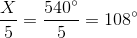
The formula for the sum of the interior angles of a polygon is
where
Plugging in our values, we get:
Dividing the sum of the interior angles by the number of angles in the polygon, we get the value for each interior angle:
← Didn't Know|Knew It →
What is the measure of an interior angle of a regular pentagon?
What is the measure of an interior angle of a regular pentagon?
Tap to reveal answer
The measure of an interior angle of a regular polygon can be determined using the following equation, where  equals the number of sides:
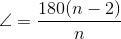

The measure of an interior angle of a regular polygon can be determined using the following equation, where
← Didn't Know|Knew It →
The angles at 3 verticies of a pentagon are 60, 80 and 100. Which of the following could NOT be the measures of the other 2 angles?
The angles at 3 verticies of a pentagon are 60, 80 and 100. Which of the following could NOT be the measures of the other 2 angles?
Tap to reveal answer
The sum of the angles in a polygon is

For a pentagon, this equals 540. Since the first 3 angles add up to 240, the remaining 2 angles must add up to 
The sum of the angles in a polygon is
For a pentagon, this equals 540. Since the first 3 angles add up to 240, the remaining 2 angles must add up to
← Didn't Know|Knew It →
What is the sum of three angles in a hexagon if the perimeter of the hexagon is  ?
?
What is the sum of three angles in a hexagon if the perimeter of the hexagon is
Tap to reveal answer
The perimeter in this question is irrelevant. Use the interior angle formula to determine the total sum of the angles in a hexagon.

There are six interior angles in a hexagon.

Each angle will be a sixth of the total angle.

Therefore, the sum of three angles in a hexagon is:

The perimeter in this question is irrelevant. Use the interior angle formula to determine the total sum of the angles in a hexagon.
There are six interior angles in a hexagon.
Each angle will be a sixth of the total angle.
Therefore, the sum of three angles in a hexagon is:
← Didn't Know|Knew It →
Add four interior angles in a regular pentagon. What is the result?
Add four interior angles in a regular pentagon. What is the result?
Tap to reveal answer
Use the interior angle formula to find the total sum of angles in a pentagon.

 for a pentagon, so substitute this value into the equation and solve:

Divide this number by 5, since there are five interior angles.

The sum of four interior angles in a regular pentagon is:

Use the interior angle formula to find the total sum of angles in a pentagon.
Divide this number by 5, since there are five interior angles.
The sum of four interior angles in a regular pentagon is:
← Didn't Know|Knew It →
What is the sum of two interior angles of a regular pentagon if the perimeter is 6?
What is the sum of two interior angles of a regular pentagon if the perimeter is 6?
Tap to reveal answer
The perimeter of a regular pentagon has no effect on the interior angles of the pentagon.
Use the following formula to solve for the sum of all interior angles in the pentagon.

Since there are 5 sides in a pentagon, substitute the side length  .
.

Divide this by 5 to determine the value of each angle, and then multiply by 2 to determine the sum of 2 interior angles.


The sum of 2 interior angles of a pentagon is  .
.
The perimeter of a regular pentagon has no effect on the interior angles of the pentagon.
Use the following formula to solve for the sum of all interior angles in the pentagon.
Since there are 5 sides in a pentagon, substitute the side length
Divide this by 5 to determine the value of each angle, and then multiply by 2 to determine the sum of 2 interior angles.
The sum of 2 interior angles of a pentagon is
← Didn't Know|Knew It →
Let the area of a regular pentagon be  . What is the value of an interior angle?
Let the area of a regular pentagon be
Tap to reveal answer
Area has no effect on the value of the interior angles of a pentagon. To find the sum of all angles of a pentagon, use the following formula, where  is the number of sides:

There are 5 sides in a pentagon.

Divide this number by 5 to determine the value of each angle.

Area has no effect on the value of the interior angles of a pentagon. To find the sum of all angles of a pentagon, use the following formula, where
There are 5 sides in a pentagon.
Divide this number by 5 to determine the value of each angle.
← Didn't Know|Knew It →
Suppose an interior angle of a regular pentagon is  . What is
  ?
?
Suppose an interior angle of a regular pentagon is
Tap to reveal answer
The pentagon has 5 sides. To find the value of the interior angle of a pentagon, use the following formula to find the sum of all interior angles.

Substitute  .
.

Divide this number by 5 to determine the value of each interior angle.

Every interior angle is 108 degrees. The problem states that an interior angle is  . Set these two values equal to each other and solve for
  .
.


The pentagon has 5 sides. To find the value of the interior angle of a pentagon, use the following formula to find the sum of all interior angles.
Substitute
Divide this number by 5 to determine the value of each interior angle.
Every interior angle is 108 degrees. The problem states that an interior angle is
← Didn't Know|Knew It →
True or false: Each of the five angles of a regular pentagon measures  .
.
True or false: Each of the five angles of a regular pentagon measures
Tap to reveal answer
A regular polygon with  sides has
  congruent angles, each of which measures

Setting  , the common angle measure can be calculated to be

The statement is therefore false.
A regular polygon with
Setting
The statement is therefore false.
← Didn't Know|Knew It →
True or false: Each of the exterior angles of a regular pentagon measures  .
.
True or false: Each of the exterior angles of a regular pentagon measures
Tap to reveal answer
If one exterior angle is taken at each vertex of any polygon, and their measures are added, the sum is  . Each exterior angle of a regular pentagon has the same measure, so if we let
  be that common measure, then

Solve for  :
:


The statement is true.
If one exterior angle is taken at each vertex of any polygon, and their measures are added, the sum is
Solve for
The statement is true.
← Didn't Know|Knew It →
Given: Pentagon  .
.

True, false, or undetermined: Pentagon  is regular.
Given: Pentagon
True, false, or undetermined: Pentagon
Tap to reveal answer
Suppose Pentagon  is regular. Each angle of a regular polygon of
  sides has measure

A pentagon has 5 sides, so set  ; each angle of the regular hexagon has measure

Since one angle is given to be of measure  , the pentagon might be regular - but without knowing more, it cannot be determined for certain. Therefore, the correct choice is "undetermined".
Suppose Pentagon
A pentagon has 5 sides, so set
Since one angle is given to be of measure
← Didn't Know|Knew It →
What is the side length of a regular pentagon with a perimeter of  ?
?
What is the side length of a regular pentagon with a perimeter of
Tap to reveal answer
To find the side length of a regular pentagon with a perimeter of  you must use the equation for the perimeter of a pentagon.
The equation is 
Plug in the numbers for perimeter and number of sides to get 
Divide each side of the equation by the number of sides to get the answer for the side length. 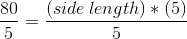
The answer is  .
.
To find the side length of a regular pentagon with a perimeter of
The equation is
Plug in the numbers for perimeter and number of sides to get
Divide each side of the equation by the number of sides to get the answer for the side length.
The answer is
← Didn't Know|Knew It →
Find the length of the side of the following pentagon.
The perimeter of the pentagon is  .
.
Find the length of the side of the following pentagon.
The perimeter of the pentagon is
Tap to reveal answer
The formula for the perimeter of a regular pentagon is
 ,
,
where  represents the length of the side.
Plugging in our values, we get:


The formula for the perimeter of a regular pentagon is
where
Plugging in our values, we get:
← Didn't Know|Knew It →
Find the length of the side of the following pentagon.
The perimeter of the pentagon is  .
.
Find the length of the side of the following pentagon.
The perimeter of the pentagon is
Tap to reveal answer
The formula for the perimeter of a regular pentagon is
 ,
,
where represents the length of the side.
Plugging in our values, we get:


The formula for the perimeter of a regular pentagon is
where
Plugging in our values, we get:
← Didn't Know|Knew It →
Find the length of the diagonal of the following pentagon:
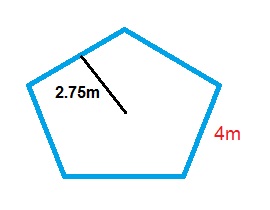
Find the length of the diagonal of the following pentagon:
Tap to reveal answer
Use the Pythagorean Theorem to find the length of the diagonal:




Use the Pythagorean Theorem to find the length of the diagonal:
← Didn't Know|Knew It →
Find the length of the diagonal of the following pentagon:
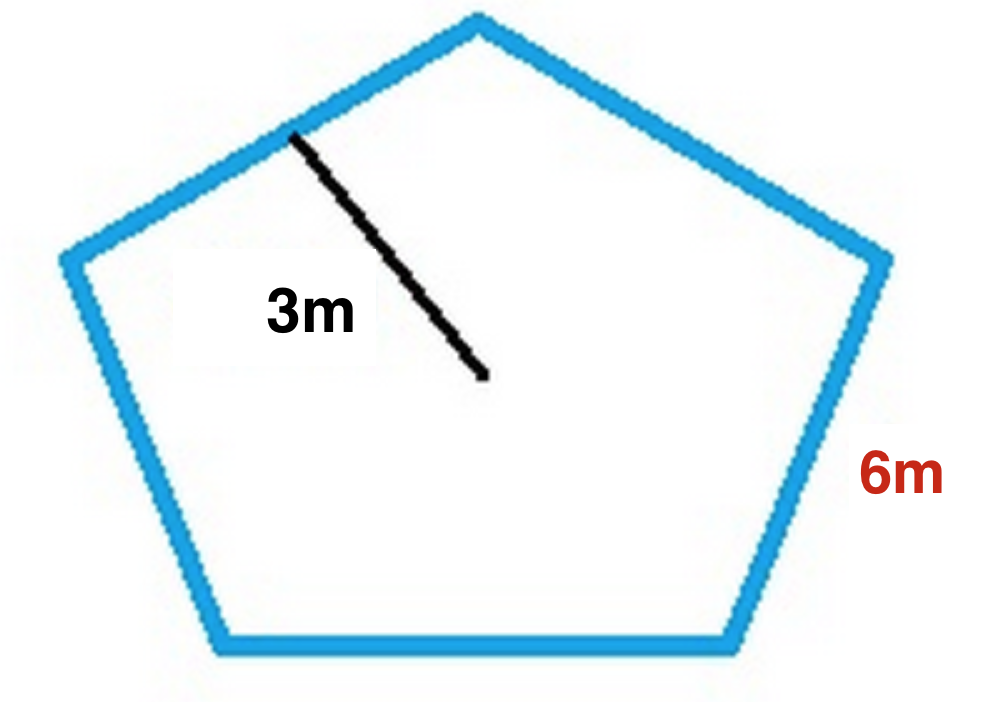
Find the length of the diagonal of the following pentagon:
Tap to reveal answer
Use the Pythagorean Theorem to find the length of the diagonal:


Use the Pythagorean Theorem to find the length of the diagonal:
← Didn't Know|Knew It →
An apothem is a line drawn from the center of a regular shape to the center of one of its edges. The line drawn is perpendicular to the edge. The apothem of a regular pentagon is  . What is the perimeter of this pentagon?
An apothem is a line drawn from the center of a regular shape to the center of one of its edges. The line drawn is perpendicular to the edge. The apothem of a regular pentagon is
Tap to reveal answer
From the given information, we can imagine the following image

In order to solve for the perimeter, we need to solve for the length of one of the sides. This can be accomplished by creating a right triangle from the apothem and the top angle that's marked.
This angle measure can be calculated through:
 , where the sum of all the angles around the center of the pentagon sum up to
  and the
  is for the number of sides. We can do this because all of the interior angles of the pentagon will be equal because it is regular. Then, this answer needs to be divided by
  because the pictured right triangle is half of a larger isosceles triangle.

Therefore, the marked angle is  .
.
Now that one side and one angle are known, we can use SOH CAH TOA because this is a right triangle. In this case, the tangent function will be used because the mystery side of interest is opposite of the known angle, and we are already given the adjacent side (the apothem). In solving for the unknown side, we will label it as  .
.


For a more precise answer, keep the entire number in your calculator. This will prevent rounding errors.
Keep in mind that the base of the triangle is actually only half the length of the side. This means that the value for  must be multiplied by
  .
.

In order to solve for the perimeter, the length of the side needs to be multiplied by the number of sides; in this case, there are five sides.

This is the final answer, so the entire decimal is no longer needed. Rounded, the perimeter is  .
.
From the given information, we can imagine the following image
In order to solve for the perimeter, we need to solve for the length of one of the sides. This can be accomplished by creating a right triangle from the apothem and the top angle that's marked.
This angle measure can be calculated through:
Therefore, the marked angle is
Now that one side and one angle are known, we can use SOH CAH TOA because this is a right triangle. In this case, the tangent function will be used because the mystery side of interest is opposite of the known angle, and we are already given the adjacent side (the apothem). In solving for the unknown side, we will label it as
For a more precise answer, keep the entire number in your calculator. This will prevent rounding errors.
Keep in mind that the base of the triangle is actually only half the length of the side. This means that the value for
In order to solve for the perimeter, the length of the side needs to be multiplied by the number of sides; in this case, there are five sides.
This is the final answer, so the entire decimal is no longer needed. Rounded, the perimeter is
← Didn't Know|Knew It →
If a side length of a pentagon is  , what is the perimeter of the pentagon?
If a side length of a pentagon is
Tap to reveal answer
Write the formula to find the perimeter of a pentagon.

Substitute the side length  into the equation and simplify.

Write the formula to find the perimeter of a pentagon.
Substitute the side length
← Didn't Know|Knew It →