Spheres - Math
Card 1 of 524
If the volume of a sphere is  , what is the approximate length of its diameter?

If the volume of a sphere is
Tap to reveal answer
The correct answer is 6.12 ft.
Plug the value of  into the equation so that

Multiply both sides by 3 to get

Then divide both sides by  to get

Then take the 3rd root of both sides to get 3.06 ft for the radius. Finally, you have to multiply by 2 on both sides to get the diameter. Thus

The correct answer is 6.12 ft.
Plug the value of
Multiply both sides by 3 to get
Then divide both sides by
Then take the 3rd root of both sides to get 3.06 ft for the radius. Finally, you have to multiply by 2 on both sides to get the diameter. Thus
← Didn't Know|Knew It →
The volume of a sphere is  . What is its radius?
The volume of a sphere is
Tap to reveal answer
The formula for the volume of a sphere is: 
The only given information in the problem is the sphere's final volume. If the volume is  , the formula for volume can be used to calculate the sphere's radius.
In this case,  , the radius, is the only unknown variable that needs to be solved for.


The formula for the volume of a sphere is:
The only given information in the problem is the sphere's final volume. If the volume is
In this case,
← Didn't Know|Knew It →
The area of a sphere is  . What is its radius?
The area of a sphere is
Tap to reveal answer
The only information given is the area of  .
.
This problem may be approached "backwards," where the area formula for a sphere can be used to solve for the radius. This is possible because the formula for area is  , where
  (the radius) is what we're looking for. After
  is substituted in for the area, the goal is to solve for
  by getting it by itself on one side of the equals sign.


The only information given is the area of
This problem may be approached "backwards," where the area formula for a sphere can be used to solve for the radius. This is possible because the formula for area is
← Didn't Know|Knew It →
If the volume of a sphere is  , what is the sphere's exact radius?
If the volume of a sphere is
Tap to reveal answer
Write the formula for the volume of a sphere:

Plug in the given volume and solve for the radius,  .
.

Start by multiplying each side of the equation by  :
:
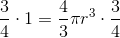

Now, divide each side of the equation by  :
:
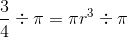

Finally, take the cubed root of each side of the equation:

Write the formula for the volume of a sphere:
Plug in the given volume and solve for the radius,
Start by multiplying each side of the equation by
Now, divide each side of the equation by
Finally, take the cubed root of each side of the equation:
← Didn't Know|Knew It →
Given the volume of a sphere is  , what is the radius?
Given the volume of a sphere is
Tap to reveal answer
The equation for the volume of a sphere is:
 , where
  is the length of the sphere's radius.
Plug in the given volume and solve for  to calculate the sphere's radius:


The equation for the volume of a sphere is:
Plug in the given volume and solve for
← Didn't Know|Knew It →
If the volume of a sphere is  , what is the radius of the sphere?
If the volume of a sphere is
Tap to reveal answer
The formula for the volume of a sphere is:
 , where
  is the sphere's radius.
Plug in the volume and solve for  , the sphere's radius:


The formula for the volume of a sphere is:
Plug in the volume and solve for
← Didn't Know|Knew It →
Find the radius of a sphere if the surface area is  .
.
Find the radius of a sphere if the surface area is
Tap to reveal answer
The formula for the surface area of a sphere is:

Substitute the given value for the sphere's surface area into the equation and solve for  to find the radius:


The formula for the surface area of a sphere is:
Substitute the given value for the sphere's surface area into the equation and solve for
← Didn't Know|Knew It →
Find the radius of a sphere if its surface area is  .
.
Find the radius of a sphere if its surface area is
Tap to reveal answer
The surface area formula for a sphere is:
 , where
  is the sphere's radius.
Substitute the given value for the sphere's area into the equation and solve for  to find the radius:


The surface area formula for a sphere is:
Substitute the given value for the sphere's area into the equation and solve for
← Didn't Know|Knew It →
In terms of  , give the surface area, in square inches, of a spherical water tank with a diameter of 20 feet.
In terms of
Tap to reveal answer
 feet =
  inches, the diameter of the tank; half of this, or 120 inches, is the radius. Set
  , substitute in the surface area formula, and solve for
  :
:




← Didn't Know|Knew It →
Which is the greater quantity?
(a) The surface area of a sphere with radius 1
(b) 12
Which is the greater quantity?
(a) The surface area of a sphere with radius 1
(b) 12
Tap to reveal answer
The surface area of a sphere can be found using the formula
 .
.
The surface area of the given sphere can be found by substituting  :
:

 so
so  , or
, or 
This makes (a) greater.
The surface area of a sphere can be found using the formula
The surface area of the given sphere can be found by substituting
This makes (a) greater.
← Didn't Know|Knew It →
Sphere A has volume  . Sphere B has surface area
  . Which is the greater quantity?
(a) The radius of Sphere A
(b) The radius of Sphere B
Sphere A has volume
(a) The radius of Sphere A
(b) The radius of Sphere B
Tap to reveal answer
(a) Substitute  in the formula for the volume of a sphere:



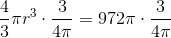

 inches
(b) Substitute  in the formula for the surface area of a sphere:




 inches
(b) is greater.
(a) Substitute
(b) Substitute
(b) is greater.
← Didn't Know|Knew It →
 is a positive number. Which is the greater quantity?
(A) The surface area of a sphere with radius 
(B) The surface area of a cube with edges of length 
(A) The surface area of a sphere with radius
(B) The surface area of a cube with edges of length
Tap to reveal answer
The surface area of a sphere is  times the square of its radius, which here is
  ; the surface area of the sphere in (A) is
  .
.
The area of one face of a cube is the square of the length of an edge, which here is  , so the area of one face of the cube in (B) is
  . The cube has six faces so the total surface area is
  .
.
 , so
, so  , giving the sphere less surface area. (B) is greater.
The surface area of a sphere is
The area of one face of a cube is the square of the length of an edge, which here is
← Didn't Know|Knew It →
In terms of , give the surface area, in square inches, of a spherical water tank with a diameter of 20 feet.
In terms of
Tap to reveal answer
feet = inches, the diameter of the tank; half of this, or 120 inches, is the radius. Set , substitute in the surface area formula, and solve for :
← Didn't Know|Knew It →
Which is the greater quantity?
(a) The surface area of a sphere with radius 1
(b) 12
Which is the greater quantity?
(a) The surface area of a sphere with radius 1
(b) 12
Tap to reveal answer
The surface area of a sphere can be found using the formula
.
The surface area of the given sphere can be found by substituting :
so , or
This makes (a) greater.
The surface area of a sphere can be found using the formula
The surface area of the given sphere can be found by substituting
This makes (a) greater.
← Didn't Know|Knew It →
Sphere A has volume . Sphere B has surface area . Which is the greater quantity?
(a) The radius of Sphere A
(b) The radius of Sphere B
Sphere A has volume
(a) The radius of Sphere A
(b) The radius of Sphere B
Tap to reveal answer
(a) Substitute in the formula for the volume of a sphere:
inches
(b) Substitute in the formula for the surface area of a sphere:
inches
(b) is greater.
(a) Substitute
(b) Substitute
(b) is greater.
← Didn't Know|Knew It →
is a positive number. Which is the greater quantity?
(A) The surface area of a sphere with radius
(B) The surface area of a cube with edges of length
(A) The surface area of a sphere with radius
(B) The surface area of a cube with edges of length
Tap to reveal answer
The surface area of a sphere is times the square of its radius, which here is ; the surface area of the sphere in (A) is .
The area of one face of a cube is the square of the length of an edge, which here is , so the area of one face of the cube in (B) is . The cube has six faces so the total surface area is .
, so , giving the sphere less surface area. (B) is greater.
The surface area of a sphere is
The area of one face of a cube is the square of the length of an edge, which here is
← Didn't Know|Knew It →
In terms of  , give the volume, in cubic feet, of a spherical tank with diameter 36 inches.
In terms of
Tap to reveal answer
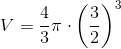
36 inches =  feet, the diameter of the tank. Half of this, or
  feet, is the radius. Set
  , substitute in the volume formula, and solve for
  :
:

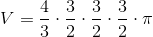
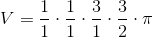

36 inches =
← Didn't Know|Knew It →
Which is the greater quantity?
(a) The volume of a sphere with radius 
(b) The volume of a cube with sidelength 
Which is the greater quantity?
(a) The volume of a sphere with radius
(b) The volume of a cube with sidelength
Tap to reveal answer
A sphere with radius  has diameter
  and can be inscribed inside a cube of sidelength
  . Therefore, the cube in (b) has the greater volume.
A sphere with radius
← Didn't Know|Knew It →
Which is the greater quantity?
(a) The volume of a cube with sidelength  inches.
(b) The volume of a sphere with radius  inches.
Which is the greater quantity?
(a) The volume of a cube with sidelength inches.
(b) The volume of a sphere with radius inches.
Tap to reveal answer
You do not need to calculate the volumes of the figures. All you need to do is observe that a sphere with radius inches has diameter inches, and can therefore be inscribed inside the cube with sidelength inches. This give the cube larger volume, making (a) the greater quantity.
You do not need to calculate the volumes of the figures. All you need to do is observe that a sphere with radius inches has diameter
inches, and can therefore be inscribed inside the cube with sidelength
inches. This give the cube larger volume, making (a) the greater quantity.
← Didn't Know|Knew It →
Which is the greater quantity?
(a) The volume of a sphere with diameter one foot
(b) 
Which is the greater quantity?
(a) The volume of a sphere with diameter one foot
(b)
Tap to reveal answer
The radius of the sphere is one half of its diameter of one foot, which is six inches, so substitute  :
:


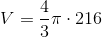
 cubic inches,
which is greater than .
The radius of the sphere is one half of its diameter of one foot, which is six inches, so substitute
which is greater than
← Didn't Know|Knew It →