Area of a Parallelogram - Pre-Algebra
Card 1 of 112
Determine the area of a parallelogram with a base and height of  .
.
Determine the area of a parallelogram with a base and height of
Tap to reveal answer
Write the formula to find the area of a parallelogram. Substitute the dimensions.

Write the formula to find the area of a parallelogram. Substitute the dimensions.
← Didn't Know|Knew It →
A parallelogram has the base length of  and the altitude of
  . Give the area of the parallelogram.
A parallelogram has the base length of
Tap to reveal answer
The area of a parallelogram is given by:

Where  is the base length and
  is the corresponding altitude. So we can write:

The area of a parallelogram is given by:
Where
← Didn't Know|Knew It →
A parallelogram has a base length of  which is 3 times longer than its corresponding altitude. The area of the parallelogram is 12 square inches. Give the
  .
.
A parallelogram has a base length of
Tap to reveal answer
Base length is  so the corresponding altitude is
  .
.
The area of a parallelogram is given by:

Where:
 is the length of any base
 is the corresponding altitude
So we can write:




Base length is
The area of a parallelogram is given by:
Where:
So we can write:
← Didn't Know|Knew It →
What is the area of the parallelogram?

What is the area of the parallelogram?
Tap to reveal answer
The area of a parallelogram is determined using the equation:

In this problem:

The area of a parallelogram is determined using the equation:
In this problem:
← Didn't Know|Knew It →
Find the area:
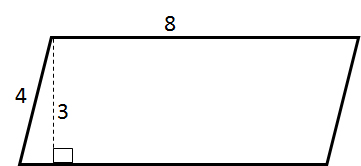
Find the area:
Tap to reveal answer
The area of a parallelogram can be determined using the following equation:

Therefore,

The area of a parallelogram can be determined using the following equation:
Therefore,
← Didn't Know|Knew It →
Find the area of a parallelogram with the base of  and a height of
  .
.
Find the area of a parallelogram with the base of
Tap to reveal answer
Write the formula for the area of a parallelogram.

Substitute the dimensions.

Remember, when multiplying fractions, multiply the numerators together and multiply the denominators together.
Write the formula for the area of a parallelogram.
Substitute the dimensions.
Remember, when multiplying fractions, multiply the numerators together and multiply the denominators together.
← Didn't Know|Knew It →
The length of the shorter diagonal of a rhombus is 40% that of the longer diagonal. The area of the rhombus is  . Give the length of the longer diagonal in terms of
  .
.
The length of the shorter diagonal of a rhombus is 40% that of the longer diagonal. The area of the rhombus is
Tap to reveal answer
Let  be the length of the longer diagonal. Then the shorter diagonal has length 40% of this. Since 40% is equal to
 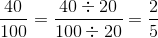 , 40% of
  is equal to
  .
.
The area of a rhombus is half the product of the lengths of its diagonals, so we can set up, and solve for  , in the equation:
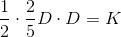

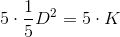


Let
The area of a rhombus is half the product of the lengths of its diagonals, so we can set up, and solve for
← Didn't Know|Knew It →
The length of the shorter diagonal of a rhombus is two-thirds that of the longer diagonal. The area of the rhombus is  square yards. Give the length of the longer diagonal, in inches, in terms of
  .
.
The length of the shorter diagonal of a rhombus is two-thirds that of the longer diagonal. The area of the rhombus is
Tap to reveal answer
Let be the length of the longer diagonal in yards. Then the shorter diagonal has length two-thirds of this, or  .
.
The area of a rhombus is half the product of the lengths of its diagonals, so we can set up the following equation and solve for :
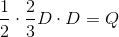

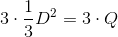


To convert yards to inches, multiply by 36:

Let
The area of a rhombus is half the product of the lengths of its diagonals, so we can set up the following equation and solve for
To convert yards to inches, multiply by 36:
← Didn't Know|Knew It →
The longer diagonal of a rhombus is 20% longer than the shorter diagonal; the rhombus has area  . Give the length of the shorter diagonal in terms of
  .
.
The longer diagonal of a rhombus is 20% longer than the shorter diagonal; the rhombus has area
Tap to reveal answer
Let  be the length of the shorter diagonal. If the longer diagonal is 20% longer, then it measures 120% of the length of the shorter diagonal; this is
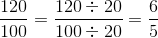
of  , or
, or  .
.
The area of a rhombus is half the product of the lengths of its diagonals, so we can set up an equation and solve for :
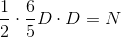

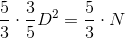


Let
of
The area of a rhombus is half the product of the lengths of its diagonals, so we can set up an equation and solve for
← Didn't Know|Knew It →

Refer to the above figure, which shows Parallelogram  . You are given that
  and
and  .
.
If you know the length of  , then, of the following segments, choose the one whose length, if known, will allow us to calculate the area of Parallelogram
  .
.
Refer to the above figure, which shows Parallelogram
If you know the length of
Tap to reveal answer
The area of a parallelogram is the product of the length of any one side, or its base, and the perpendicular distance to the opposite side, or its height. If we know  , then we also know
  , which is of the same length. We can take
  to be the base, and the segement perpendicular to it,
  , as the altitude. Therefore, is the segment whose length we need to know.
The area of a parallelogram is the product of the length of any one side, or its base, and the perpendicular distance to the opposite side, or its height. If we know
← Didn't Know|Knew It →
Note: Figure NOT drawn to scale.
Refer to the above figure, which shows Parallelogram . You are given that and .
 ,
,  .
.  .
.
Evaluate  .
.
Note: Figure NOT drawn to scale.
Refer to the above figure, which shows Parallelogram
Evaluate
Tap to reveal answer
The area of a parallelogram is the product of the length of any one side, or its base, and the length of a segment perpendicular to that side, or its height.
One way to find the area is to multiply the length of side  by its corresponding altitude,
  . Since
  and
and  ,
,
 .
.
Another way to find the area is to multiply the length of side  by its corresponding altitude,
  . Since
  and the area is 9,600, we set up this equation and solve for
  :
:


The area of a parallelogram is the product of the length of any one side, or its base, and the length of a segment perpendicular to that side, or its height.
One way to find the area is to multiply the length of side
Another way to find the area is to multiply the length of side
← Didn't Know|Knew It →
Find the area of a parallelogram with a base of length 8 and a height of length 6.
Find the area of a parallelogram with a base of length 8 and a height of length 6.
Tap to reveal answer
The area of a parallelogram is 

The area of a parallelogram is
← Didn't Know|Knew It →
What is the area of a parallelogram with a base of  and a height of
  ?
?
What is the area of a parallelogram with a base of
Tap to reveal answer
Write the formula for the area of a parallelogram.

Substitute the dimensions.

Write the formula for the area of a parallelogram.
Substitute the dimensions.
← Didn't Know|Knew It →
Find the area of a parallelogram if the base length is  and the height is
  .
.
Find the area of a parallelogram if the base length is
Tap to reveal answer
Write the formula for thearea of a parallelogram.

Substitute the dimensions.

Write the formula for thearea of a parallelogram.
Substitute the dimensions.
← Didn't Know|Knew It →
Find the area of a parallelogram with a base of 4 and a height of 40.
Find the area of a parallelogram with a base of 4 and a height of 40.
Tap to reveal answer
Write the formula to find the area of a parallelogram.

Substitute the dimensions.

Write the formula to find the area of a parallelogram.
Substitute the dimensions.
← Didn't Know|Knew It →
Find the area of a parallelogram if the base and height are  and
and  , respectively.
Find the area of a parallelogram if the base and height are
Tap to reveal answer
Write the formula for the area of a parallelogram.

Substitute the dimensions. Use the distributive property. The distibutive property means to multiply the monomial term,  , to each term within the parentheses. Remember when like bases are multiplied, their exponents are added together. Thus resulting in the following area.

Write the formula for the area of a parallelogram.
Substitute the dimensions. Use the distributive property. The distibutive property means to multiply the monomial term,
← Didn't Know|Knew It →
Find the area of a parallelogram if both the base and height have a length of 10.
Find the area of a parallelogram if both the base and height have a length of 10.
Tap to reveal answer
Write the area of the parallelogram.

Substitute the dimensions.

Write the area of the parallelogram.
Substitute the dimensions.
← Didn't Know|Knew It →
Find the area of a parallelogram in  if the base is
  and the height is
  .
.
Find the area of a parallelogram in
Tap to reveal answer
Convert the base from feet to inches. There are  in a foot. Multiply the base by
  .
.

Write the area for a parallelogram.

Substitute the new base and the height.

Convert the base from feet to inches. There are
Write the area for a parallelogram.
Substitute the new base and the height.
← Didn't Know|Knew It →
Find the area of a parallelogram with a base of  and a height of
  .
.
Find the area of a parallelogram with a base of
Tap to reveal answer
Write the formula to find the area of a parallelogram.

Substitute the dimensions. Use the distributive property.

Write the formula to find the area of a parallelogram.
Substitute the dimensions. Use the distributive property.
← Didn't Know|Knew It →
Find the area of a parallelogram if the base is 3 inches and the height is 8 inches.
Find the area of a parallelogram if the base is 3 inches and the height is 8 inches.
Tap to reveal answer
Write the formula for the area of a parallelogram.

Substitute the dimensions.

Write the formula for the area of a parallelogram.
Substitute the dimensions.
← Didn't Know|Knew It →