Irrational Numbers - Pre-Algebra
Card 1 of 80
Which of the following is an irrational number?
Which of the following is an irrational number?
Tap to reveal answer
A rational number can be expressed as a fraction of integers, while an irrational number cannot.
 can be written as
  .
.
 is simply
  , which is a rational number.
The number  can be rewritten as a fraction of whole numbers,
  , which makes it a rational number.
 is also a rational number because it is a ratio of whole numbers.
The number,  , on the other hand, is irrational, since it has an irregular sequence of numbers (
 ...) that cannot be written as a fraction.
A rational number can be expressed as a fraction of integers, while an irrational number cannot.
The number
The number,
← Didn't Know|Knew It →
Of the following, which is a rational number?
Of the following, which is a rational number?
Tap to reveal answer
A rational number is any number that can be expressed as a fraction/ratio, with both the numerator and denominator being integers. The one limitation to this definition is that the denominator cannot be equal to  .
.
Using the above definition, we see  ,
,  and
and  (which is
  ) cannot be expressed as fractions. These are non-terminating numbers that are not repeating, meaning the decimal has no pattern and constantly changes. When a decimal is non-terminating and constantly changes, it cannot be expressed as a fraction.
 is the correct answer because
  , which can be expressed as
  , fullfilling our above defintion of a rational number.
A rational number is any number that can be expressed as a fraction/ratio, with both the numerator and denominator being integers. The one limitation to this definition is that the denominator cannot be equal to
Using the above definition, we see
← Didn't Know|Knew It →
Which of the following is an irrational number?
Which of the following is an irrational number?
Tap to reveal answer
An irrational number is any number that cannot be written as a fraction of whole numbers. The number pi and square roots of non-perfect squares are examples of irrational numbers.
 can be written as the fraction
  . The term
 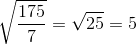 is a whole number. The square root of
  is
is  , also a rational number.
  , however, is not a perfect square, and its square root, therefore, is irrational.
An irrational number is any number that cannot be written as a fraction of whole numbers. The number pi and square roots of non-perfect squares are examples of irrational numbers.
← Didn't Know|Knew It →
Which of the following is an irrational number?
Which of the following is an irrational number?
Tap to reveal answer
A rational number is any number that can be expressed as a fraction where both the numerator and denominator are integers. The denominator also cannot be equal to 0. In this set, the irrational number is  because the There is no fraction that can be made, it's decimal goes on and on and does not repeat in a pattern. Using the fraction test, we can prove that the following numbers are rational:


A rational number is any number that can be expressed as a fraction where both the numerator and denominator are integers. The denominator also cannot be equal to 0. In this set, the irrational number is
← Didn't Know|Knew It →
Which of the following is an irrational number?
Which of the following is an irrational number?
Tap to reveal answer
An irrational number is any number that can not be expressed as a ratio of integers, i.e. a fraction. Therefore, the only irrational number listed is  .
.
An irrational number is any number that can not be expressed as a ratio of integers, i.e. a fraction. Therefore, the only irrational number listed is
← Didn't Know|Knew It →
Which of the following represents an irrational number?
Which of the following represents an irrational number?
Tap to reveal answer
Pi is the only irrational number listed. Irrational numbers are in the form of infinite non-repeating decimals.
Pi is the only irrational number listed. Irrational numbers are in the form of infinite non-repeating decimals.
← Didn't Know|Knew It →
Which of the following is not an irrational number?
Which of the following is not an irrational number?
Tap to reveal answer
A root of an integer is one of two things, an integer or an irrational number. By testing all five on a calculator, only  comes up an exact integer - 5. This is the correct choice.
A root of an integer is one of two things, an integer or an irrational number. By testing all five on a calculator, only
← Didn't Know|Knew It →
Of the following, which is an irrational number?
Of the following, which is an irrational number?
Tap to reveal answer
The definition of an irrational number is a number which cannot be expressed in a simple fraction, or a number that is not rational.
Using the above definition, we see that  is already expressed as a simple fraction.

 any number
  and
and
 . All of these options can be expressed as simple fractions, making them all rational numbers, and the incorrect answers.
 cannot be expressed as a simple fraction and is equal to a non-terminating, non-repeating (ever-changing) decimal, begining with
This is an irrational number and our correct answer.
The definition of an irrational number is a number which cannot be expressed in a simple fraction, or a number that is not rational.
Using the above definition, we see that
This is an irrational number and our correct answer.
← Didn't Know|Knew It →
Which of the following expressions is irrational?
Which of the following expressions is irrational?
Tap to reveal answer
An irrational number is defined as any number that cannot be expressed as a simple fraction or does not have terminating or repeating decimals. Of the answer choices given, the only number that cannot be expressed as a simple fraction or with repeating or terminating decimals is  .
.
An irrational number is defined as any number that cannot be expressed as a simple fraction or does not have terminating or repeating decimals. Of the answer choices given, the only number that cannot be expressed as a simple fraction or with repeating or terminating decimals is
← Didn't Know|Knew It →
Which of the following is closest to the value of the expression  ?
?
Which of the following is closest to the value of the expression
Tap to reveal answer



Since  ,
,
 .
.
We can determine which is closer by evaluating  .
.
Since  , 9 is the closer integer, and it is the correct choice.
Since
We can determine which is closer by evaluating
Since
← Didn't Know|Knew It →
Which of the following numbers is an irrational number?
 ,
, 
Which of the following numbers is an irrational number?
Tap to reveal answer
An irrational number is one that cannot be written as a fraction. All integers are rational numberes.
Repeating decimals are never irrational,  can be eliminated because
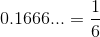 .
.
 and
and  are perfect squares making them both integers.

Therefore, the only remaining answer is  .
.
An irrational number is one that cannot be written as a fraction. All integers are rational numberes.
Repeating decimals are never irrational,
Therefore, the only remaining answer is
← Didn't Know|Knew It →
What do you get when you multiply two irrational numbers?
What do you get when you multiply two irrational numbers?
Tap to reveal answer
Let's take two irrationals like  and multiply them. The answer is
  which is rational.

But what if we took the product of  and
and  . We would get
  which doesn't have a definite value and can't be expressed as a fraction.
This makes it irrational and therefore, the answer is sometimes irrational, sometimes rational.
Let's take two irrationals like
But what if we took the product of
This makes it irrational and therefore, the answer is sometimes irrational, sometimes rational.
← Didn't Know|Knew It →
Which of the following is NOT an irrational number?
Which of the following is NOT an irrational number?
Tap to reveal answer
Rational numbers are those which can be written as a ratio of two integers, or simply, as a fraction.
The solution of  is
is  , which can be written as
  . Each of the other answers would have a solution with an infinite number of decimal points, and therefore cannot be written as a simple ratio. They are irrational numbers.
Rational numbers are those which can be written as a ratio of two integers, or simply, as a fraction.
The solution of
← Didn't Know|Knew It →
Which of the following numbers is considered to be an irrational number?
Which of the following numbers is considered to be an irrational number?
Tap to reveal answer
An irrational number cannot be represented as the quotient of two integers.
Irrational numbers do not terminate and are not repeat numbers.
Looking at the possible answers,
 can be reduced to
  , therefore it is an integer.
 by definition is a quotient of two integers and thus it is not an irrational number.
 can be rewritten as
  and by definition is a quotient of two integers and thus it is not an irrational number.
 is a terminated decimal and therefore can be written as a fraction. Thus it is not an irrational number.
 is the number for
  and does not terminate, therefore it is irrational.
An irrational number cannot be represented as the quotient of two integers.
Irrational numbers do not terminate and are not repeat numbers.
Looking at the possible answers,
← Didn't Know|Knew It →
Which of the following choices is irrational?
Which of the following choices is irrational?
Tap to reveal answer
The meaning of irrational states that numbers cannot be rewritten as a ratio of integers. Of the following that could be simplified, the only possible choice of irrational numbers is  .
.
The answer is  .
.
All other options are rational because they can be written as either a fraction of integers or just an integer.


The meaning of irrational states that numbers cannot be rewritten as a ratio of integers. Of the following that could be simplified, the only possible choice of irrational numbers is
The answer is
All other options are rational because they can be written as either a fraction of integers or just an integer.
← Didn't Know|Knew It →
Add the following: 
Add the following:
Tap to reveal answer
To add the numerator, first multiply the denominator to find the least common denominator.
The common denominator is: 
Rewrite the fractions.

To add the numerator, first multiply the denominator to find the least common denominator.
The common denominator is:
Rewrite the fractions.
← Didn't Know|Knew It →
Which of the following is an irrational number?
Which of the following is an irrational number?
Tap to reveal answer
A rational number can be put in the form  , it can be a terminating decimal, or it can be a repeating decimal.
  is a continual number, therefore it is an irrational number.
A rational number can be put in the form
← Didn't Know|Knew It →
Which of the following is an irrational number?
Which of the following is an irrational number?
Tap to reveal answer
An irrational number is any number that cannot be expressed as a ratio of integers.
Therefore,  is considered irrational because it cannot be expressed as a ratio of integers.
An irrational number is any number that cannot be expressed as a ratio of integers.
Therefore,
← Didn't Know|Knew It →
Which of the following is an irrational number?
Which of the following is an irrational number?
Tap to reveal answer
An irrational number is a number that cannot be expressed as a ratio of integers and cannot be expressed as terminating or repeating decimals.
Therefore, the only answer that follows this definition is  .
.
An irrational number is a number that cannot be expressed as a ratio of integers and cannot be expressed as terminating or repeating decimals.
Therefore, the only answer that follows this definition is
← Didn't Know|Knew It →
Which of these expressions is not irrational?
Which of these expressions is not irrational?
Tap to reveal answer
The square root of an integer is either an irrational number or an integer. The latter is the case if and only if there is an integer which, when multiplied by itself, or squared, yields the number inside the symbol (the radicand) as the product. Of  , only 81 is the square of an integer (9).
The square root of an integer is either an irrational number or an integer. The latter is the case if and only if there is an integer which, when multiplied by itself, or squared, yields the number inside the symbol (the radicand) as the product. Of
← Didn't Know|Knew It →