Amplitude, Period, Phase Shift of a Trig Function - Pre-Calculus
Card 0 of 40
What is the amplitude of the following function?

What is the amplitude of the following function?

Tap to see back →
When you think of a trigonometric function of the form y=Asin(Bx+C)+D, the amplitude is represented by A, or the coefficient in front of the sine function. While this number is -24, we always represent amplitude as a positive number, by taking the absolute value of it. Therefore, the amplitude of this function is 24.
When you think of a trigonometric function of the form y=Asin(Bx+C)+D, the amplitude is represented by A, or the coefficient in front of the sine function. While this number is -24, we always represent amplitude as a positive number, by taking the absolute value of it. Therefore, the amplitude of this function is 24.
Select the answer choice that correctly matches each function to its period.
Select the answer choice that correctly matches each function to its period.
Tap to see back →
The following matches the correct period with its corresponding trig function:


In other words, sin x, cos x, sec x, and csc x all repeat themselves every  units. However, tan x and cot x repeat themselves more frequently, every
  units.
The following matches the correct period with its corresponding trig function:


In other words, sin x, cos x, sec x, and csc x all repeat themselves every 

What is the period of this sine graph?

What is the period of this sine graph?
Tap to see back →
The graph has 3 waves between 0 and  , meaning that the length of each of the waves is
  divided by 3, or
  .
.
The graph has 3 waves between 0 and
Write the equation for a cosine graph with a maximum at  and a minimum at
  .
.
Write the equation for a cosine graph with a maximum at
Tap to see back →
In order to write this equation, it is helpful to sketch a graph:
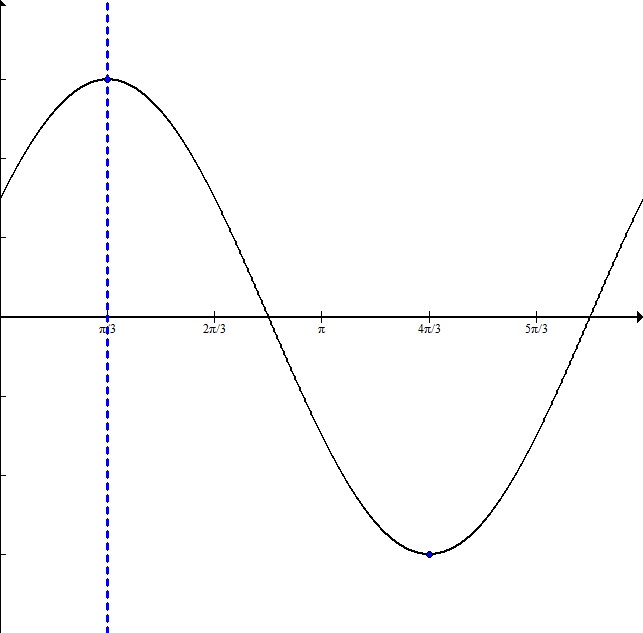
The dotted line is at  , where the maximum occurs and therefore where the graph starts. This means that the graph is shifted to the right
  .
.
The distance from the maximum to the minimum is half the entire wavelength. Here it is 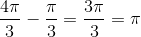 .
.
Since half the wavelength is  , that means the full wavelength is
  so the frequency is just 1.
The amplitude is 3 because the graph goes symmetrically from -3 to 3.
The equation will be in the form  where A is the amplitude, f is the frequency, h is the horizontal shift, and k is the vertical shift.
This equation is
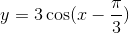 .
.
In order to write this equation, it is helpful to sketch a graph:
The dotted line is at
The distance from the maximum to the minimum is half the entire wavelength. Here it is
Since half the wavelength is
The amplitude is 3 because the graph goes symmetrically from -3 to 3.
The equation will be in the form
This equation is
Find the phase shift of  .
.
Find the phase shift of
Tap to see back →
In the formula,
 .
.
 represents the phase shift.
Plugging in what we know gives us:
 .
.
Simplified, the phase is then  .
.
In the formula,
Plugging in what we know gives us:
Simplified, the phase is then
Which equation would produce this sine graph?
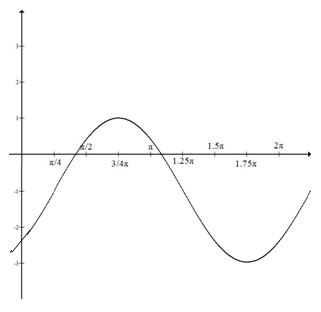
Which equation would produce this sine graph?
Tap to see back →
The graph has an amplitude of 2 but has been shifted down 1:
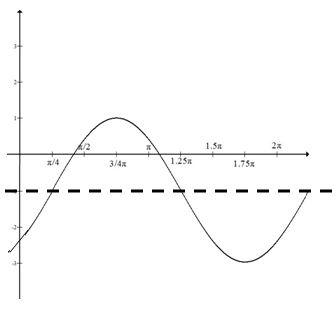
In terms of the equation, this puts a 2 in front of sin, and -1 at the end.
This makes it easier to see that the graph starts \[is at 0\] where  .
.
The phase shift is  to the right, or
  .
.
The graph has an amplitude of 2 but has been shifted down 1:
In terms of the equation, this puts a 2 in front of sin, and -1 at the end.
This makes it easier to see that the graph starts \[is at 0\] where
The phase shift is
Which of the following equations could represent a cosine function with amplitude 3, period  , and a phase shift of
  ?
?
Which of the following equations could represent a cosine function with amplitude 3, period 

Tap to see back →
The form of the equation will be 
First, think about all possible values of A that could give you an amplitude of 3. Either A = -3 or A = 3 could each produce amplitude = 3. Be sure to look for answer choices that satisfy either of these.
Secondly, we know that the period is  . Normally we know what B is and need to find the period, but this is the other way around. We can still use the same equation and solve:
 . You can cross multiply to solve and get B = 4.
Finally, we need to find a value of C that satisfies
 . Cross multiply to get:
 .
.
Next, plug in B= 4 to solve for C:


Putting this all together, the equation could either be:
 or
or 
The form of the equation will be

First, think about all possible values of A that could give you an amplitude of 3. Either A = -3 or A = 3 could each produce amplitude = 3. Be sure to look for answer choices that satisfy either of these.
Secondly, we know that the period is 

Finally, we need to find a value of C that satisfies


Next, plug in B= 4 to solve for C:


Putting this all together, the equation could either be:


State the amplitude, period, phase shift, and vertical shift of the function 
State the amplitude, period, phase shift, and vertical shift of the function

Tap to see back →
A common way to make sense of all of the transformations that can happen to a trigonometric function is the following. For the equations y = A sin(Bx + C) + D,
- amplitude is |A|
- period is 2
 /|B|
/|B|
- phase shift is - C/B
- vertical shift is D
In our equation, A=-7, B=6, C= , and D=-4. Next, apply the above numbers to find amplitude, period, phase shift, and vertical shift.
To find amplitude, look at the coefficient in front of the sine function. A=-7, so our amplitude is equal to 7.
The period is 2 /B, and in this case B=6. Therefore the period of this function is equal to 2
 /6 or
/6 or  /3.
/3.
To find the phase shift, take -C/B, or - /6. Another way to find this same value is to set the inside of the parenthesis equal to 0, then solve for x.
6x+ =0
=0
6x=-
x=- /6
/6
Either way, our phase shift is equal to - /6.
/6.
The vertical shift is equal to D, which is -4.
y=-7\sin(6x+\pi)-4
A common way to make sense of all of the transformations that can happen to a trigonometric function is the following. For the equations y = A sin(Bx + C) + D,
- amplitude is |A|
- period is 2
- phase shift is - C/B
- vertical shift is D
 /|B|
/|B|In our equation, A=-7, B=6, C=
To find amplitude, look at the coefficient in front of the sine function. A=-7, so our amplitude is equal to 7.
The period is 2


To find the phase shift, take -C/B, or -
6x+
6x=-
x=-
Either way, our phase shift is equal to -

The vertical shift is equal to D, which is -4.
y=-7\sin(6x+\pi)-4
State the amplitude, period, phase shift, and vertical shift of the function 
State the amplitude, period, phase shift, and vertical shift of the function

Tap to see back →
A common way to make sense of all of the transformations that can happen to a trigonometric function is the following. For the equations y = A sin(Bx + C) + D,
- amplitude is |A|
- period is 2/|B|
- phase shift is - C/B
- vertical shift is D
In our equation, A=-1, B=1, C=- , and D=3. Next, apply the above numbers to find amplitude, period, phase shift, and vertical shift.
To find amplitude, look at the coefficient in front of the sine function. A=-1, so our amplitude is equal to 1.
The period is 2/B, and in this case B=1. Therefore the period of this function is equal to 2 .
.
To find the phase shift, take -C/B, or  . Another way to find this same value is to set the inside of the parenthesis equal to 0, then solve for x.
x- =0
=0
x=
Either way, our phase shift is equal to  .
.
The vertical shift is equal to D, which is 3.
A common way to make sense of all of the transformations that can happen to a trigonometric function is the following. For the equations y = A sin(Bx + C) + D,
- amplitude is |A|
- period is 2
- phase shift is - C/B
- vertical shift is D
In our equation, A=-1, B=1, C=-
To find amplitude, look at the coefficient in front of the sine function. A=-1, so our amplitude is equal to 1.
The period is 2
To find the phase shift, take -C/B, or 
x-
x=
Either way, our phase shift is equal to 

The vertical shift is equal to D, which is 3.
State the amplitude, period, phase shift, and vertical shift of the function 
State the amplitude, period, phase shift, and vertical shift of the function

Tap to see back →
A common way to make sense of all of the transformations that can happen to a trigonometric function is the following. For the equations y = A sin(Bx + C) + D,
- amplitude is |A|
- period is 2/|B|
- phase shift is - C/B
- vertical shift is D
In our equation, A=1, B=2, C=-3, and D=2. Next, apply the above numbers to find amplitude, period, phase shift, and vertical shift.
To find amplitude, look at the coefficient in front of the sine function. A=1, so our amplitude is equal to 1.
The period is 2/B, and in this case B=2. Therefore the period of this function is equal to .
To find the phase shift, take -C/B, or 3/2. Another way to find this same value is to set the inside of the parenthesis equal to 0, then solve for x.
2x-3=0
2x=3
x=3/2
Either way, our phase shift is equal to 3/2.
The vertical shift is equal to D, which is 2.
A common way to make sense of all of the transformations that can happen to a trigonometric function is the following. For the equations y = A sin(Bx + C) + D,
- amplitude is |A|
- period is 2
- phase shift is - C/B
- vertical shift is D
In our equation, A=1, B=2, C=-3, and D=2. Next, apply the above numbers to find amplitude, period, phase shift, and vertical shift.
To find amplitude, look at the coefficient in front of the sine function. A=1, so our amplitude is equal to 1.
The period is 2
To find the phase shift, take -C/B, or 3/2. Another way to find this same value is to set the inside of the parenthesis equal to 0, then solve for x.
2x-3=0
2x=3
x=3/2
Either way, our phase shift is equal to 3/2.
The vertical shift is equal to D, which is 2.
What is the amplitude of the following function?
What is the amplitude of the following function?
Tap to see back →
When you think of a trigonometric function of the form y=Asin(Bx+C)+D, the amplitude is represented by A, or the coefficient in front of the sine function. While this number is -24, we always represent amplitude as a positive number, by taking the absolute value of it. Therefore, the amplitude of this function is 24.
When you think of a trigonometric function of the form y=Asin(Bx+C)+D, the amplitude is represented by A, or the coefficient in front of the sine function. While this number is -24, we always represent amplitude as a positive number, by taking the absolute value of it. Therefore, the amplitude of this function is 24.
Select the answer choice that correctly matches each function to its period.
Select the answer choice that correctly matches each function to its period.
Tap to see back →
The following matches the correct period with its corresponding trig function:
In other words, sin x, cos x, sec x, and csc x all repeat themselves every units. However, tan x and cot x repeat themselves more frequently, every units.
The following matches the correct period with its corresponding trig function:
In other words, sin x, cos x, sec x, and csc x all repeat themselves every
What is the period of this sine graph?
What is the period of this sine graph?
Tap to see back →
The graph has 3 waves between 0 and , meaning that the length of each of the waves is divided by 3, or .
The graph has 3 waves between 0 and
Write the equation for a cosine graph with a maximum at and a minimum at .
Write the equation for a cosine graph with a maximum at
Tap to see back →
In order to write this equation, it is helpful to sketch a graph:
The dotted line is at , where the maximum occurs and therefore where the graph starts. This means that the graph is shifted to the right .
The distance from the maximum to the minimum is half the entire wavelength. Here it is .
Since half the wavelength is , that means the full wavelength is so the frequency is just 1.
The amplitude is 3 because the graph goes symmetrically from -3 to 3.
The equation will be in the form where A is the amplitude, f is the frequency, h is the horizontal shift, and k is the vertical shift.
This equation is
.
In order to write this equation, it is helpful to sketch a graph:
The dotted line is at
The distance from the maximum to the minimum is half the entire wavelength. Here it is
Since half the wavelength is
The amplitude is 3 because the graph goes symmetrically from -3 to 3.
The equation will be in the form
This equation is
Find the phase shift of .
Find the phase shift of
Tap to see back →
In the formula,
.
represents the phase shift.
Plugging in what we know gives us:
.
Simplified, the phase is then .
In the formula,
Plugging in what we know gives us:
Simplified, the phase is then
Which equation would produce this sine graph?
Which equation would produce this sine graph?
Tap to see back →
The graph has an amplitude of 2 but has been shifted down 1:
In terms of the equation, this puts a 2 in front of sin, and -1 at the end.
This makes it easier to see that the graph starts \[is at 0\] where .
The phase shift is to the right, or .
The graph has an amplitude of 2 but has been shifted down 1:
In terms of the equation, this puts a 2 in front of sin, and -1 at the end.
This makes it easier to see that the graph starts \[is at 0\] where
The phase shift is
Which of the following equations could represent a cosine function with amplitude 3, period , and a phase shift of ?
Which of the following equations could represent a cosine function with amplitude 3, period
Tap to see back →
The form of the equation will be
First, think about all possible values of A that could give you an amplitude of 3. Either A = -3 or A = 3 could each produce amplitude = 3. Be sure to look for answer choices that satisfy either of these.
Secondly, we know that the period is . Normally we know what B is and need to find the period, but this is the other way around. We can still use the same equation and solve:
. You can cross multiply to solve and get B = 4.
Finally, we need to find a value of C that satisfies
. Cross multiply to get:
.
Next, plug in B= 4 to solve for C:
Putting this all together, the equation could either be:
or
The form of the equation will be
First, think about all possible values of A that could give you an amplitude of 3. Either A = -3 or A = 3 could each produce amplitude = 3. Be sure to look for answer choices that satisfy either of these.
Secondly, we know that the period is
Finally, we need to find a value of C that satisfies
Next, plug in B= 4 to solve for C:
Putting this all together, the equation could either be:
State the amplitude, period, phase shift, and vertical shift of the function
State the amplitude, period, phase shift, and vertical shift of the function
Tap to see back →
A common way to make sense of all of the transformations that can happen to a trigonometric function is the following. For the equations y = A sin(Bx + C) + D,
- amplitude is |A|
- period is 2/|B|
- phase shift is - C/B
- vertical shift is D
In our equation, A=-7, B=6, C=, and D=-4. Next, apply the above numbers to find amplitude, period, phase shift, and vertical shift.
To find amplitude, look at the coefficient in front of the sine function. A=-7, so our amplitude is equal to 7.
The period is 2/B, and in this case B=6. Therefore the period of this function is equal to 2/6 or /3.
To find the phase shift, take -C/B, or -/6. Another way to find this same value is to set the inside of the parenthesis equal to 0, then solve for x.
6x+=0
6x=-
x=-/6
Either way, our phase shift is equal to -/6.
The vertical shift is equal to D, which is -4.
y=-7\sin(6x+\pi)-4
A common way to make sense of all of the transformations that can happen to a trigonometric function is the following. For the equations y = A sin(Bx + C) + D,
- amplitude is |A|
- period is 2
- phase shift is - C/B
- vertical shift is D
In our equation, A=-7, B=6, C=
To find amplitude, look at the coefficient in front of the sine function. A=-7, so our amplitude is equal to 7.
The period is 2
To find the phase shift, take -C/B, or -
6x+
6x=-
x=-
Either way, our phase shift is equal to -
The vertical shift is equal to D, which is -4.
y=-7\sin(6x+\pi)-4
State the amplitude, period, phase shift, and vertical shift of the function
State the amplitude, period, phase shift, and vertical shift of the function
Tap to see back →
A common way to make sense of all of the transformations that can happen to a trigonometric function is the following. For the equations y = A sin(Bx + C) + D,
- amplitude is |A|
- period is 2/|B|
- phase shift is - C/B
- vertical shift is D
In our equation, A=-1, B=1, C=-, and D=3. Next, apply the above numbers to find amplitude, period, phase shift, and vertical shift.
To find amplitude, look at the coefficient in front of the sine function. A=-1, so our amplitude is equal to 1.
The period is 2/B, and in this case B=1. Therefore the period of this function is equal to 2.
To find the phase shift, take -C/B, or . Another way to find this same value is to set the inside of the parenthesis equal to 0, then solve for x.
x-=0
x=
Either way, our phase shift is equal to .
The vertical shift is equal to D, which is 3.
A common way to make sense of all of the transformations that can happen to a trigonometric function is the following. For the equations y = A sin(Bx + C) + D,
- amplitude is |A|
- period is 2
- phase shift is - C/B
- vertical shift is D
In our equation, A=-1, B=1, C=-
To find amplitude, look at the coefficient in front of the sine function. A=-1, so our amplitude is equal to 1.
The period is 2
To find the phase shift, take -C/B, or
x-
x=
Either way, our phase shift is equal to
The vertical shift is equal to D, which is 3.
State the amplitude, period, phase shift, and vertical shift of the function
State the amplitude, period, phase shift, and vertical shift of the function
Tap to see back →
A common way to make sense of all of the transformations that can happen to a trigonometric function is the following. For the equations y = A sin(Bx + C) + D,
- amplitude is |A|
- period is 2/|B|
- phase shift is - C/B
- vertical shift is D
In our equation, A=1, B=2, C=-3, and D=2. Next, apply the above numbers to find amplitude, period, phase shift, and vertical shift.
To find amplitude, look at the coefficient in front of the sine function. A=1, so our amplitude is equal to 1.
The period is 2/B, and in this case B=2. Therefore the period of this function is equal to .
To find the phase shift, take -C/B, or 3/2. Another way to find this same value is to set the inside of the parenthesis equal to 0, then solve for x.
2x-3=0
2x=3
x=3/2
Either way, our phase shift is equal to 3/2.
The vertical shift is equal to D, which is 2.
A common way to make sense of all of the transformations that can happen to a trigonometric function is the following. For the equations y = A sin(Bx + C) + D,
- amplitude is |A|
- period is 2
- phase shift is - C/B
- vertical shift is D
In our equation, A=1, B=2, C=-3, and D=2. Next, apply the above numbers to find amplitude, period, phase shift, and vertical shift.
To find amplitude, look at the coefficient in front of the sine function. A=1, so our amplitude is equal to 1.
The period is 2
To find the phase shift, take -C/B, or 3/2. Another way to find this same value is to set the inside of the parenthesis equal to 0, then solve for x.
2x-3=0
2x=3
x=3/2
Either way, our phase shift is equal to 3/2.
The vertical shift is equal to D, which is 2.