Determine if a Function is Continuous Using Limits - Pre-Calculus
Card 0 of 20
What are the discontinuities in the following function and what are their types?
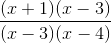
What are the discontinuities in the following function and what are their types?
Tap to see back →
Since the factor  is in the numerator and the denominator, there is a removable discontinuity at
  . The function is not defined at
  , but function would move towards the same point for the resultant function
  .
.
Since the factor cannot be factored out, there is an infinite discontinuity at
  . The denominator will get very small and the numerator will move toward a fixed value.
There is no discontinuity at all at  . The function simply evaluates to zero at this point.
Since the factor
Since the factor
There is no discontinuity at all at
Find the domain where the following function is continuous:
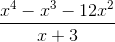
Find the domain where the following function is continuous:
Tap to see back →
The function in the numerator factors to:

so if we cancel the x+3 in the numerator and denominator we have the same function but it is continuous. The  gives us a hole at x=-3 so our function is not continuous at x=-3.
The function in the numerator factors to:
so if we cancel the x+3 in the numerator and denominator we have the same function but it is continuous. The
Determine if the function  is continuous at
  using limits.
Determine if the function
Tap to see back →
In order to determine if a function is continuous at a point three things must happen.
-
Taking the limit from the lefthand side of the function towards a specific point exists.
-
Taking the limit from the righthand side of the function towards a specific point exists.
-
The limits from 1) and 2) are equal and equal the value of the original function at the specific point in question.
In our case,
-

-

-

Because all of these conditions are met, the function is continuous at 0.
In order to determine if a function is continuous at a point three things must happen.
-
Taking the limit from the lefthand side of the function towards a specific point exists.
-
Taking the limit from the righthand side of the function towards a specific point exists.
-
The limits from 1) and 2) are equal and equal the value of the original function at the specific point in question.
In our case,
Because all of these conditions are met, the function is continuous at 0.
Determine if  is continuous on all points of its domain.
Determine if
Tap to see back →
First, find that at any point where  ,
,  .
.
Then find that
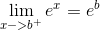 and
and 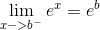 .
.
As these are all equal, it can be determined that the function is continuous on all points of its domain.
First, find that at any point where
Then find that
As these are all equal, it can be determined that the function is continuous on all points of its domain.
Let 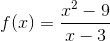 . Determine if the function is continuous using limits.
Let
Tap to see back →
As  approaches
  , the function
 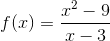 approaches
  , which is undefined. However, if we factor
  , we get:
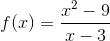
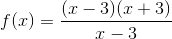
The  factors in the numerator and denominator cancel out, leaving
  .
.
Therefore, our function is continuous at all values of  from
from  .
.
As
The
Therefore, our function is continuous at all values of
What are the discontinuities in the following function and what are their types?
What are the discontinuities in the following function and what are their types?
Tap to see back →
Since the factor is in the numerator and the denominator, there is a removable discontinuity at . The function is not defined at , but function would move towards the same point for the resultant function .
Since the factor cannot be factored out, there is an infinite discontinuity at . The denominator will get very small and the numerator will move toward a fixed value.
There is no discontinuity at all at . The function simply evaluates to zero at this point.
Since the factor
Since the factor
There is no discontinuity at all at
Find the domain where the following function is continuous:
Find the domain where the following function is continuous:
Tap to see back →
The function in the numerator factors to:
so if we cancel the x+3 in the numerator and denominator we have the same function but it is continuous. The gives us a hole at x=-3 so our function is not continuous at x=-3.
The function in the numerator factors to:
so if we cancel the x+3 in the numerator and denominator we have the same function but it is continuous. The
Determine if the function is continuous at using limits.
Determine if the function
Tap to see back →
In order to determine if a function is continuous at a point three things must happen.
-
Taking the limit from the lefthand side of the function towards a specific point exists.
-
Taking the limit from the righthand side of the function towards a specific point exists.
-
The limits from 1) and 2) are equal and equal the value of the original function at the specific point in question.
In our case,
-
-
-
Because all of these conditions are met, the function is continuous at 0.
In order to determine if a function is continuous at a point three things must happen.
-
Taking the limit from the lefthand side of the function towards a specific point exists.
-
Taking the limit from the righthand side of the function towards a specific point exists.
-
The limits from 1) and 2) are equal and equal the value of the original function at the specific point in question.
In our case,
Because all of these conditions are met, the function is continuous at 0.
Determine if is continuous on all points of its domain.
Determine if
Tap to see back →
First, find that at any point where , .
Then find that
and .
As these are all equal, it can be determined that the function is continuous on all points of its domain.
First, find that at any point where
Then find that
As these are all equal, it can be determined that the function is continuous on all points of its domain.
Let . Determine if the function is continuous using limits.
Let
Tap to see back →
As approaches , the function approaches , which is undefined. However, if we factor , we get:
The factors in the numerator and denominator cancel out, leaving .
Therefore, our function is continuous at all values of from .
As
The
Therefore, our function is continuous at all values of
What are the discontinuities in the following function and what are their types?
What are the discontinuities in the following function and what are their types?
Tap to see back →
Since the factor is in the numerator and the denominator, there is a removable discontinuity at . The function is not defined at , but function would move towards the same point for the resultant function .
Since the factor cannot be factored out, there is an infinite discontinuity at . The denominator will get very small and the numerator will move toward a fixed value.
There is no discontinuity at all at . The function simply evaluates to zero at this point.
Since the factor
Since the factor
There is no discontinuity at all at
Find the domain where the following function is continuous:
Find the domain where the following function is continuous:
Tap to see back →
The function in the numerator factors to:
so if we cancel the x+3 in the numerator and denominator we have the same function but it is continuous. The gives us a hole at x=-3 so our function is not continuous at x=-3.
The function in the numerator factors to:
so if we cancel the x+3 in the numerator and denominator we have the same function but it is continuous. The
Determine if the function is continuous at using limits.
Determine if the function
Tap to see back →
In order to determine if a function is continuous at a point three things must happen.
-
Taking the limit from the lefthand side of the function towards a specific point exists.
-
Taking the limit from the righthand side of the function towards a specific point exists.
-
The limits from 1) and 2) are equal and equal the value of the original function at the specific point in question.
In our case,
-
-
-
Because all of these conditions are met, the function is continuous at 0.
In order to determine if a function is continuous at a point three things must happen.
-
Taking the limit from the lefthand side of the function towards a specific point exists.
-
Taking the limit from the righthand side of the function towards a specific point exists.
-
The limits from 1) and 2) are equal and equal the value of the original function at the specific point in question.
In our case,
Because all of these conditions are met, the function is continuous at 0.
Determine if is continuous on all points of its domain.
Determine if
Tap to see back →
First, find that at any point where , .
Then find that
and .
As these are all equal, it can be determined that the function is continuous on all points of its domain.
First, find that at any point where
Then find that
As these are all equal, it can be determined that the function is continuous on all points of its domain.
Let . Determine if the function is continuous using limits.
Let
Tap to see back →
As approaches , the function approaches , which is undefined. However, if we factor , we get:
The factors in the numerator and denominator cancel out, leaving .
Therefore, our function is continuous at all values of from .
As
The
Therefore, our function is continuous at all values of
What are the discontinuities in the following function and what are their types?
What are the discontinuities in the following function and what are their types?
Tap to see back →
Since the factor is in the numerator and the denominator, there is a removable discontinuity at . The function is not defined at , but function would move towards the same point for the resultant function .
Since the factor cannot be factored out, there is an infinite discontinuity at . The denominator will get very small and the numerator will move toward a fixed value.
There is no discontinuity at all at . The function simply evaluates to zero at this point.
Since the factor
Since the factor
There is no discontinuity at all at
Find the domain where the following function is continuous:
Find the domain where the following function is continuous:
Tap to see back →
The function in the numerator factors to:
so if we cancel the x+3 in the numerator and denominator we have the same function but it is continuous. The gives us a hole at x=-3 so our function is not continuous at x=-3.
The function in the numerator factors to:
so if we cancel the x+3 in the numerator and denominator we have the same function but it is continuous. The
Determine if the function is continuous at using limits.
Determine if the function
Tap to see back →
In order to determine if a function is continuous at a point three things must happen.
-
Taking the limit from the lefthand side of the function towards a specific point exists.
-
Taking the limit from the righthand side of the function towards a specific point exists.
-
The limits from 1) and 2) are equal and equal the value of the original function at the specific point in question.
In our case,
-
-
-
Because all of these conditions are met, the function is continuous at 0.
In order to determine if a function is continuous at a point three things must happen.
-
Taking the limit from the lefthand side of the function towards a specific point exists.
-
Taking the limit from the righthand side of the function towards a specific point exists.
-
The limits from 1) and 2) are equal and equal the value of the original function at the specific point in question.
In our case,
Because all of these conditions are met, the function is continuous at 0.
Determine if is continuous on all points of its domain.
Determine if
Tap to see back →
First, find that at any point where , .
Then find that
and .
As these are all equal, it can be determined that the function is continuous on all points of its domain.
First, find that at any point where
Then find that
As these are all equal, it can be determined that the function is continuous on all points of its domain.
Let . Determine if the function is continuous using limits.
Let
Tap to see back →
As approaches , the function approaches , which is undefined. However, if we factor , we get:
The factors in the numerator and denominator cancel out, leaving .
Therefore, our function is continuous at all values of from .
As
The
Therefore, our function is continuous at all values of