Evaluate Expressions That Include the Inverse Tangent, Cosecant, Secant, or Cotangent Function - Pre-Calculus
Card 0 of 48
Evaluate:
Evaluate:
Tap to see back →
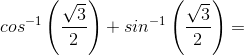
To determine the value of 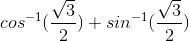 , solve each of the terms first.

The inverse cosine has a domain and range restriction.
The domain exists from  , and the range from
  . The inverse cosine asks for the angle when the x-value of the existing coordinate is
  . The only possibility is
  since the coordinate can only exist in the first quadrant.

The inverse sine also has a domain and range restriction.
The domain exists from  , and the range from
  . The inverse sine asks for the angle when the y-value of the existing coordinate is
  . The only possibility is
  since the coordinate can only exist in the first quadrant.
Therefore:

To determine the value of
The inverse cosine has a domain and range restriction.
The domain exists from
The inverse sine also has a domain and range restriction.
The domain exists from
Therefore:
Approximate: 
Approximate:
Tap to see back →
 :
:
There is a restriction for the range of the inverse tangent function from  .
.
The inverse tangent of a value asks for the angle where the coordinate  lies on the unit circle under the condition that
  . For this to be valid on the unit circle, the
  must be very close to 1, with an
  value also very close to zero, but cannot equal to zero since
  would be undefined.
The point  is located on the unit circle when
  , but
, but  is invalid due to the existent asymptote at this angle.
An example of a point very close to  that will yield can be written as:

Therefore, the approximated rounded value of  is
is  .
.
There is a restriction for the range of the inverse tangent function from
The inverse tangent of a value asks for the angle where the coordinate
The point
An example of a point very close to
Therefore, the approximated rounded value of
Determine the value of  in degrees.
Determine the value of
Tap to see back →
Rewrite and evaluate  .
.

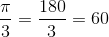
The inverse sine of one-half is  since
since  is the y-value of the coordinate when the angle is
  .
.

To convert from radians to degrees, replace  with 180.
Rewrite and evaluate
The inverse sine of one-half is
To convert from radians to degrees, replace
Evaluate the following:

Evaluate the following:
Tap to see back →
For this particular problem we need to recall that the inverse cosine cancels out the cosine therefore,
 .
.
So the expression just becomes
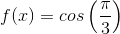
From here, recall the unit circle for specific angles such as  .
.
Thus,
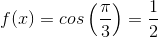 .
.
For this particular problem we need to recall that the inverse cosine cancels out the cosine therefore,
So the expression just becomes
From here, recall the unit circle for specific angles such as
Thus,
Evaluate the following expression: 
Evaluate the following expression:

Tap to see back →
This one seems complicated, but becomes considerably easier once you implement the fact that the composite  cancels out to 1 and you are left with
  which is equal to 1
This one seems complicated, but becomes considerably easier once you implement the fact that the composite 

Evaluate: 
Evaluate:

Tap to see back →

Approximate the following: 
Approximate the following:

Tap to see back →
This one is rather simple with knowledge of the unit circle: the value is extremely close to zero, of which  always
This one is rather simple with knowledge of the unit circle: the value is extremely close to zero, of which 
Given that  and that
  is acute, find the value of
  without using a calculator.
Given that 


Tap to see back →
Given the value of the opposite and hypotenuse sides from the sine expression (3 and 4 respectively) we can use the Pythagorean Theorem to find the 3rd side (we’ll call it “t”):  . From here we can easily deduce the value of
  (the adjacent side over the opposite side)
Given the value of the opposite and hypotenuse sides from the sine expression (3 and 4 respectively) we can use the Pythagorean Theorem to find the 3rd side (we’ll call it “t”): 

Evaluate the following expression: 
Evaluate the following expression:

Tap to see back →
This one seems complicated but becomes considerably easier once you implement the fact that the composite  cancels out to
  and you are left with
  which is equal to
  , and so the answer is
  .
.
This one seems complicated but becomes considerably easier once you implement the fact that the composite 


Evaluate: 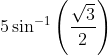
Evaluate:
Tap to see back →
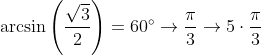 and so the credited answer is
  .
.

Approximate the following:  is closest in value to which of the following?
Approximate the following: 
Tap to see back →
This problem is quite manageable with knowledge of the unit circle: the value is extremely close to zero, of which  always, so the only reasonable estimation of this value is 0.
This problem is quite manageable with knowledge of the unit circle: the value is extremely close to zero, of which 
Given that  and that
  is acute, find the value of
  without using a calculator.
Given that 


Tap to see back →
Given the value of the opposite and hypotenuse sides from the sine expression (3 and 4 respectively) we can use the Pythagorean Theorem to find the 3rd side (we’ll call it “t”):  .
.
From here we can deduce the value of  (the adjacent side over the opposite side) and so the answer is
  .
.
Given the value of the opposite and hypotenuse sides from the sine expression (3 and 4 respectively) we can use the Pythagorean Theorem to find the 3rd side (we’ll call it “t”): 
From here we can deduce the value of 

Evaluate:
Evaluate:
Tap to see back →
To determine the value of , solve each of the terms first.
The inverse cosine has a domain and range restriction.
The domain exists from , and the range from . The inverse cosine asks for the angle when the x-value of the existing coordinate is . The only possibility is since the coordinate can only exist in the first quadrant.
The inverse sine also has a domain and range restriction.
The domain exists from , and the range from . The inverse sine asks for the angle when the y-value of the existing coordinate is . The only possibility is since the coordinate can only exist in the first quadrant.
Therefore:
To determine the value of
The inverse cosine has a domain and range restriction.
The domain exists from
The inverse sine also has a domain and range restriction.
The domain exists from
Therefore:
Approximate:
Approximate:
Tap to see back →
:
There is a restriction for the range of the inverse tangent function from .
The inverse tangent of a value asks for the angle where the coordinate lies on the unit circle under the condition that . For this to be valid on the unit circle, the must be very close to 1, with an value also very close to zero, but cannot equal to zero since would be undefined.
The point is located on the unit circle when , but is invalid due to the existent asymptote at this angle.
An example of a point very close to that will yield can be written as:
Therefore, the approximated rounded value of is .
There is a restriction for the range of the inverse tangent function from
The inverse tangent of a value asks for the angle where the coordinate
The point
An example of a point very close to
Therefore, the approximated rounded value of
Determine the value of in degrees.
Determine the value of
Tap to see back →
Rewrite and evaluate .
The inverse sine of one-half is since is the y-value of the coordinate when the angle is .
To convert from radians to degrees, replace with 180.
Rewrite and evaluate
The inverse sine of one-half is
To convert from radians to degrees, replace
Evaluate the following:
Evaluate the following:
Tap to see back →
For this particular problem we need to recall that the inverse cosine cancels out the cosine therefore,
.
So the expression just becomes
From here, recall the unit circle for specific angles such as .
Thus,
.
For this particular problem we need to recall that the inverse cosine cancels out the cosine therefore,
So the expression just becomes
From here, recall the unit circle for specific angles such as
Thus,
Evaluate the following expression:
Evaluate the following expression:
Tap to see back →
This one seems complicated, but becomes considerably easier once you implement the fact that the composite cancels out to 1 and you are left with which is equal to 1
This one seems complicated, but becomes considerably easier once you implement the fact that the composite
Evaluate:
Evaluate:
Tap to see back →
Approximate the following:
Approximate the following:
Tap to see back →
This one is rather simple with knowledge of the unit circle: the value is extremely close to zero, of which always
This one is rather simple with knowledge of the unit circle: the value is extremely close to zero, of which
Given that and that is acute, find the value of without using a calculator.
Given that
Tap to see back →
Given the value of the opposite and hypotenuse sides from the sine expression (3 and 4 respectively) we can use the Pythagorean Theorem to find the 3rd side (we’ll call it “t”): . From here we can easily deduce the value of (the adjacent side over the opposite side)
Given the value of the opposite and hypotenuse sides from the sine expression (3 and 4 respectively) we can use the Pythagorean Theorem to find the 3rd side (we’ll call it “t”):