Express a Vector in Component Form - Pre-Calculus
Card 0 of 24
Express the following vector in component form:
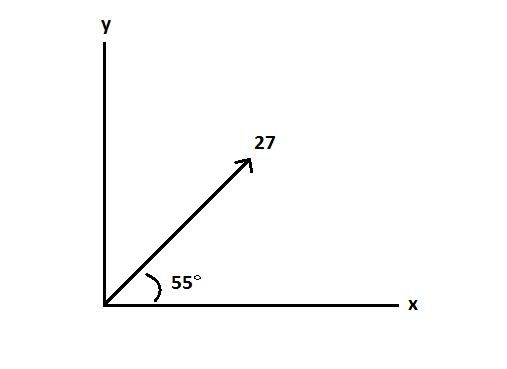
Express the following vector in component form:
Tap to see back →
When separating a vector into its component form, we are essentially creating a right triangle with the vector being the hypotenuse.
Therefore, we can find each component using the cos (for the x component) and sin (for the y component) functions:


We can now represent these two components together using the denotations i (for the x component) and j (for the y component).
When separating a vector into its component form, we are essentially creating a right triangle with the vector being the hypotenuse.
Therefore, we can find each component using the cos (for the x component) and sin (for the y component) functions:
We can now represent these two components together using the denotations i (for the x component) and j (for the y component).
Find  , then find its magnitude.
  and
and  are both vectors.


Find
Tap to see back →
In vector addition, you simply add each component of the vectors to each other.
x component:  .
.
y component:  .
.
z component:  .
.
The new vector is
 .
.
To find the magnitude we use the formula,



Thus its magnitude is 5.
In vector addition, you simply add each component of the vectors to each other.
x component:
y component:
z component:
The new vector is
To find the magnitude we use the formula,
Thus its magnitude is 5.
Find the component form of the vector with
initial point 
and
terminal point  .
.
Find the component form of the vector with
initial point
and
terminal point
Tap to see back →
To find the vector in component form given the initial and terminal points, simply subtract the initial point from the terminal point.

To find the vector in component form given the initial and terminal points, simply subtract the initial point from the terminal point.
Find the component form of the vector with
initial point 
and
terminal point 
Find the component form of the vector with
initial point
and
terminal point
Tap to see back →
To find the vector in component form given the initial and terminal points, simply subtract the initial point from the terminal point.


To find the vector in component form given the initial and terminal points, simply subtract the initial point from the terminal point.
A bird flies 15 mph up at an angle of 45 degrees to the horizontal. What is the bird's velocity in component form?
A bird flies 15 mph up at an angle of 45 degrees to the horizontal. What is the bird's velocity in component form?
Tap to see back →
Write the formula to find both the x and y-components of a vector.


Substitute the value of velocity and theta into the equations.
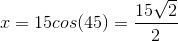
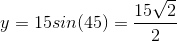
The vector is: 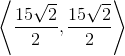
Write the formula to find both the x and y-components of a vector.
Substitute the value of velocity and theta into the equations.
The vector is:
Write this vector in component form: 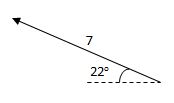
Write this vector in component form:
Tap to see back →
In order to find the horizontal component, set up an equation involving cosine with 7 as the hypotenuse, since the side in the implied triangle that represents the horizontal component is adjacent to the 22-degree angle:
 First, find the cosine of 22, then multiply by 7

To find the vertical component, set up an equation involving sine, since the side in the implied triangle that represents the vertical component is opposite the 22-degree angle:
 First, find the sine of 22, then multiply by 7

We are almost done, but we need to make a small adjustment. The picture indicates that the vector points up and to the left, so the horizontal component, 6.49, should be negative:

In order to find the horizontal component, set up an equation involving cosine with 7 as the hypotenuse, since the side in the implied triangle that represents the horizontal component is adjacent to the 22-degree angle:
To find the vertical component, set up an equation involving sine, since the side in the implied triangle that represents the vertical component is opposite the 22-degree angle:
We are almost done, but we need to make a small adjustment. The picture indicates that the vector points up and to the left, so the horizontal component, 6.49, should be negative:
Express the following vector in component form:
Express the following vector in component form:
Tap to see back →
When separating a vector into its component form, we are essentially creating a right triangle with the vector being the hypotenuse.
Therefore, we can find each component using the cos (for the x component) and sin (for the y component) functions:
We can now represent these two components together using the denotations i (for the x component) and j (for the y component).
When separating a vector into its component form, we are essentially creating a right triangle with the vector being the hypotenuse.
Therefore, we can find each component using the cos (for the x component) and sin (for the y component) functions:
We can now represent these two components together using the denotations i (for the x component) and j (for the y component).
Find , then find its magnitude. and are both vectors.
Find
Tap to see back →
In vector addition, you simply add each component of the vectors to each other.
x component: .
y component: .
z component: .
The new vector is
.
To find the magnitude we use the formula,
Thus its magnitude is 5.
In vector addition, you simply add each component of the vectors to each other.
x component:
y component:
z component:
The new vector is
To find the magnitude we use the formula,
Thus its magnitude is 5.
Find the component form of the vector with
initial point
and
terminal point .
Find the component form of the vector with
initial point
and
terminal point
Tap to see back →
To find the vector in component form given the initial and terminal points, simply subtract the initial point from the terminal point.
To find the vector in component form given the initial and terminal points, simply subtract the initial point from the terminal point.
Find the component form of the vector with
initial point
and
terminal point
Find the component form of the vector with
initial point
and
terminal point
Tap to see back →
To find the vector in component form given the initial and terminal points, simply subtract the initial point from the terminal point.
To find the vector in component form given the initial and terminal points, simply subtract the initial point from the terminal point.
A bird flies 15 mph up at an angle of 45 degrees to the horizontal. What is the bird's velocity in component form?
A bird flies 15 mph up at an angle of 45 degrees to the horizontal. What is the bird's velocity in component form?
Tap to see back →
Write the formula to find both the x and y-components of a vector.
Substitute the value of velocity and theta into the equations.
The vector is:
Write the formula to find both the x and y-components of a vector.
Substitute the value of velocity and theta into the equations.
The vector is:
Write this vector in component form:
Write this vector in component form:
Tap to see back →
In order to find the horizontal component, set up an equation involving cosine with 7 as the hypotenuse, since the side in the implied triangle that represents the horizontal component is adjacent to the 22-degree angle:
First, find the cosine of 22, then multiply by 7
To find the vertical component, set up an equation involving sine, since the side in the implied triangle that represents the vertical component is opposite the 22-degree angle:
First, find the sine of 22, then multiply by 7
We are almost done, but we need to make a small adjustment. The picture indicates that the vector points up and to the left, so the horizontal component, 6.49, should be negative:
In order to find the horizontal component, set up an equation involving cosine with 7 as the hypotenuse, since the side in the implied triangle that represents the horizontal component is adjacent to the 22-degree angle:
To find the vertical component, set up an equation involving sine, since the side in the implied triangle that represents the vertical component is opposite the 22-degree angle:
We are almost done, but we need to make a small adjustment. The picture indicates that the vector points up and to the left, so the horizontal component, 6.49, should be negative:
Express the following vector in component form:
Express the following vector in component form:
Tap to see back →
When separating a vector into its component form, we are essentially creating a right triangle with the vector being the hypotenuse.
Therefore, we can find each component using the cos (for the x component) and sin (for the y component) functions:
We can now represent these two components together using the denotations i (for the x component) and j (for the y component).
When separating a vector into its component form, we are essentially creating a right triangle with the vector being the hypotenuse.
Therefore, we can find each component using the cos (for the x component) and sin (for the y component) functions:
We can now represent these two components together using the denotations i (for the x component) and j (for the y component).
Find , then find its magnitude. and are both vectors.
Find
Tap to see back →
In vector addition, you simply add each component of the vectors to each other.
x component: .
y component: .
z component: .
The new vector is
.
To find the magnitude we use the formula,
Thus its magnitude is 5.
In vector addition, you simply add each component of the vectors to each other.
x component:
y component:
z component:
The new vector is
To find the magnitude we use the formula,
Thus its magnitude is 5.
Find the component form of the vector with
initial point
and
terminal point .
Find the component form of the vector with
initial point
and
terminal point
Tap to see back →
To find the vector in component form given the initial and terminal points, simply subtract the initial point from the terminal point.
To find the vector in component form given the initial and terminal points, simply subtract the initial point from the terminal point.
Find the component form of the vector with
initial point
and
terminal point
Find the component form of the vector with
initial point
and
terminal point
Tap to see back →
To find the vector in component form given the initial and terminal points, simply subtract the initial point from the terminal point.
To find the vector in component form given the initial and terminal points, simply subtract the initial point from the terminal point.
A bird flies 15 mph up at an angle of 45 degrees to the horizontal. What is the bird's velocity in component form?
A bird flies 15 mph up at an angle of 45 degrees to the horizontal. What is the bird's velocity in component form?
Tap to see back →
Write the formula to find both the x and y-components of a vector.
Substitute the value of velocity and theta into the equations.
The vector is:
Write the formula to find both the x and y-components of a vector.
Substitute the value of velocity and theta into the equations.
The vector is:
Write this vector in component form:
Write this vector in component form:
Tap to see back →
In order to find the horizontal component, set up an equation involving cosine with 7 as the hypotenuse, since the side in the implied triangle that represents the horizontal component is adjacent to the 22-degree angle:
First, find the cosine of 22, then multiply by 7
To find the vertical component, set up an equation involving sine, since the side in the implied triangle that represents the vertical component is opposite the 22-degree angle:
First, find the sine of 22, then multiply by 7
We are almost done, but we need to make a small adjustment. The picture indicates that the vector points up and to the left, so the horizontal component, 6.49, should be negative:
In order to find the horizontal component, set up an equation involving cosine with 7 as the hypotenuse, since the side in the implied triangle that represents the horizontal component is adjacent to the 22-degree angle:
To find the vertical component, set up an equation involving sine, since the side in the implied triangle that represents the vertical component is opposite the 22-degree angle:
We are almost done, but we need to make a small adjustment. The picture indicates that the vector points up and to the left, so the horizontal component, 6.49, should be negative:
Express the following vector in component form:
Express the following vector in component form:
Tap to see back →
When separating a vector into its component form, we are essentially creating a right triangle with the vector being the hypotenuse.
Therefore, we can find each component using the cos (for the x component) and sin (for the y component) functions:
We can now represent these two components together using the denotations i (for the x component) and j (for the y component).
When separating a vector into its component form, we are essentially creating a right triangle with the vector being the hypotenuse.
Therefore, we can find each component using the cos (for the x component) and sin (for the y component) functions:
We can now represent these two components together using the denotations i (for the x component) and j (for the y component).
Find , then find its magnitude. and are both vectors.
Find
Tap to see back →
In vector addition, you simply add each component of the vectors to each other.
x component: .
y component: .
z component: .
The new vector is
.
To find the magnitude we use the formula,
Thus its magnitude is 5.
In vector addition, you simply add each component of the vectors to each other.
x component:
y component:
z component:
The new vector is
To find the magnitude we use the formula,
Thus its magnitude is 5.