Find the Period of a Sine or Cosine Function - Pre-Calculus
Card 0 of 36
Please choose the best answer from the following choices.
Find the period of the following function in radians:

Please choose the best answer from the following choices.
Find the period of the following function in radians:
Tap to see back →
If you look at a graph, you can see that the period (length of one wave) is  . Without the graph, you can divide
  with the frequency, which in this case, is 1.
If you look at a graph, you can see that the period (length of one wave) is
Given  , what is the period for the function?
Given
Tap to see back →
The formula for the period of a sine/cosine function is  .
.
With the standard form being:

Since  , the formula becomes
  .
.
Simplified, the period is  .
.
The formula for the period of a sine/cosine function is
With the standard form being:
Since
Simplified, the period is
What could be the function for the following graph?

What could be the function for the following graph?
Tap to see back →
What could be the function for the following graph?
Begin by realizing we are dealing with a periodic function, so sine and cosine are your best bet.
Next, note that the range of the function is  and that the function goes through the point
  .
.
From this information, we can find the amplitude:

So our function must have a  out in front.
Also, from the point  , we can deduce that the function has a vertical translation of positive two.
The only remaining obstacle, is whether the function is sine or cosine. Recall that sine passes through  , while cosine passes through
  . this means that our function must be a sine function, because in order to be a cosien graph, we would need a horizontal translation as well.
Thus, our answer is:

What could be the function for the following graph?
Begin by realizing we are dealing with a periodic function, so sine and cosine are your best bet.
Next, note that the range of the function is
From this information, we can find the amplitude:
So our function must have a
Also, from the point
The only remaining obstacle, is whether the function is sine or cosine. Recall that sine passes through
Thus, our answer is:
What is the period of this sine graph?

What is the period of this sine graph?
Tap to see back →
The graph has 3 waves between 0 and  , meaning that the length of each of the waves is
  divided by 3, or
  .
.
The graph has 3 waves between 0 and
What is the period of this graph?

What is the period of this graph?
Tap to see back →
One wave of the graph goes exactly from 0 to  before repeating itself. This means that the period is
  .
.
One wave of the graph goes exactly from 0 to
Please choose the best answer from the following choices.
Find the period of the following function.

Please choose the best answer from the following choices.
Find the period of the following function.
Tap to see back →
The period is defined as the length of one wave of the function. In this case, one full wave is 180 degrees or  radians. You can figure this out without looking at a graph by dividing
  with the frequency, which in this case, is 2.
The period is defined as the length of one wave of the function. In this case, one full wave is 180 degrees or
Write the equation for a cosine graph with a minimum at  and a maximum at
  .
.
Write the equation for a cosine graph with a minimum at
Tap to see back →
The equation for this graph will be in the form  where A is the amplitude, f is the frequency, h is the horizontal shift, and k is the vertical shift.
To write this equation, it is helpful to sketch a graph:
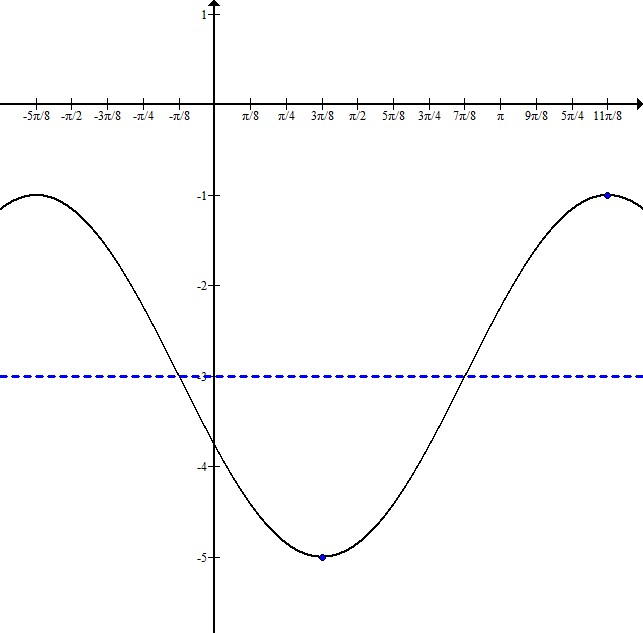
From sketching the maximum and the minimum, we can see that the graph is centered at  and has an amplitude of 2.
The distance between the maximum and the minimum is half the wavelength. Here, it is  . That means that the full wavelength is
  , so the frequency is 1.
The minimum occurs in the middle of the graph, so to figure out where it starts, subtract  from the minimum's x-coordinate:

This graph's equation is
 .
.
The equation for this graph will be in the form
To write this equation, it is helpful to sketch a graph:
From sketching the maximum and the minimum, we can see that the graph is centered at
The distance between the maximum and the minimum is half the wavelength. Here, it is
The minimum occurs in the middle of the graph, so to figure out where it starts, subtract
This graph's equation is
Give the period and frequency for the equation  .
.
Give the period and frequency for the equation
Tap to see back →
Our equation is in the form 
where A is the amplitude, f is the frequency, h is the horizontal shift, and k is the vertical shift.
We can look at the equation and see that the frequency,  , is
, is  .
.
The period is  , so in this case
  .
.
Our equation is in the form
where A is the amplitude, f is the frequency, h is the horizontal shift, and k is the vertical shift.
We can look at the equation and see that the frequency,
The period is
What is the period of the graph  ?
?
What is the period of the graph
Tap to see back →
The equation for this function is in the form 
where A is the amplitude, f is the frequency, h is the horizontal shift, and k is the vertical shift.
By looking at the equation, we can see that the frequency,  , is
, is  .
.
The period is  , so in this case
  .
.
The equation for this function is in the form
where A is the amplitude, f is the frequency, h is the horizontal shift, and k is the vertical shift.
By looking at the equation, we can see that the frequency,
The period is
Please choose the best answer from the following choices.
Find the period of the following function in radians:
Please choose the best answer from the following choices.
Find the period of the following function in radians:
Tap to see back →
If you look at a graph, you can see that the period (length of one wave) is . Without the graph, you can divide with the frequency, which in this case, is 1.
If you look at a graph, you can see that the period (length of one wave) is
Given , what is the period for the function?
Given
Tap to see back →
The formula for the period of a sine/cosine function is .
With the standard form being:
Since , the formula becomes .
Simplified, the period is .
The formula for the period of a sine/cosine function is
With the standard form being:
Since
Simplified, the period is
What could be the function for the following graph?
What could be the function for the following graph?
Tap to see back →
What could be the function for the following graph?
Begin by realizing we are dealing with a periodic function, so sine and cosine are your best bet.
Next, note that the range of the function is and that the function goes through the point .
From this information, we can find the amplitude:
So our function must have a out in front.
Also, from the point , we can deduce that the function has a vertical translation of positive two.
The only remaining obstacle, is whether the function is sine or cosine. Recall that sine passes through , while cosine passes through . this means that our function must be a sine function, because in order to be a cosien graph, we would need a horizontal translation as well.
Thus, our answer is:
What could be the function for the following graph?
Begin by realizing we are dealing with a periodic function, so sine and cosine are your best bet.
Next, note that the range of the function is
From this information, we can find the amplitude:
So our function must have a
Also, from the point
The only remaining obstacle, is whether the function is sine or cosine. Recall that sine passes through
Thus, our answer is:
What is the period of this sine graph?
What is the period of this sine graph?
Tap to see back →
The graph has 3 waves between 0 and , meaning that the length of each of the waves is divided by 3, or .
The graph has 3 waves between 0 and
What is the period of this graph?
What is the period of this graph?
Tap to see back →
One wave of the graph goes exactly from 0 to before repeating itself. This means that the period is .
One wave of the graph goes exactly from 0 to
Please choose the best answer from the following choices.
Find the period of the following function.
Please choose the best answer from the following choices.
Find the period of the following function.
Tap to see back →
The period is defined as the length of one wave of the function. In this case, one full wave is 180 degrees or radians. You can figure this out without looking at a graph by dividing with the frequency, which in this case, is 2.
The period is defined as the length of one wave of the function. In this case, one full wave is 180 degrees or
Write the equation for a cosine graph with a minimum at and a maximum at .
Write the equation for a cosine graph with a minimum at
Tap to see back →
The equation for this graph will be in the form where A is the amplitude, f is the frequency, h is the horizontal shift, and k is the vertical shift.
To write this equation, it is helpful to sketch a graph:
From sketching the maximum and the minimum, we can see that the graph is centered at and has an amplitude of 2.
The distance between the maximum and the minimum is half the wavelength. Here, it is . That means that the full wavelength is , so the frequency is 1.
The minimum occurs in the middle of the graph, so to figure out where it starts, subtract from the minimum's x-coordinate:
This graph's equation is
.
The equation for this graph will be in the form
To write this equation, it is helpful to sketch a graph:
From sketching the maximum and the minimum, we can see that the graph is centered at
The distance between the maximum and the minimum is half the wavelength. Here, it is
The minimum occurs in the middle of the graph, so to figure out where it starts, subtract
This graph's equation is
Give the period and frequency for the equation .
Give the period and frequency for the equation
Tap to see back →
Our equation is in the form
where A is the amplitude, f is the frequency, h is the horizontal shift, and k is the vertical shift.
We can look at the equation and see that the frequency, , is .
The period is , so in this case .
Our equation is in the form
where A is the amplitude, f is the frequency, h is the horizontal shift, and k is the vertical shift.
We can look at the equation and see that the frequency,
The period is
What is the period of the graph ?
What is the period of the graph
Tap to see back →
The equation for this function is in the form
where A is the amplitude, f is the frequency, h is the horizontal shift, and k is the vertical shift.
By looking at the equation, we can see that the frequency, , is .
The period is , so in this case .
The equation for this function is in the form
where A is the amplitude, f is the frequency, h is the horizontal shift, and k is the vertical shift.
By looking at the equation, we can see that the frequency,
The period is
Given , what is the period for the function?
Given
Tap to see back →
The formula for the period of a sine/cosine function is .
With the standard form being:
Since , the formula becomes .
Simplified, the period is .
The formula for the period of a sine/cosine function is
With the standard form being:
Since
Simplified, the period is
What could be the function for the following graph?
What could be the function for the following graph?
Tap to see back →
What could be the function for the following graph?
Begin by realizing we are dealing with a periodic function, so sine and cosine are your best bet.
Next, note that the range of the function is and that the function goes through the point .
From this information, we can find the amplitude:
So our function must have a out in front.
Also, from the point , we can deduce that the function has a vertical translation of positive two.
The only remaining obstacle, is whether the function is sine or cosine. Recall that sine passes through , while cosine passes through . this means that our function must be a sine function, because in order to be a cosien graph, we would need a horizontal translation as well.
Thus, our answer is:
What could be the function for the following graph?
Begin by realizing we are dealing with a periodic function, so sine and cosine are your best bet.
Next, note that the range of the function is
From this information, we can find the amplitude:
So our function must have a
Also, from the point
The only remaining obstacle, is whether the function is sine or cosine. Recall that sine passes through
Thus, our answer is: