Find the Roots of Complex Numbers - Pre-Calculus
Card 0 of 52
Solve for  (there may be more than one solution).
Solve for 
Tap to see back →
To solve for the roots, just set equal to zero and solve for z using the quadratic formula ( ) :
) :  and now setting both
  and
and  equal to zero we end up with the answers
  and
and 
To solve for the roots, just set equal to zero and solve for z using the quadratic formula (


Evaluate  , where
  is a natural number and
  is the complex number
  .
.
Evaluate
Tap to see back →
Note that,

Note that,
What is the length of
 ?
?
What is the length of
Tap to see back →
We have
 .
.
Hence,
 .
.
We have
Hence,
Solve for  (there may be more than one solution).
Solve for
Tap to see back →
Solving that equation is equivalent to solving the roots of the polynomial  .
.
Clearly, one of roots is 1.
Thus, we can factor the polynomial as 
so that we solve for the roots of  .
.
Using the quadratic equation, we solve for roots, which are 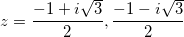 .
.
This means the solutions to  are
are

Solving that equation is equivalent to solving the roots of the polynomial
Clearly, one of roots is 1.
Thus, we can factor the polynomial as
so that we solve for the roots of
Using the quadratic equation, we solve for roots, which are
This means the solutions to
Recall that  is just shorthand for
  when dealing with complex numbers in polar form.
Express  in polar form.
Recall that
Express in polar form.
Tap to see back →
First we recognize that we are trying to solve  where
where  .
.
Then we want to convert  into polar form using,
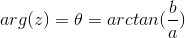 and
and  .
.
Then since De Moivre's theorem states,
 if
if  is an integer, we can say
 .
.
First we recognize that we are trying to solve
Then we want to convert
Then since De Moivre's theorem states,
Compute 
Compute

Tap to see back →
To solve this question, you must first derive a few values and convert the equation into exponential form:  :
: 
Now plug back into the original equation and solve: 
To solve this question, you must first derive a few values and convert the equation into exponential form: 

Now plug back into the original equation and solve:

Solve for all possible solutions to the quadratic expression: 
Solve for all possible solutions to the quadratic expression:

Tap to see back →
Solve for complex values of m using the aforementioned quadratic formula:


Solve for complex values of m using the aforementioned quadratic formula:


Determine the length of 
Determine the length of

Tap to see back →
 , so
, so 


Solve for  (there may be more than one solution).
Solve for 
Tap to see back →
To solve for the roots, just set equal to zero and solve for  using the quadratic formula (
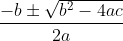 ):
):  and now setting both
  and
and  equal to zero we end up with the answers
  and
and  .
.
To solve for the roots, just set equal to zero and solve for 


Which of the following lists all possible solutions to the quadratic expression: 
Which of the following lists all possible solutions to the quadratic expression:

Tap to see back →
Solve for complex values of  using the quadratic formula:
Solve for complex values of 

Solve for  (there may be more than one solution).
Solve for 
Tap to see back →
To solve for the roots, just set equal to zero and solve for z using the quadratic formula, which is 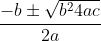
 and now setting both
  and
and  equal to zero we end up with the answers
  and
and  and so the correct answer is
  .
.
To solve for the roots, just set equal to zero and solve for z using the quadratic formula, which is


Solve for all possible solutions to the quadratic expression: 
Solve for all possible solutions to the quadratic expression:
Tap to see back →
Solve for complex values of  using the quadratic formula:
  .
.
Solve for complex values of 
Determine the length of  .
.
Determine the length of 
Tap to see back →
To begin, we must recall that  . Plug this in to get
  . Length must be a positive value, so we'll take the absolute value:
  . Therefore the length is 3.
To begin, we must recall that 


Solve for (there may be more than one solution).
Solve for
Tap to see back →
To solve for the roots, just set equal to zero and solve for z using the quadratic formula () : and now setting both and equal to zero we end up with the answers and
To solve for the roots, just set equal to zero and solve for z using the quadratic formula (
Evaluate , where is a natural number and is the complex number .
Evaluate
Tap to see back →
Note that,
Note that,
What is the length of
?
What is the length of
Tap to see back →
We have
.
Hence,
.
We have
Hence,
Solve for (there may be more than one solution).
Solve for
Tap to see back →
Solving that equation is equivalent to solving the roots of the polynomial .
Clearly, one of roots is 1.
Thus, we can factor the polynomial as
so that we solve for the roots of .
Using the quadratic equation, we solve for roots, which are .
This means the solutions to are
Solving that equation is equivalent to solving the roots of the polynomial
Clearly, one of roots is 1.
Thus, we can factor the polynomial as
so that we solve for the roots of
Using the quadratic equation, we solve for roots, which are
This means the solutions to
Recall that is just shorthand for when dealing with complex numbers in polar form.
Express in polar form.
Recall that
Express in polar form.
Tap to see back →
First we recognize that we are trying to solve where .
Then we want to convert into polar form using,
and .
Then since De Moivre's theorem states,
if is an integer, we can say
.
First we recognize that we are trying to solve
Then we want to convert
Then since De Moivre's theorem states,
Compute
Compute
Tap to see back →
To solve this question, you must first derive a few values and convert the equation into exponential form: :
Now plug back into the original equation and solve:
To solve this question, you must first derive a few values and convert the equation into exponential form:
Now plug back into the original equation and solve:
Solve for all possible solutions to the quadratic expression:
Solve for all possible solutions to the quadratic expression:
Tap to see back →
Solve for complex values of m using the aforementioned quadratic formula:
Solve for complex values of m using the aforementioned quadratic formula: