Graphs and Inverses of Trigonometric Functions - Pre-Calculus
Card 0 of 236
Which quadrant could arccot (−½) fall in?
Which quadrant could arccot (−½) fall in?
Tap to see back →
The cotangent function is negative in quadrants II and IV, so arccot (−½) could fall in either of these quadrants. The below image shows where each function is positive. Any that are not noted are negative. Since cotangent is positive in Quadrants I and III, it is negative in Quadrants II and IV.

The cotangent function is negative in quadrants II and IV, so arccot (−½) could fall in either of these quadrants. The below image shows where each function is positive. Any that are not noted are negative. Since cotangent is positive in Quadrants I and III, it is negative in Quadrants II and IV.
Which quadrant could arcsin (−½) fall in?
Which quadrant could arcsin (−½) fall in?
Tap to see back →
The sine function is negative in quadrants III and IV, so arcsin (−½) could fall in either of these quadrants. The below image shows where each function is positive. Any that are not noted are negative. Since sine is positive in Quadrants I and II, it is negative in Quadrants III and IV.
The sine function is negative in quadrants III and IV, so arcsin (−½) could fall in either of these quadrants. The below image shows where each function is positive. Any that are not noted are negative. Since sine is positive in Quadrants I and II, it is negative in Quadrants III and IV.
Evaluate the following expression, assuming that all angles are in Quadrant I:

Evaluate the following expression, assuming that all angles are in Quadrant I:
Tap to see back →
To solve , first, let  . Then,
  . Because this value is positive, we know that this must be in Quadrant I or Quadrant II, but given the instructions, we can assume A is in Quadrant I.

Next, recall that  .
.
Using the Pythagorean Theorem, you can solve for the following:
x2 + y2 = r2
x2 + 122 = 132
x = 5
Therefore,  . Now, solve:


Therefore, 
To solve , first, let  . Because this value is positive, we know that this must be in Quadrant I or Quadrant II, but given the instructions, we can assume A is in Quadrant I.
Next, recall that 
Using the Pythagorean Theorem, you can solve for the following:
x2 + y2 = r2
x2 + 122 = 132
x = 5
Therefore, 

Therefore,
Find the inverse of the function y = sin(x). Then graph both functions.
Find the inverse of the function y = sin(x). Then graph both functions.
Tap to see back →
To find the inverse of a function, exchange the values of x and y, then solve for y.
Change y = sin(x) to x = sin(y). Then solve for y:
x = sin(y)
sin-1(x) = sin-1(sin(y))
sin-1(x) = y
Now graph each function:
y = sin(x)

y = sin-1(x)

If you look at the upper graph and restrict the domain to the interval \[- /2, /2\], you can more clearly see the relationship between the two graphs.

To further illustrate the relationship between the two functions, examine the inputs and outputs of the two functions on the interval \[-/2, /2\]:
y = sin(x)

y = sin-1(x)

To find the inverse of a function, exchange the values of x and y, then solve for y.
Change y = sin(x) to x = sin(y). Then solve for y:
x = sin(y)
sin-1(x) = sin-1(sin(y))
sin-1(x) = y
Now graph each function:
y = sin(x)
y = sin-1(x)
If you look at the upper graph and restrict the domain to the interval \[-
To further illustrate the relationship between the two functions, examine the inputs and outputs of the two functions on the interval \[-
y = sin(x)
y = sin-1(x)
State the domain and range of sin(x) and arcsin(x).
State the domain and range of sin(x) and arcsin(x).
Tap to see back →
The two graphs help provide a visual. The domain is all possible x values, and the range is all possible y values. The arcsin function turns the sine function on its side, but, in order to continue being a function (by passing the horizontal line test), the arcsine function's range is restricted to  . It is not a coincidence that the range of the sine function is equal to the domain of the arcsin function because of the nature of inverse relationships.
y=sin x

y=arcsin x

sin(x) domain: 
sin(x) range: 
arcsin(x) domain: 
arcsin(x) range: 
The two graphs help provide a visual. The domain is all possible x values, and the range is all possible y values. The arcsin function turns the sine function on its side, but, in order to continue being a function (by passing the horizontal line test), the arcsine function's range is restricted to 
y=sin x
y=arcsin x
sin(x) domain:

sin(x) range:

arcsin(x) domain:

arcsin(x) range:

True or false: None of the inverses of the trigonometric functions are functions.
True or false: None of the inverses of the trigonometric functions are functions.
Tap to see back →
This is true. Each of the inverse trig functions fails to pass the vertical line test, and is therefore not a function. For this reason, you will also see graphs of the inverse trig functions that restrict the domain such that is can be graphed as a function.
This is true. Each of the inverse trig functions fails to pass the vertical line test, and is therefore not a function. For this reason, you will also see graphs of the inverse trig functions that restrict the domain such that is can be graphed as a function.
This graph could be which of the following functions?

This graph could be which of the following functions?
Tap to see back →
This is the graph of arcsec(x). Think of a few points of the function sec(x): (- , -1), (0,1), (
 , -1). Now, interchange the x and y values to yield: (-1, -
 ), (1, 0), (-1,
  ). Notice that (-1, -
 ) and (1, 0) both exist on this graph. (-1,
  ) does not exist on this graph because in order to make this a function, the domain was required to be restricted such that it would pass the vertical line test. You can see how the graph of arcsec(x) relates to the graph of sec(x) by comparing the two:

This is the graph of arcsec(x). Think of a few points of the function sec(x): (-


This graph could be the graph of which of the following functions?

This graph could be the graph of which of the following functions?
Tap to see back →
This is the graph of arccot(x). Think of a few characteristics of the function cot(x): it has a point at (- /2, 0), and vertical asymptotes at x=-
 , x=0, and x=
 . Notice that in the graph above, we have the point (0, -
 /2), which flips the x and y values of the point on cot(x), and we can also see horizontal asymptotes at both y=0 and y=
 . We don't also have another horizontal asymptote at y=-
 because we needed to restrict the domain of arccot(x) in order for it to be a function and pass the vertical line test. You can look at the graph of cot(x) below and compare the two and see their similarities:

This is the graph of arccot(x). Think of a few characteristics of the function cot(x): it has a point at (-


State the domain and range of  and
and  .
.
State the domain and range of 

Tap to see back →
The two graphs help provide a visual. The domain is all possible x values, and the range is all possible y values. The arctan function exchanges all x and y values of the tangent function. However, in order to continue being a function (by passing the horizontal line test), the arctangent function's range is restricted to  . It is not a coincidence that the range of the tangent function is equal to the domain of the arctangent function because of the nature of inverse relationships.


 domain:
  , such that
 range:
 domain:
 range:
You can see that while the  range and the
  domain match, the
  domain and the
  range are not exact matches; this is so that
  can be a function (by being restricted).
The two graphs help provide a visual. The domain is all possible x values, and the range is all possible y values. The arctan function exchanges all x and y values of the tangent function. However, in order to continue being a function (by passing the horizontal line test), the arctangent function's range is restricted to 


You can see that while the 


Evaluate the following expression, assuming that all angles are in Quadrant I:

Evaluate the following expression, assuming that all angles are in Quadrant I:

Tap to see back →
To solve  , first, let
  . Then,
  . Because this value is positive, we know that this must be in Quadrant I or Quadrant IV, but given the instructions, we can assume A is in Quadrant I.
Next, recall that  . Therefore

By definition,  , assuming that
  , since the cosine function can only output values within this range.
Therefore,  .
.
To solve 


Next, recall that 

By definition, 

Therefore, 
Please choose the best answer from the following choices.
Find the period of the following function in radians:

Please choose the best answer from the following choices.
Find the period of the following function in radians:
Tap to see back →
If you look at a graph, you can see that the period (length of one wave) is  . Without the graph, you can divide
  with the frequency, which in this case, is 1.
If you look at a graph, you can see that the period (length of one wave) is
Evaluate:
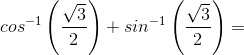
Evaluate:
Tap to see back →
To determine the value of 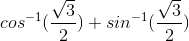 , solve each of the terms first.

The inverse cosine has a domain and range restriction.
The domain exists from  , and the range from
  . The inverse cosine asks for the angle when the x-value of the existing coordinate is
  . The only possibility is
  since the coordinate can only exist in the first quadrant.

The inverse sine also has a domain and range restriction.
The domain exists from  , and the range from
  . The inverse sine asks for the angle when the y-value of the existing coordinate is
  . The only possibility is
  since the coordinate can only exist in the first quadrant.
Therefore:

To determine the value of
The inverse cosine has a domain and range restriction.
The domain exists from
The inverse sine also has a domain and range restriction.
The domain exists from
Therefore:
Approximate: 
Approximate:
Tap to see back →
 :
:
There is a restriction for the range of the inverse tangent function from  .
.
The inverse tangent of a value asks for the angle where the coordinate  lies on the unit circle under the condition that
  . For this to be valid on the unit circle, the
  must be very close to 1, with an
  value also very close to zero, but cannot equal to zero since
  would be undefined.
The point  is located on the unit circle when
  , but
, but  is invalid due to the existent asymptote at this angle.
An example of a point very close to  that will yield can be written as:

Therefore, the approximated rounded value of  is
is  .
.
There is a restriction for the range of the inverse tangent function from
The inverse tangent of a value asks for the angle where the coordinate
The point
An example of a point very close to
Therefore, the approximated rounded value of
Determine the value of  in degrees.
Determine the value of
Tap to see back →
Rewrite and evaluate  .
.

The inverse sine of one-half is  since
since  is the y-value of the coordinate when the angle is
  .
.

To convert from radians to degrees, replace  with 180.
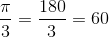
Rewrite and evaluate
The inverse sine of one-half is
To convert from radians to degrees, replace
Evaluate the following:

Evaluate the following:
Tap to see back →
For this particular problem we need to recall that the inverse cosine cancels out the cosine therefore,
 .
.
So the expression just becomes
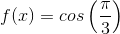
From here, recall the unit circle for specific angles such as  .
.
Thus,
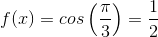 .
.
For this particular problem we need to recall that the inverse cosine cancels out the cosine therefore,
So the expression just becomes
From here, recall the unit circle for specific angles such as
Thus,
Evaluate the following expression: 
Evaluate the following expression:

Tap to see back →
This one seems complicated, but becomes considerably easier once you implement the fact that the composite  cancels out to 1 and you are left with
  which is equal to 1
This one seems complicated, but becomes considerably easier once you implement the fact that the composite 

Evaluate: 
Evaluate:

Tap to see back →

Approximate the following: 
Approximate the following:

Tap to see back →
This one is rather simple with knowledge of the unit circle: the value is extremely close to zero, of which  always
This one is rather simple with knowledge of the unit circle: the value is extremely close to zero, of which 
Given that  and that
  is acute, find the value of
  without using a calculator.
Given that 


Tap to see back →
Given the value of the opposite and hypotenuse sides from the sine expression (3 and 4 respectively) we can use the Pythagorean Theorem to find the 3rd side (we’ll call it “t”):  . From here we can easily deduce the value of
  (the adjacent side over the opposite side)
Given the value of the opposite and hypotenuse sides from the sine expression (3 and 4 respectively) we can use the Pythagorean Theorem to find the 3rd side (we’ll call it “t”): 

Evaluate the following expression: 
Evaluate the following expression:

Tap to see back →
This one seems complicated but becomes considerably easier once you implement the fact that the composite  cancels out to
  and you are left with
  which is equal to
  , and so the answer is
  .
.
This one seems complicated but becomes considerably easier once you implement the fact that the composite 


