Multiplication of Matrices - Pre-Calculus
Card 0 of 144
Find the product.
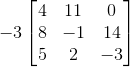
Find the product.
Tap to see back →
When we multiply a scalar (regular number) by a matrix, all we need to do is mulitply it to every entry inside the matrix:
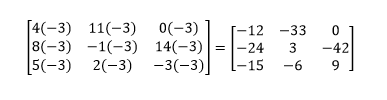
When we multiply a scalar (regular number) by a matrix, all we need to do is mulitply it to every entry inside the matrix:
Find the product.
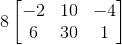
Find the product.
Tap to see back →
When we multiply a scalar (regular number) by a matrix, all we need to do is mulitply it through to every entry inside the matrix:
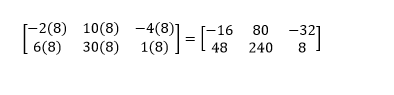
When we multiply a scalar (regular number) by a matrix, all we need to do is mulitply it through to every entry inside the matrix:
Find the product.

Find the product.
Tap to see back →
When we multiply a scalar (regular number) by a matrix, all we need to do is mulitply it through to every entry inside the matrix:
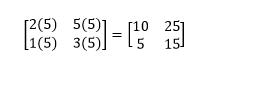
When we multiply a scalar (regular number) by a matrix, all we need to do is mulitply it through to every entry inside the matrix:
We consider the following matrix:
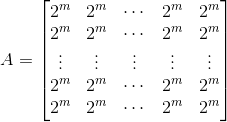
let 
what matrix do we get when we perform the following product:

We consider the following matrix:
let
what matrix do we get when we perform the following product:
Tap to see back →
We note k is simply a scalar. To do this multiplication all we need to do is to multply each entry of the matrix by k.
we see that when we multiply we have :

this gives the entry of the matrix kA.
Therefore the resulting matrix is :
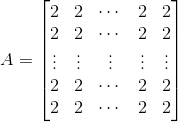
We note k is simply a scalar. To do this multiplication all we need to do is to multply each entry of the matrix by k.
we see that when we multiply we have :
this gives the entry of the matrix kA.
Therefore the resulting matrix is :
We consider the matrix defined below.
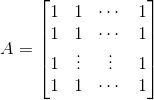
Find the sum : 
We consider the matrix defined below.
Find the sum :
Tap to see back →
Since we are adding the matrix to itself, we have the same size, we can perform the matrices addition.
We know that when adding matrices, we add them componenwise. Let (i,j) be any entry of the addition matrix. We add the entry form A to the entry from B which is the same as A. This means that to add A+A we simply add each entry of A to itself.
Since the entries from A are the same and given by 1 and the entries from B=A are the same and given by 1, we add these two to obtain:
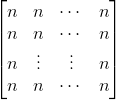
1+1 and this means that each entry of A+A is 2. We continue in this fashion by additing the entries of A each one to itself n times to obtain that the entries of A+A+....A( n times ) are given by:
Since we are adding the matrix to itself, we have the same size, we can perform the matrices addition.
We know that when adding matrices, we add them componenwise. Let (i,j) be any entry of the addition matrix. We add the entry form A to the entry from B which is the same as A. This means that to add A+A we simply add each entry of A to itself.
Since the entries from A are the same and given by 1 and the entries from B=A are the same and given by 1, we add these two to obtain:
1+1 and this means that each entry of A+A is 2. We continue in this fashion by additing the entries of A each one to itself n times to obtain that the entries of A+A+....A( n times ) are given by:
Let  be a positive integer and let
  be defined as below:
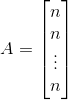
Find the product  .
.
Let
Find the product
Tap to see back →
We note n is simply a scalar. To do this multiplication all we need to do is to multply each entry of the matrix by n.
We see that when we multiply we have :  .
.
This means that each entry of the resulting matrix is  .
.
This gives the nA which is :
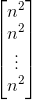
We note n is simply a scalar. To do this multiplication all we need to do is to multply each entry of the matrix by n.
We see that when we multiply we have :
This means that each entry of the resulting matrix is
This gives the nA which is :
Evaluate: 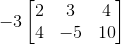
Evaluate:
Tap to see back →
This problem involves a scalar multiplication with a matrix. Simply distribute the negative three and multiply this value with every number in the 2 by 3 matrix. The rows and columns will not change.

This problem involves a scalar multiplication with a matrix. Simply distribute the negative three and multiply this value with every number in the 2 by 3 matrix. The rows and columns will not change.
Compute: 
Compute:
Tap to see back →
A scalar that multiplies a one by two matrix will result in a one by two matrix.
Multiply the scalar value with each value in the matrix.

A scalar that multiplies a one by two matrix will result in a one by two matrix.
Multiply the scalar value with each value in the matrix.
Simplify:
Simplify:
Tap to see back →
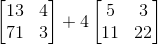
Scalar multiplication and addition of matrices are both very easy. Just like regular scalar values, you do multiplication first:

The addition of matrices is very easy. You merely need to add them directly together, correlating the spaces directly.


Scalar multiplication and addition of matrices are both very easy. Just like regular scalar values, you do multiplication first:
The addition of matrices is very easy. You merely need to add them directly together, correlating the spaces directly.
What is  ?
?
What is
Tap to see back →
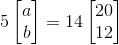
You can begin by treating this equation just like it was:

That is, you can divide both sides by  :
:
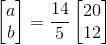
Now, for scalar multiplication of matrices, you merely need to multiply the scalar by each component:
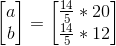
Then, simplify:

Therefore, 
You can begin by treating this equation just like it was:
That is, you can divide both sides by
Now, for scalar multiplication of matrices, you merely need to multiply the scalar by each component:
Then, simplify:
Therefore,
If  , what is
  ?
?
If
Tap to see back →
Begin by distributing the fraction through the matrix on the left side of the equation. This will simplify the contents, given that they are factors of  :
:
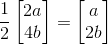
Now, this means that your equation looks like:

This simply means:

and
 or
or 
Therefore, 
Begin by distributing the fraction through the matrix on the left side of the equation. This will simplify the contents, given that they are factors of
Now, this means that your equation looks like:
This simply means:
and
Therefore,
Find 3A given:
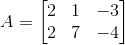
Find 3A given:
Tap to see back →
To multiply a scalar and a matrix, simly multiply each number in the matrix by the scalar. Thus,

To multiply a scalar and a matrix, simly multiply each number in the matrix by the scalar. Thus,
Multiply:

Multiply:
Tap to see back →
To find the product of 2 matrices, first line up the first row of the left matrix with the first column of the right matrix. Multiply the first, second, and third entries and then add them together.
Next, line up the second row of the left matrix with the second column of the right matrix. Then the first row and the second column, and finally the second row and the first column:


To find the product of 2 matrices, first line up the first row of the left matrix with the first column of the right matrix. Multiply the first, second, and third entries and then add them together.
Next, line up the second row of the left matrix with the second column of the right matrix. Then the first row and the second column, and finally the second row and the first column:
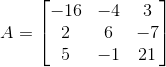

Find  .
.
Find
Tap to see back →
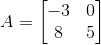
The dimensions of A and B are as follows: A= 3x3, B= 3x1
When we mulitply two matrices, we need to keep in mind their dimensions (in this case 3x_3 and 3_x1).
The two inner numbers need to be the same. Otherwise, we cannot multiply them. The product's dimensions will be the two outer numbers: 3x1.
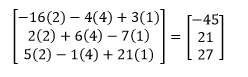
The dimensions of A and B are as follows: A= 3x3, B= 3x1
When we mulitply two matrices, we need to keep in mind their dimensions (in this case 3x_3 and 3_x1).
The two inner numbers need to be the same. Otherwise, we cannot multiply them. The product's dimensions will be the two outer numbers: 3x1.

Find  .
.
Find
Tap to see back →
The dimensions of both A and B are 2x2. Therefore, the matrix that results from their product will have the same dimensions.

Thus plugging in our values for this particular problem we get the following:

The dimensions of both A and B are 2x2. Therefore, the matrix that results from their product will have the same dimensions.
Thus plugging in our values for this particular problem we get the following:


Find  .
.
Find
Tap to see back →
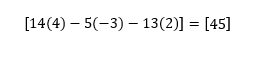
The dimensions of A and B are as follows: A=1x3, B= 3x1.
Because the two inner numbers are the same, we can find the product.
The two outer numbers will tell us the dimensions of the product: 1x1.
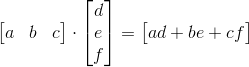
Therefore, plugging in our values for this problem we get the following:
The dimensions of A and B are as follows: A=1x3, B= 3x1.
Because the two inner numbers are the same, we can find the product.
The two outer numbers will tell us the dimensions of the product: 1x1.
Therefore, plugging in our values for this problem we get the following:

Find  .
.
Find
Tap to see back →
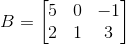
The dimensions of A and B are as follows: A= 3x1, B= 2x3
In order to be able to multiply matrices, the inner numbers need to be the same. In this case, they are 1 and 2. As such, we cannot find their product.
The answer is No Solution.
The dimensions of A and B are as follows: A= 3x1, B= 2x3
In order to be able to multiply matrices, the inner numbers need to be the same. In this case, they are 1 and 2. As such, we cannot find their product.
The answer is No Solution.
We consider the matrix equality:

Find the  that makes the matrix equality possible.
We consider the matrix equality:
Find the
Tap to see back →
To have the above equality we need to have  and
and  .
.
 means that
  , or
, or  . Trying all different values of
  , we see that no
  can satisfy both matrices.
Therefore there is no  that satisfies the above equality.
To have the above equality we need to have
Therefore there is no
Let  be the matrix defined by:

The value of  ( the nth power of
  ) is:
) is:
Let
The value of
Tap to see back →
We will use an induction proof to show this result.
We first note the above result holds for n=1. This means 
We suppose that  and we need to show that:
By definition  . By inductive hypothesis, we have:

Therefore, 

This shows that the result is true for n+1. By the principle of mathematical induction we have the result.
We will use an induction proof to show this result.
We first note the above result holds for n=1. This means
We suppose that
By definition
Therefore,
This shows that the result is true for n+1. By the principle of mathematical induction we have the result.
We will consider the 5x5 matrix  defined by:

what is the value of  ?
?
We will consider the 5x5 matrix
what is the value of
Tap to see back →
Note that:


Since  .
.
This means that 
Note that:
Since
This means that