Polar Coordinates and Complex Numbers - Pre-Calculus
Card 0 of 588
Find the value of  ,where
  the complex number is given by
  .
.
Find the value of
Tap to see back →
We note that  by FOILing.
We also know that:

We have by using the above rule: n=2 , m=50

Since we know that,

We have then:


Since we know that:
 , we use a=2 ,b=i
We have then:

We note that
We also know that:
We have by using the above rule: n=2 , m=50
Since we know that,
We have then:
Since we know that:
We have then:
Compute the following sum:
 . Remember
  is the complex number satisfying
  .
.
Compute the following sum:
Tap to see back →
Note that this is a geometric series.
Therefore we have:

Note that,
 =
=  and since
  we have
  .
.
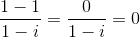
this shows that the sum is 0.
Note that this is a geometric series.
Therefore we have:
Note that,
this shows that the sum is 0.
Find the following product.

Find the following product.
Tap to see back →
Note that by FOILing the two binomials we get the following:

Therefore,

Note that by FOILing the two binomials we get the following:
Therefore,
Compute the magnitude of  .
.
Compute the magnitude of
Tap to see back →
We have
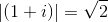 .
.
We know that 
Thus this gives us,
 .
.
We have
We know that
Thus this gives us,
Let  ,
,  . Find a simple form of
  .
.
Let
Tap to see back →
We remark first that:


and we know that :
 .
.
This means that:


We remark first that:
and we know that :
This means that:
Evaluate:

Evaluate:
Tap to see back →
To evaluate this problem we need to FOIL the binomials.



Now recall that 
Thus,


To evaluate this problem we need to FOIL the binomials.
Now recall that
Thus,
Find the product  , if
, if
 .
.
Find the product
Tap to see back →
To find the product  , FOIL the complex numbers. FOIL stands for the multiplication of the Firsts, Outers, Inners, and Lasts.
Using this method we get the following,

and because 
 .
.
To find the product
Using this method we get the following,
and because
Simplify: 
Simplify:
Tap to see back →
The expression  can be rewritten as:

Since  , the value of
  .
.

The correct answer is: 
The expression
Since
The correct answer is:
Find the product of the two complex numbers
 and
and 
Find the product of the two complex numbers
Tap to see back →
The product is

The product is
Solve for  (there may be more than one solution).
Solve for 
Tap to see back →
To solve for the roots, just set equal to zero and solve for z using the quadratic formula ( ) :
) :  and now setting both
  and
and  equal to zero we end up with the answers
  and
and 
To solve for the roots, just set equal to zero and solve for z using the quadratic formula (


What is  ?
?
What is
Tap to see back →
Since  ,
,
the problem becomes,


Since
the problem becomes,
Write

in the form  for some real numbers
  and
and  .
.
Write
in the form
Tap to see back →
The correct answer is

Using simple algebra and multiplying the expression by the complex conjugate of the denominator, we get:


The correct answer is
Using simple algebra and multiplying the expression by the complex conjugate of the denominator, we get:
Simplify  into a number of the form
  .
.
Simplify
Tap to see back →
We have

Multiply by the complex conjugate of the denominator.
The complex conjugate is the denominator with the sign changed:
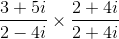
Multiply fractions
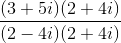
FOIL the numerator and denominator
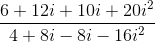
Apply the rule of  :
:
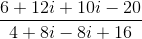
Simplify.

Simplify further using the addition of fractions rule, then factor the i out of the 2nd fraction.

We have
Multiply by the complex conjugate of the denominator.
The complex conjugate is the denominator with the sign changed:
Multiply fractions
FOIL the numerator and denominator
Apply the rule of
Simplify.
Simplify further using the addition of fractions rule, then factor the i out of the 2nd fraction.
Divide:

Divide:
Tap to see back →
To divide complex numbers, multiply both the numerator and denominator by the conjugate of the denominator.
To find the conjugate, just change the sign in the denominator. The conjugate used will be  .
.

Now, distribute and simplify.

Recall that 

To divide complex numbers, multiply both the numerator and denominator by the conjugate of the denominator.
To find the conjugate, just change the sign in the denominator. The conjugate used will be
Now, distribute and simplify.
Recall that
Convert 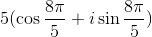 to rectangular form
Convert
Tap to see back →
To convert, evaluate the trig ratios and then distribute the radius:

To convert, evaluate the trig ratios and then distribute the radius:
Divide:

Divide:
Tap to see back →
To divide complex numbers, multiply both the numerator and denominator by the conjugate of the denominator.
To find the conjugate, just change the sign in the denominator. The conjugate used will be  .
.

Now, distribute and simplify.

Recall that 

To divide complex numbers, multiply both the numerator and denominator by the conjugate of the denominator.
To find the conjugate, just change the sign in the denominator. The conjugate used will be
Now, distribute and simplify.
Recall that
Divide.

Divide.
Tap to see back →
To divide complex numbers, multiply both the numerator and denominator by the conjugate of the denominator.
To find the conjugate, just change the sign in the denominator. The conjugate used will be  .
.

Now, distribute and simplify.

Recall that 

To divide complex numbers, multiply both the numerator and denominator by the conjugate of the denominator.
To find the conjugate, just change the sign in the denominator. The conjugate used will be
Now, distribute and simplify.
Recall that
Divide:

Divide:
Tap to see back →
To divide complex numbers, multiply both the numerator and denominator by the conjugate of the denominator.
To find the conjugate, just change the sign in the denominator. The conjugate used will be  .
.
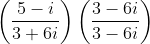
Now, distribute and simplify.

Recall that 

Then combine like terms:

Then since each term is a multiple of  you can simplify:

To divide complex numbers, multiply both the numerator and denominator by the conjugate of the denominator.
To find the conjugate, just change the sign in the denominator. The conjugate used will be
Now, distribute and simplify.
Recall that

Then combine like terms:

Then since each term is a multiple of 

Divide.

Divide.
Tap to see back →
To divide complex numbers, multiply both the numerator and denominator by the conjugate of the denominator.
To find the conjugate, just change the sign in the denominator. The conjugate used will be  .
.

Now, distribute and simplify.

Recall that

To divide complex numbers, multiply both the numerator and denominator by the conjugate of the denominator.
To find the conjugate, just change the sign in the denominator. The conjugate used will be
Now, distribute and simplify.
Recall that
Divide.

Divide.
Tap to see back →
To divide complex numbers, multiply both the numerator and denominator by the conjugate of the denominator.
To find the conjugate, just change the sign in the denominator. The conjugate used will be  .
.

Now, distribute and simplify.

Recall that

To divide complex numbers, multiply both the numerator and denominator by the conjugate of the denominator.
To find the conjugate, just change the sign in the denominator. The conjugate used will be
Now, distribute and simplify.
Recall that