Simplify expressions using trigonometric identities - Pre-Calculus
Card 0 of 256
State  in terms of sine and cosine.
State
Tap to see back →
The definition of tangent is sine divided by cosine.
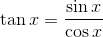
The definition of tangent is sine divided by cosine.
Which of the following statements is false?
Which of the following statements is false?
Tap to see back →
Of the six trigonometric functions, four are odd, meaning  . These four are:
- sin x
- tan x
- cot x
- csc x
That leaves two functions which are even, which means that  . These are:
- cos x
- sec x
Of the aforementioned, only  is incorrect, since secant is an even function, which implies that
Of the six trigonometric functions, four are odd, meaning
- sin x
- tan x
- cot x
- csc x
That leaves two functions which are even, which means that
- cos x
- sec x
Of the aforementioned, only
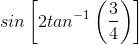
Find the exact value
 .
.
Find the exact value
Tap to see back →
By the double angle formula


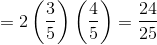
By the double angle formula
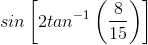
Find the exact value
 .
.
Find the exact value
Tap to see back →
By the double angle formula


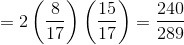
By the double angle formula
Find the exact value
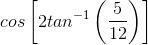 .
.
Find the exact value
Tap to see back →
By the double-angula formula for cosine

For this problem

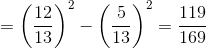
By the double-angula formula for cosine
For this problem
Compute  in function of
  .
.
Compute
Tap to see back →
Using trigonometric identities we have :
 and we know that:

This gives us :


Hence:

Using trigonometric identities we have :
This gives us :
Hence:
Find the exact value
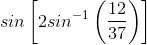 .
.
Find the exact value
Tap to see back →
By the double-angle formula for the sine function

we have
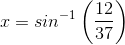
thus the double angle formula becomes,

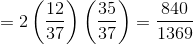
By the double-angle formula for the sine function
we have
thus the double angle formula becomes,
Which of the following is equivalent to 
Which of the following is equivalent to
Tap to see back →
When trying to identify equivalent equations that use trigonometric functions it is important to recall the general formula and understand how the terms affect the translations.
The general formula for sine is as follows.
 where
where  is the amplitude,
  is used to find the period of the function
  ,
,  represents the phase shift
  , and
, and  is the vertical shift.
This is also true for,
 .
.
Looking at the possible answer choices lets first focus on the ones containing sine.
 has a vertical shift of
  therefore it is not an equivalent function as it is moving the original function up.
 has a phase shift of
  therefore it is not an equivalent function as it is moving the original function to the right.
Now lets shift our focus to the answer choices that contain cosine.
 has a vertical shift down of
  units. This will create a graph that has a range that is below the
  -axis. It is important to remember that
  has a range of
  . Therefore this cosine function is not an equivalent equation.
 has a phase shift to the right
  units. Plugging in some values we see that,
 ,
,
 .
.
Now, looking back at our original function and plugging in those same values of  and
and  we get,
 ,
,
 .
.
Since the function values are the same for each of the input values, we can conclude that  is equivalent to
  .
.
When trying to identify equivalent equations that use trigonometric functions it is important to recall the general formula and understand how the terms affect the translations.
The general formula for sine is as follows.
This is also true for,
Looking at the possible answer choices lets first focus on the ones containing sine.
Now lets shift our focus to the answer choices that contain cosine.
Now, looking back at our original function and plugging in those same values of
Since the function values are the same for each of the input values, we can conclude that
If  , which of the following best represents
  ?
?
If
Tap to see back →
The expression  is a double angle identity that can also be rewritten as:

Replace the value of theta for  .
.
The correct answer is: 
The expression
Replace the value of theta for
The correct answer is:
Compute

Compute
Tap to see back →
A useful trigonometric identity to remember is

If we plug in  into this equation, we get

We can divide the equation by 2 to get

A useful trigonometric identity to remember is
If we plug in
We can divide the equation by 2 to get
Compute

Compute
Tap to see back →
A useful trigonometric identity to remember for this problem is

or equivalently,

If we substitute  for
for  , we get

A useful trigonometric identity to remember for this problem is
or equivalently,
If we substitute
Using the half-angle identities, which of the following answers best resembles  ?
?
Using the half-angle identities, which of the following answers best resembles
Tap to see back →
Write the half angle identity for sine.

Since we are given  , the angle is equal to
  . Set these two angles equal to each other and solve for
  .
.


Substitute this value into the formula.

Write the half angle identity for sine.
Since we are given
Substitute this value into the formula.
Let  and
and  two reals. Given that:


What is the value of:
 ?
?
Let
What is the value of:
Tap to see back →
We have:


and :


(1)-(2) gives:

Knowing from the above formula that:( take a=b in the formula above)

This gives:

We have:
and :
(1)-(2) gives:
Knowing from the above formula that:( take a=b in the formula above)
This gives:
Let  ,
,  , and
, and  be real numbers. Given that:


What is the value of  in function of
  ?
?
Let
What is the value of
Tap to see back →
We note first, using trigonometric identities that:


This gives:

Since, 
We have :

We note first, using trigonometric identities that:
This gives:
Since,
We have :
Using the fact that,
 .
.
What is the result of the following sum:

Using the fact that,
What is the result of the following sum:
Tap to see back →
We can write the above sum as :


From the given fact, we have :


and we have :  .
.
This gives :

We can write the above sum as :
From the given fact, we have :
and we have :
This gives :
Given that :

Let,

What is  in function of
  ?
?
Given that :
Let,
What is
Tap to see back →
We will use the given formula :
We have in this case:

Since we know that :

This gives :

We will use the given formula :
We have in this case:
Since we know that :
This gives :
Using the fact that  , what is the result of the following sum:

Using the fact that
Tap to see back →
We can write the above sum as :

From the given fact, we have :


This gives us :


Therefore we have:

We can write the above sum as :
From the given fact, we have :
This gives us :
Therefore we have:
Let  be real numbers. If
  and
and 
What is the value of  in function of
  ?
?
Let
What is the value of
Tap to see back →
Using trigonometric identities we know that :

This gives :

We also know that 
This gives :

Using trigonometric identities we know that :
This gives :
We also know that
This gives :
Given that :
 and,
and,

Compute :
 in function of
  .
.
Given that :
Compute :
Tap to see back →
We have using the given result:


This gives us:


Hence :

We have using the given result:
This gives us:
Hence :
Let  be an integer and
  a real number. Compute
  as a function of
  .
.
Let
Tap to see back →
Using trigonometric identities we have :

We know that :
 and
and 
This gives :

Using trigonometric identities we have :
We know that :
This gives :