Solve a Quadratic Equation - Pre-Calculus
Card 0 of 28
Solve the quadratic equation for  .
.

Use the quadratic formula.
Solve the quadratic equation for
Use the quadratic formula.
Tap to see back →
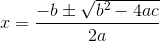
For any quadtratic equation of the form  , the quadratic formula is
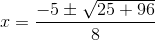
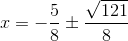
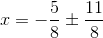
Plugging in our given values  we have:

For any quadtratic equation of the form
Plugging in our given values
Find the root(s) of the following quadratic equation?

Find the root(s) of the following quadratic equation?
Tap to see back →
To find the roots of an equation in the form  , you use the quadratic formula
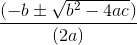 .
.
In our case, we have  .
.
This gives us 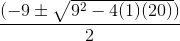 which simplifies to

To find the roots of an equation in the form
In our case, we have
This gives us
Solve the following quadratic equation:

Solve the following quadratic equation:
Tap to see back →
When solving a quadratic equation, the first thing to look for is whether or not it can be factored, as this is most often the easiest and fastest method if the quadratic can in fact be factored. We can see that each of the terms in the given equation have a common factor of 3, so it will be easier to factor the quadratic if we first factor out the 3:


Now we're left with a polynomial where we need to find two numbers whose product is -28 and whose sum is -3. Thinking about the factors of 28, we can see that 4 and 7 will yield -3 if 7 is negative and 4 is positive, so we now have our factorization:



When solving a quadratic equation, the first thing to look for is whether or not it can be factored, as this is most often the easiest and fastest method if the quadratic can in fact be factored. We can see that each of the terms in the given equation have a common factor of 3, so it will be easier to factor the quadratic if we first factor out the 3:
Now we're left with a polynomial where we need to find two numbers whose product is -28 and whose sum is -3. Thinking about the factors of 28, we can see that 4 and 7 will yield -3 if 7 is negative and 4 is positive, so we now have our factorization:
Given the function  , find a possible root for this quadratic.
Given the function
Tap to see back →
Factorize  and set this equation equal to zero.



The answer  is one of the possible choices.
Factorize
The answer
Solve the quadratic equation for  .
.

Solve the quadratic equation for
Tap to see back →
There are two solutions;  .
.
We proceed as follows.

Add  to both sides.

Take the square root of both sides, remember to introduce plus/minus on the right side since you are introducing a square root into your work.

Add  to both sides.

There are two solutions;
We proceed as follows.
Add
Take the square root of both sides, remember to introduce plus/minus on the right side since you are introducing a square root into your work.
Add
Find the roots of the equation.

Find the roots of the equation.
Tap to see back →
Use either the quadratic formula or factoring to solve the quadratic equation.
Using factoring, we want to find which factors of six when multiplied with the factors of two and then added together result in negative one.


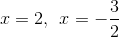
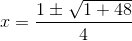
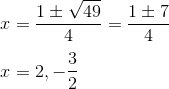
Using the quadratic formula,
let

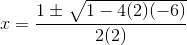
Use either the quadratic formula or factoring to solve the quadratic equation.
Using factoring, we want to find which factors of six when multiplied with the factors of two and then added together result in negative one.
Using the quadratic formula,
let
Solve  .
.
Solve
Tap to see back →
To solve this equation, use trial and error to factor it. Since the leading coefficient is  , there is only one way to get
 , so that is helpful reminder. Once it's properly factored, you get:
  . Then, set both of those expressions equal to
  to get your roots:
  .
.
To solve this equation, use trial and error to factor it. Since the leading coefficient is
Solve the quadratic equation for .
Use the quadratic formula.
Solve the quadratic equation for
Use the quadratic formula.
Tap to see back →
For any quadtratic equation of the form , the quadratic formula is
Plugging in our given values we have:
For any quadtratic equation of the form
Plugging in our given values
Find the root(s) of the following quadratic equation?
Find the root(s) of the following quadratic equation?
Tap to see back →
To find the roots of an equation in the form , you use the quadratic formula
.
In our case, we have .
This gives us which simplifies to
To find the roots of an equation in the form
In our case, we have
This gives us
Solve the following quadratic equation:
Solve the following quadratic equation:
Tap to see back →
When solving a quadratic equation, the first thing to look for is whether or not it can be factored, as this is most often the easiest and fastest method if the quadratic can in fact be factored. We can see that each of the terms in the given equation have a common factor of 3, so it will be easier to factor the quadratic if we first factor out the 3:
Now we're left with a polynomial where we need to find two numbers whose product is -28 and whose sum is -3. Thinking about the factors of 28, we can see that 4 and 7 will yield -3 if 7 is negative and 4 is positive, so we now have our factorization:
When solving a quadratic equation, the first thing to look for is whether or not it can be factored, as this is most often the easiest and fastest method if the quadratic can in fact be factored. We can see that each of the terms in the given equation have a common factor of 3, so it will be easier to factor the quadratic if we first factor out the 3:
Now we're left with a polynomial where we need to find two numbers whose product is -28 and whose sum is -3. Thinking about the factors of 28, we can see that 4 and 7 will yield -3 if 7 is negative and 4 is positive, so we now have our factorization:
Given the function , find a possible root for this quadratic.
Given the function
Tap to see back →
Factorize and set this equation equal to zero.
The answer is one of the possible choices.
Factorize
The answer
Solve the quadratic equation for .
Solve the quadratic equation for
Tap to see back →
There are two solutions; .
We proceed as follows.
Add to both sides.
Take the square root of both sides, remember to introduce plus/minus on the right side since you are introducing a square root into your work.
Add to both sides.
There are two solutions;
We proceed as follows.
Add
Take the square root of both sides, remember to introduce plus/minus on the right side since you are introducing a square root into your work.
Add
Find the roots of the equation.
Find the roots of the equation.
Tap to see back →
Use either the quadratic formula or factoring to solve the quadratic equation.
Using factoring, we want to find which factors of six when multiplied with the factors of two and then added together result in negative one.
Using the quadratic formula,
let
Use either the quadratic formula or factoring to solve the quadratic equation.
Using factoring, we want to find which factors of six when multiplied with the factors of two and then added together result in negative one.
Using the quadratic formula,
let
Solve .
Solve
Tap to see back →
To solve this equation, use trial and error to factor it. Since the leading coefficient is , there is only one way to get , so that is helpful reminder. Once it's properly factored, you get: . Then, set both of those expressions equal to to get your roots: .
To solve this equation, use trial and error to factor it. Since the leading coefficient is
Find the root(s) of the following quadratic equation?
Find the root(s) of the following quadratic equation?
Tap to see back →
To find the roots of an equation in the form , you use the quadratic formula
.
In our case, we have .
This gives us which simplifies to
To find the roots of an equation in the form
In our case, we have
This gives us
Solve the following quadratic equation:
Solve the following quadratic equation:
Tap to see back →
When solving a quadratic equation, the first thing to look for is whether or not it can be factored, as this is most often the easiest and fastest method if the quadratic can in fact be factored. We can see that each of the terms in the given equation have a common factor of 3, so it will be easier to factor the quadratic if we first factor out the 3:
Now we're left with a polynomial where we need to find two numbers whose product is -28 and whose sum is -3. Thinking about the factors of 28, we can see that 4 and 7 will yield -3 if 7 is negative and 4 is positive, so we now have our factorization:
When solving a quadratic equation, the first thing to look for is whether or not it can be factored, as this is most often the easiest and fastest method if the quadratic can in fact be factored. We can see that each of the terms in the given equation have a common factor of 3, so it will be easier to factor the quadratic if we first factor out the 3:
Now we're left with a polynomial where we need to find two numbers whose product is -28 and whose sum is -3. Thinking about the factors of 28, we can see that 4 and 7 will yield -3 if 7 is negative and 4 is positive, so we now have our factorization:
Given the function , find a possible root for this quadratic.
Given the function
Tap to see back →
Factorize and set this equation equal to zero.
The answer is one of the possible choices.
Factorize
The answer
Solve the quadratic equation for .
Solve the quadratic equation for
Tap to see back →
There are two solutions; .
We proceed as follows.
Add to both sides.
Take the square root of both sides, remember to introduce plus/minus on the right side since you are introducing a square root into your work.
Add to both sides.
There are two solutions;
We proceed as follows.
Add
Take the square root of both sides, remember to introduce plus/minus on the right side since you are introducing a square root into your work.
Add
Solve the quadratic equation for .
Use the quadratic formula.
Solve the quadratic equation for
Use the quadratic formula.
Tap to see back →
For any quadtratic equation of the form , the quadratic formula is
Plugging in our given values we have:
For any quadtratic equation of the form
Plugging in our given values
Find the roots of the equation.
Find the roots of the equation.
Tap to see back →
Use either the quadratic formula or factoring to solve the quadratic equation.
Using factoring, we want to find which factors of six when multiplied with the factors of two and then added together result in negative one.
Using the quadratic formula,
let
Use either the quadratic formula or factoring to solve the quadratic equation.
Using factoring, we want to find which factors of six when multiplied with the factors of two and then added together result in negative one.
Using the quadratic formula,
let