Write the Equation of a Polynomial Function Based on Its Graph - Pre-Calculus
Card 0 of 28
Which could be the equation for this graph?

Which could be the equation for this graph?
Tap to see back →
This graph has zeros at 3, -2, and -4.5. This means that  ,
,  , and
, and  . That last root is easier to work with if we consider it as
  and simplify it to
  . Also, this is a negative polynomial, because it is decreasing, increasing, decreasing and not the other way around.
Our equation results from multiplying  , which results in
  .
.
This graph has zeros at 3, -2, and -4.5. This means that
Our equation results from multiplying
Write the quadratic function for the graph:
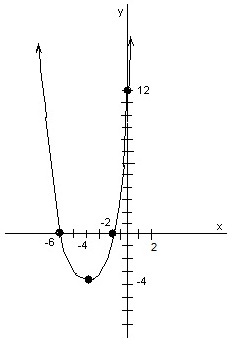
Write the quadratic function for the graph:
Tap to see back →
Method 1:
The x-intercepts are  . These values would be obtained if the original quadratic were factored, or reverse-FOILed and the factors were set equal to zero.
For  ,
,  . For
. For  ,
,  . These equations determine the resulting factors and the resulting function;
  .
.
Multiplying the factors and simplifying,
 .
.
Answer:  .
.
Method 2:
Use the form  , where
  is the vertex.
 is
is  , so
, so  ,
,  .
.

Answer: 



Method 1:
The x-intercepts are
For
Multiplying the factors and simplifying,
Answer:
Method 2:
Use the form
Answer:
Write the quadratic function for the graph:

Write the quadratic function for the graph:
Tap to see back →
Because there are no x-intercepts, use the form  , where vertex
  is
is  , so
, so  ,
,  , which gives


Because there are no x-intercepts, use the form
Write the equation for the polynomial in this graph:
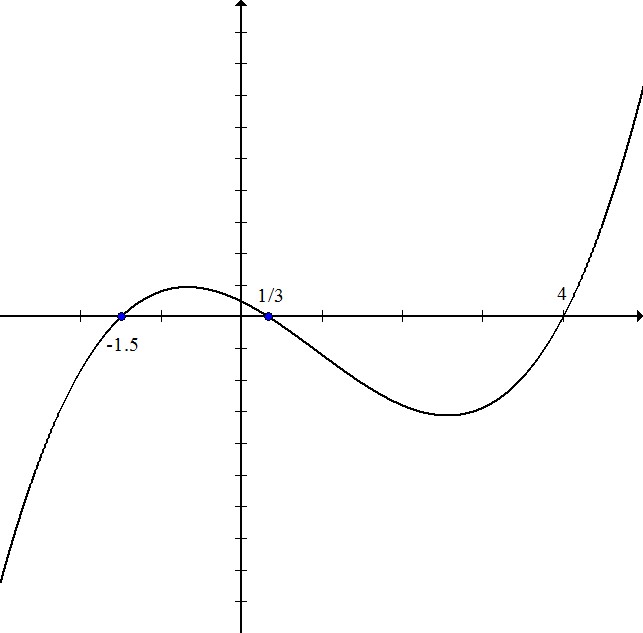
Write the equation for the polynomial in this graph:
Tap to see back →
The zeros for this polynomial are  .
.
This means that the factors are equal to zero when these values are plugged in for x.
 multiply both sides by 2
 so one factor is
 multiply both sides by 3
 so one factor is
 so one factor is
Multiply these three factors:



The zeros for this polynomial are
This means that the factors are equal to zero when these values are plugged in for x.
Multiply these three factors:
Write the equation for the polynomial shown in this graph:
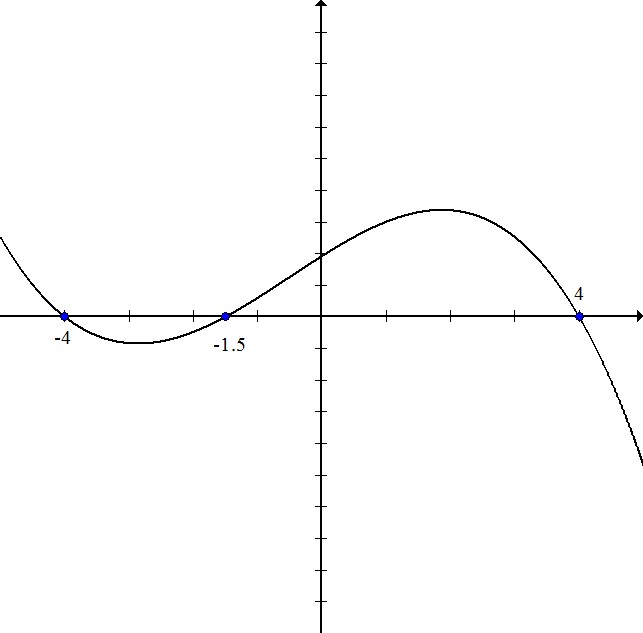
Write the equation for the polynomial shown in this graph:
Tap to see back →
The zeros of this polynomial are  . This means that the factors equal zero when these values are plugged in.
One factor is 
One factor is 
The third factor is equivalent to  . Set equal to 0 and multiply by 2:


Multiply these three factors:


The graph is negative since it goes down then up then down, so we have to switch all of the signs:

The zeros of this polynomial are
One factor is
One factor is
The third factor is equivalent to
Multiply these three factors:
The graph is negative since it goes down then up then down, so we have to switch all of the signs:
Write the equation for the polynomial in this graph:
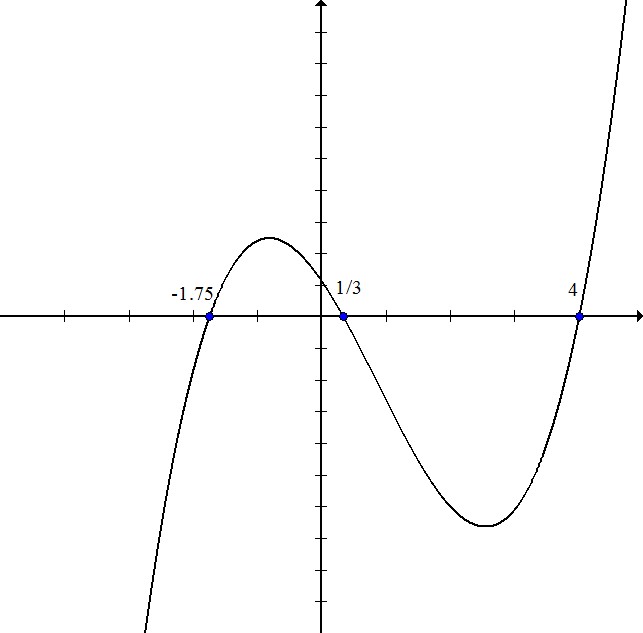
Write the equation for the polynomial in this graph:
Tap to see back →
The zeros for this polynomial are  . That means that the factors are equal to zero when these values are plugged in.
 or equivalently
  multiply both sides by 4
 the first factor is
 multiply both sides by 3
 the second factor is
 the third factor is
Multiply the three factors:



The zeros for this polynomial are
Multiply the three factors:
Write the equation for the polynomial in the graph:
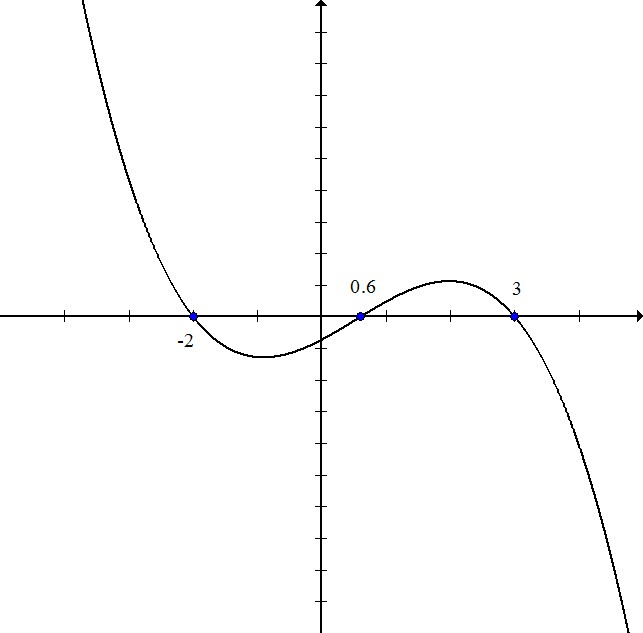
Write the equation for the polynomial in the graph:
Tap to see back →
The zeros of the polynomial are  . That means that the factors equal zero when these values are plugged in.
The first factor is  or equivalently
  multiply both sides by 5:

The second and third factors are  and
and 
Multiply:



Because the graph goes down-up-down instead of the standard up-down-up, the graph is negative, so change all of the signs:

The zeros of the polynomial are
The first factor is
The second and third factors are
Multiply:
Because the graph goes down-up-down instead of the standard up-down-up, the graph is negative, so change all of the signs:
Which could be the equation for this graph?
Which could be the equation for this graph?
Tap to see back →
This graph has zeros at 3, -2, and -4.5. This means that , , and . That last root is easier to work with if we consider it as and simplify it to . Also, this is a negative polynomial, because it is decreasing, increasing, decreasing and not the other way around.
Our equation results from multiplying , which results in .
This graph has zeros at 3, -2, and -4.5. This means that
Our equation results from multiplying
Write the quadratic function for the graph:
Write the quadratic function for the graph:
Tap to see back →
Method 1:
The x-intercepts are . These values would be obtained if the original quadratic were factored, or reverse-FOILed and the factors were set equal to zero.
For , . For , . These equations determine the resulting factors and the resulting function; .
Multiplying the factors and simplifying,
.
Answer: .
Method 2:
Use the form , where is the vertex.
is , so , .
Answer:
Method 1:
The x-intercepts are
For
Multiplying the factors and simplifying,
Answer:
Method 2:
Use the form
Answer:
Write the quadratic function for the graph:
Write the quadratic function for the graph:
Tap to see back →
Because there are no x-intercepts, use the form , where vertex is , so , , which gives
Because there are no x-intercepts, use the form
Write the equation for the polynomial in this graph:
Write the equation for the polynomial in this graph:
Tap to see back →
The zeros for this polynomial are .
This means that the factors are equal to zero when these values are plugged in for x.
multiply both sides by 2
so one factor is
multiply both sides by 3
so one factor is
so one factor is
Multiply these three factors:
The zeros for this polynomial are
This means that the factors are equal to zero when these values are plugged in for x.
Multiply these three factors:
Write the equation for the polynomial shown in this graph:
Write the equation for the polynomial shown in this graph:
Tap to see back →
The zeros of this polynomial are . This means that the factors equal zero when these values are plugged in.
One factor is
One factor is
The third factor is equivalent to . Set equal to 0 and multiply by 2:
Multiply these three factors:
The graph is negative since it goes down then up then down, so we have to switch all of the signs:
The zeros of this polynomial are
One factor is
One factor is
The third factor is equivalent to
Multiply these three factors:
The graph is negative since it goes down then up then down, so we have to switch all of the signs:
Write the equation for the polynomial in this graph:
Write the equation for the polynomial in this graph:
Tap to see back →
The zeros for this polynomial are . That means that the factors are equal to zero when these values are plugged in.
or equivalently multiply both sides by 4
the first factor is
multiply both sides by 3
the second factor is
the third factor is
Multiply the three factors:
The zeros for this polynomial are
Multiply the three factors:
Write the equation for the polynomial in the graph:
Write the equation for the polynomial in the graph:
Tap to see back →
The zeros of the polynomial are . That means that the factors equal zero when these values are plugged in.
The first factor is or equivalently multiply both sides by 5:
The second and third factors are and
Multiply:
Because the graph goes down-up-down instead of the standard up-down-up, the graph is negative, so change all of the signs:
The zeros of the polynomial are
The first factor is
The second and third factors are
Multiply:
Because the graph goes down-up-down instead of the standard up-down-up, the graph is negative, so change all of the signs:
Write the quadratic function for the graph:
Write the quadratic function for the graph:
Tap to see back →
Method 1:
The x-intercepts are . These values would be obtained if the original quadratic were factored, or reverse-FOILed and the factors were set equal to zero.
For , . For , . These equations determine the resulting factors and the resulting function; .
Multiplying the factors and simplifying,
.
Answer: .
Method 2:
Use the form , where is the vertex.
is , so , .
Answer:
Method 1:
The x-intercepts are
For
Multiplying the factors and simplifying,
Answer:
Method 2:
Use the form
Answer:
Write the quadratic function for the graph:
Write the quadratic function for the graph:
Tap to see back →
Because there are no x-intercepts, use the form , where vertex is , so , , which gives
Because there are no x-intercepts, use the form
Which could be the equation for this graph?
Which could be the equation for this graph?
Tap to see back →
This graph has zeros at 3, -2, and -4.5. This means that , , and . That last root is easier to work with if we consider it as and simplify it to . Also, this is a negative polynomial, because it is decreasing, increasing, decreasing and not the other way around.
Our equation results from multiplying , which results in .
This graph has zeros at 3, -2, and -4.5. This means that
Our equation results from multiplying
Write the equation for the polynomial in this graph:
Write the equation for the polynomial in this graph:
Tap to see back →
The zeros for this polynomial are .
This means that the factors are equal to zero when these values are plugged in for x.
multiply both sides by 2
so one factor is
multiply both sides by 3
so one factor is
so one factor is
Multiply these three factors:
The zeros for this polynomial are
This means that the factors are equal to zero when these values are plugged in for x.
Multiply these three factors:
Write the equation for the polynomial shown in this graph:
Write the equation for the polynomial shown in this graph:
Tap to see back →
The zeros of this polynomial are . This means that the factors equal zero when these values are plugged in.
One factor is
One factor is
The third factor is equivalent to . Set equal to 0 and multiply by 2:
Multiply these three factors:
The graph is negative since it goes down then up then down, so we have to switch all of the signs:
The zeros of this polynomial are
One factor is
One factor is
The third factor is equivalent to
Multiply these three factors:
The graph is negative since it goes down then up then down, so we have to switch all of the signs:
Write the equation for the polynomial in this graph:
Write the equation for the polynomial in this graph:
Tap to see back →
The zeros for this polynomial are . That means that the factors are equal to zero when these values are plugged in.
or equivalently multiply both sides by 4
the first factor is
multiply both sides by 3
the second factor is
the third factor is
Multiply the three factors:
The zeros for this polynomial are
Multiply the three factors: