Decimals - PSAT Math
Card 0 of 322
Trevor, James, and Will were each given a candy bar. Trevor ate 7/12 of his and Will ate 20% of his. If James ate more than Will and less than Trevor, what amount could James have eaten?
Trevor, James, and Will were each given a candy bar. Trevor ate 7/12 of his and Will ate 20% of his. If James ate more than Will and less than Trevor, what amount could James have eaten?
Tap to see back →
Turn Trevor and Will’s amounts into decimals to compare: 20% = 0.20 and 7/12 = 0.5083 rounded. When the answer choices are converted into decimals, 2/7 = 0.2871 is the only value between 0.20 and 0.5083.
Turn Trevor and Will’s amounts into decimals to compare: 20% = 0.20 and 7/12 = 0.5083 rounded. When the answer choices are converted into decimals, 2/7 = 0.2871 is the only value between 0.20 and 0.5083.

Tap to see back →
.3 can be written as .30. Now we can add the two more easily:


.3 can be written as .30. Now we can add the two more easily:
Which of the following numbers is between 1/5 and 1/6?
Which of the following numbers is between 1/5 and 1/6?
Tap to see back →
Long division shows that 1/5 = 0.20 and 1/6 = 0.16666... 0.13 < 0.16 < 1/6 < 0.19 < 1/5 < 0.22 < 0.25.
Long division shows that 1/5 = 0.20 and 1/6 = 0.16666... 0.13 < 0.16 < 1/6 < 0.19 < 1/5 < 0.22 < 0.25.
At the store, green fabric costs $4.53 a yard. How much does 3.8 yards of green fabric cost? (Round to two decimal places.)
At the store, green fabric costs $4.53 a yard. How much does 3.8 yards of green fabric cost? (Round to two decimal places.)
Tap to see back →
This is a simple multiplication problem involving decimals. Simply multiply 4.53 by 3.8:

Now, round to the nearest two decimal places, giving an answer of 17.21.
This is a simple multiplication problem involving decimals. Simply multiply 4.53 by 3.8:
Now, round to the nearest two decimal places, giving an answer of 17.21.
The ogre under the bridge eats  of a pizza and then throws the rest of the pizza to the rats. The rats eat
  of what is left. What fraction of the pizza is left when the rats are done?
The ogre under the bridge eats
Tap to see back →
1/5 of the pizza is left after the ogre eats his share. The rats eat 3/4 of that, so 1/4 of 1/5 of the pizza is left.
1/4 * 1/5 = 1/20 = 5%
1/5 of the pizza is left after the ogre eats his share. The rats eat 3/4 of that, so 1/4 of 1/5 of the pizza is left.
1/4 * 1/5 = 1/20 = 5%
Tap to see back →
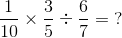
Multiply numerator by the other numerator and multiply the denominator by the other denominator for multiplication. To divide fractions, switch numerator and denominator and treat it as multiplication. The answer is 0.07.
Multiply numerator by the other numerator and multiply the denominator by the other denominator for multiplication. To divide fractions, switch numerator and denominator and treat it as multiplication. The answer is 0.07.
How much less is  than
than  ?
?
How much less is
Tap to see back →
$\frac{1}{16}$=.0625
.0665-.0625=.004=\frac{4}{1000}$=\frac{1}{250}$
$\frac{1}{16}$=.0625
.0665-.0625=.004=\frac{4}{1000}$=\frac{1}{250}$
Express as a decimal: 
Express as a decimal:
Tap to see back →
Divide 16 by 9:
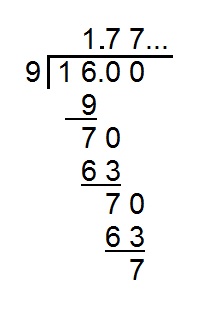
The "7" repeats forever, so

Divide 16 by 9:
The "7" repeats forever, so
Express as a decimal: 
Express as a decimal:
Tap to see back →
Divide 9 by 16:
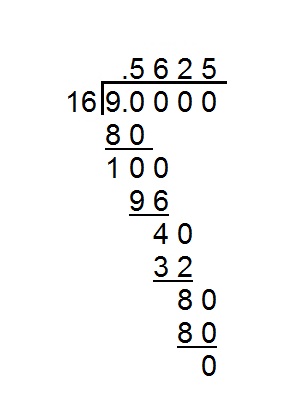

Divide 9 by 16:
Convert the fraction to a decimal.

Convert the fraction to a decimal.
Tap to see back →
We can multiply our numerator and denominator by  , which leads to
  . From here we divide by our denominator, moving the decimal two places to the left.
We can multiply our numerator and denominator by
Write 0.45 as a fraction.
Write 0.45 as a fraction.
Tap to see back →
.45 is equivalent to 45 out of 100, or  .
.
Divide both the numerator and denominator by 5 to simplify the fraction:

.45 is equivalent to 45 out of 100, or
Divide both the numerator and denominator by 5 to simplify the fraction:
Express as a fraction: 
Express as a fraction:
Tap to see back →
Let 
Then

and

Subtract:




Let
Then
and
Subtract:
If Johnny buys two comic books, priced at $1.50 each, and a candy bar, priced at $0.75, he'll have three quarters and two dimes left over. How much money does he have right now?
If Johnny buys two comic books, priced at $1.50 each, and a candy bar, priced at $0.75, he'll have three quarters and two dimes left over. How much money does he have right now?
Tap to see back →
Add what he can purchase to what he has left over:
Two comic books and the candy bar: $1.50 + $1.0 + $0.75 = $3.75
Three quarters and two dimes: $0.75 + $0.20 = $0.95
Therefore his total amount of money is $3.75 + $0.95 = $4.70.
Add what he can purchase to what he has left over:
Two comic books and the candy bar: $1.50 + $1.0 + $0.75 = $3.75
Three quarters and two dimes: $0.75 + $0.20 = $0.95
Therefore his total amount of money is $3.75 + $0.95 = $4.70.
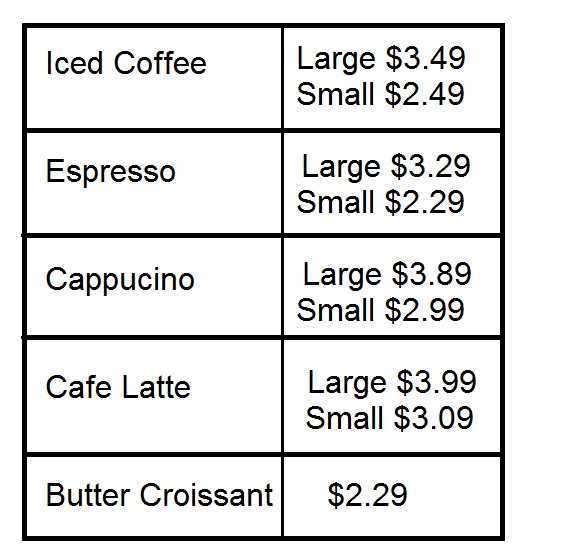
Above is the menu at a coffee shop.
Delia has a coupon that entitles her to a free butter croissant with the purchase of one large drink of any kind. The coupon says "limit one per coupon".
She decides to purchase two small espressos, two small cappucinos, and four butter croissants. Disregarding tax, how much will Delia spend?
Above is the menu at a coffee shop.
Delia has a coupon that entitles her to a free butter croissant with the purchase of one large drink of any kind. The coupon says "limit one per coupon".
She decides to purchase two small espressos, two small cappucinos, and four butter croissants. Disregarding tax, how much will Delia spend?
Tap to see back →
Delia will not use the coupon, since all four of her drinks are small. She will pay full price for:
Two small espressos: 
Two small cappucinos: 
Four butter croissants: 
The total price: 
Delia will not use the coupon, since all four of her drinks are small. She will pay full price for:
Two small espressos:
Two small cappucinos:
Four butter croissants:
The total price:
Find the sum.

Find the sum.
Tap to see back →

Find the sum.

Find the sum.
Tap to see back →

Convert 0.0004640 into scientific notation.
Convert 0.0004640 into scientific notation.
Tap to see back →
When written in scientific notation, a number will follow the format  in which
  is between one and ten and
  is an integer value.
To find  , take the first non-zero digit in your given number as the ones place. In 0.0004640 this would be the first 4. All subsequent digits fall into the tenths, hundredths, etc. places.

To find  , we must count the number of places that
  is removed. In 0.0004640, the first digit of
  is in the ten-thousandths place. This indicates that
  will be
  .
.
Together, the final scientific notation will be  .
.
When written in scientific notation, a number will follow the format
To find
To find
Together, the final scientific notation will be
Express 770,000,000,000 in scientific notation.
Express 770,000,000,000 in scientific notation.
Tap to see back →
Write the number with a decimal point and without commas:

Counting the number of places, move the decimal point to the left until it is after the first nonzero digit:

The resulting number is 7.7; the number of places the decimal point moved to the left was 11. In scientific notation, this number is  .
.
Write the number with a decimal point and without commas:
Counting the number of places, move the decimal point to the left until it is after the first nonzero digit:
The resulting number is 7.7; the number of places the decimal point moved to the left was 11. In scientific notation, this number is
Convert  into scientific notation.
Convert
Tap to see back →
To convert a number into scientific notation, the decimal must be moved until our base number is greater than 1 and less than 10. Next, we must count the number of places we moved it and multiply it by 10 to that number. Thus, our answer is:

To convert a number into scientific notation, the decimal must be moved until our base number is greater than 1 and less than 10. Next, we must count the number of places we moved it and multiply it by 10 to that number. Thus, our answer is:
Represent  in scientific notation.
Represent
Tap to see back →

Trick: Count how many times you move the decimal to get 3.452. We moved the decimal 6 times to the right so the exponent above 10 will be -6. If we move the decimal to the left then our exponent would be positive.
Another way to remember whether the exponent will be negative or possitive is whether or not the original number is less than or greater than one. If the original number is less than one, when you put it in scientific notation the exponent above the 10 will be negative. On the other hand, if the original number is greater than one, then the exponent above the 10 will be positive.
Trick: Count how many times you move the decimal to get 3.452. We moved the decimal 6 times to the right so the exponent above 10 will be -6. If we move the decimal to the left then our exponent would be positive.
Another way to remember whether the exponent will be negative or possitive is whether or not the original number is less than or greater than one. If the original number is less than one, when you put it in scientific notation the exponent above the 10 will be negative. On the other hand, if the original number is greater than one, then the exponent above the 10 will be positive.