Factoring and Simplifying Square Roots - PSAT Math
Card 0 of 84
If m and n are postive integers and 4m = 2n, what is the value of m/n?
If m and n are postive integers and 4m = 2n, what is the value of m/n?
Tap to see back →
- 22 = 4. Also, following the rules of exponents, 41 = 1.
- One can therefore say that m = 1 and n = 2.
- The question asks to solve for m/n. Since m = 1 and n = 2, m/n = 1/2.
- 22 = 4. Also, following the rules of exponents, 41 = 1.
- One can therefore say that m = 1 and n = 2.
- The question asks to solve for m/n. Since m = 1 and n = 2, m/n = 1/2.
Solve for x:
x$\sqrt{45}$+x$\sqrt{72}$=$\sqrt{18}$
Solve for x:
x$\sqrt{45}$+x$\sqrt{72}$=$\sqrt{18}$
Tap to see back →
x$\sqrt{45}$+x$\sqrt{72}$=$\sqrt{18}$
Notice how all of the quantities in square roots are divisible by 9
x$\sqrt{9times 5}$+x$\sqrt{9times 8}$=$\sqrt{9times 2}$
x$\sqrt{9}$$\sqrt{5}$+x$\sqrt{9}$$\sqrt{4times 2}$=$\sqrt{9}$$\sqrt{2}$
3x$\sqrt{5}$+3x$\sqrt{4}$$\sqrt{2}$=3$\sqrt{2}$
3x$\sqrt{5}$+6x$\sqrt{2}$=3$\sqrt{2}$
x(3$\sqrt{5}$+6$\sqrt{2}$)=3$\sqrt{2}$
x=\frac{3sqrt{2}$}{3$\sqrt{5}$+6$\sqrt{2}$}
Simplifying, this becomes
x=\frac{sqrt{2}$}{$\sqrt{5}$+2$\sqrt{2}$}
x$\sqrt{45}$+x$\sqrt{72}$=$\sqrt{18}$
Notice how all of the quantities in square roots are divisible by 9
x$\sqrt{9times 5}$+x$\sqrt{9times 8}$=$\sqrt{9times 2}$
x$\sqrt{9}$$\sqrt{5}$+x$\sqrt{9}$$\sqrt{4times 2}$=$\sqrt{9}$$\sqrt{2}$
3x$\sqrt{5}$+3x$\sqrt{4}$$\sqrt{2}$=3$\sqrt{2}$
3x$\sqrt{5}$+6x$\sqrt{2}$=3$\sqrt{2}$
x(3$\sqrt{5}$+6$\sqrt{2}$)=3$\sqrt{2}$
x=\frac{3sqrt{2}$}{3$\sqrt{5}$+6$\sqrt{2}$}
Simplifying, this becomes
x=\frac{sqrt{2}$}{$\sqrt{5}$+2$\sqrt{2}$}
Simplify the radical:

Simplify the radical:
Tap to see back →

Simplify
9 ÷ √3
Simplify
9 ÷ √3
Tap to see back →
in order to simplify a square root on the bottom, multiply top and bottom by the root
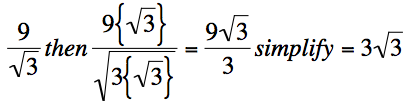
in order to simplify a square root on the bottom, multiply top and bottom by the root
Simplify:
√112
Simplify:
√112
Tap to see back →
√112 = {√2 * √56} = {√2 * √2 * √28} = {2√28} = {2√4 * √7} = 4√7
√112 = {√2 * √56} = {√2 * √2 * √28} = {2√28} = {2√4 * √7} = 4√7
Simplify:
√192
Simplify:
√192
Tap to see back →
√192 = √2 X √96
√96 = √2 X √48
√48 = √4 X√12
√12 = √4 X √3
√192 = √(2X2X4X4) X √3
= √4X√4X√4 X √3
= 8√3
√192 = √2 X √96
√96 = √2 X √48
√48 = √4 X√12
√12 = √4 X √3
√192 = √(2X2X4X4) X √3
= √4X√4X√4 X √3
= 8√3
Simplify:

Simplify:
Tap to see back →
4√27 + 16√75 +3√12 =
4*(√3)*(√9) + 16*(√3)*(√25) +3*(√3)*(√4) =
4*(√3)*(3) + 16*(√3)*(5) + 3*(√3)*(2) =
12√3 + 80√3 +6√3= 98√3
4√27 + 16√75 +3√12 =
4*(√3)*(√9) + 16*(√3)*(√25) +3*(√3)*(√4) =
4*(√3)*(3) + 16*(√3)*(5) + 3*(√3)*(2) =
12√3 + 80√3 +6√3= 98√3
What is the simplest way to express $\sqrt{3888}$?
What is the simplest way to express $\sqrt{3888}$?
Tap to see back →
First we will list the factors of 3888:
$3888=3times1296=3times3times432=3^2times12times36$$=3^2times12times12times3$$=3^2times12$^2times3

First we will list the factors of 3888:
$3888=3times1296=3times3times432=3^2times12times36$$=3^2times12times12times3$$=3^2times12$^2times3
Simplify. Assume all variables are positive real numbers.

Simplify. Assume all variables are positive real numbers.
Tap to see back →

The index coefficent in  is represented by
  . When no index is present, assume it is equal to 2.
  under the radical is known as the radican, the number you are taking a root of.
First look for a perfect square, 
Then to your Variables 
Take your exponents on both variables and determine the number of times our index will evenly go into both.

So you would take out a  and would be left with a

*Dividing the radican exponent by the index - gives you the number of variables that should be pulled out.
The final answer would be  .
.
The index coefficent in
First look for a perfect square,
Then to your Variables
Take your exponents on both variables and determine the number of times our index will evenly go into both.
So you would take out a
*Dividing the radican exponent by the index - gives you the number of variables that should be pulled out.
The final answer would be
Simplify. Assume all integers are positive real numbers.

Simplify. Assume all integers are positive real numbers.
Tap to see back →

Index of  means the cube root of Radican
Find a perfect cube in 


Simplify the perfect cube, giving you  .
.
Take your exponents on both variables and determine the number of times our index will evenly go into both.
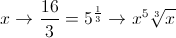
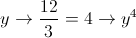
The final answer would be

Index of
Find a perfect cube in
Simplify the perfect cube, giving you
Take your exponents on both variables and determine the number of times our index will evenly go into both.
The final answer would be
Simplify square roots. Assume all integers are positive real numbers.
Simplify as much as possible. List all possible answers.
1a.
1b. 
1c. 
Simplify square roots. Assume all integers are positive real numbers.
Simplify as much as possible. List all possible answers.
1a.
1b.
1c.
Tap to see back →
When simplifying radicans (integers under the radical symbol), we first want to look for a perfect square. For example,  is not a perfect square. You look to find factors of
  to see if there is a perfect square factor in
  , which there is.
1a. 
Do the same thing for  .
.
1b.
1c.Follow the same procedure except now you are looking for perfect cubes.

When simplifying radicans (integers under the radical symbol), we first want to look for a perfect square. For example,
1a.
Do the same thing for
1b.
1c.Follow the same procedure except now you are looking for perfect cubes.
Simplify: 
Simplify:
Tap to see back →
To simplify a square root, you can break the number down into its prime factors using a factor tree. The prime factors of 72 are  . Let's take each piece separately.
The square root of  can be simplified to be
  which is the same as
  .
.
The square root of  is
is  .
.
When you multiply together your answers, 
To simplify a square root, you can break the number down into its prime factors using a factor tree. The prime factors of 72 are
The square root of
The square root of
When you multiply together your answers,
If m and n are postive integers and 4m = 2n, what is the value of m/n?
If m and n are postive integers and 4m = 2n, what is the value of m/n?
Tap to see back →
- 22 = 4. Also, following the rules of exponents, 41 = 1.
- One can therefore say that m = 1 and n = 2.
- The question asks to solve for m/n. Since m = 1 and n = 2, m/n = 1/2.
- 22 = 4. Also, following the rules of exponents, 41 = 1.
- One can therefore say that m = 1 and n = 2.
- The question asks to solve for m/n. Since m = 1 and n = 2, m/n = 1/2.
Solve for x:
x$\sqrt{45}$+x$\sqrt{72}$=$\sqrt{18}$
Solve for x:
x$\sqrt{45}$+x$\sqrt{72}$=$\sqrt{18}$
Tap to see back →
x$\sqrt{45}$+x$\sqrt{72}$=$\sqrt{18}$
Notice how all of the quantities in square roots are divisible by 9
x$\sqrt{9times 5}$+x$\sqrt{9times 8}$=$\sqrt{9times 2}$
x$\sqrt{9}$$\sqrt{5}$+x$\sqrt{9}$$\sqrt{4times 2}$=$\sqrt{9}$$\sqrt{2}$
3x$\sqrt{5}$+3x$\sqrt{4}$$\sqrt{2}$=3$\sqrt{2}$
3x$\sqrt{5}$+6x$\sqrt{2}$=3$\sqrt{2}$
x(3$\sqrt{5}$+6$\sqrt{2}$)=3$\sqrt{2}$
x=\frac{3sqrt{2}$}{3$\sqrt{5}$+6$\sqrt{2}$}
Simplifying, this becomes
x=\frac{sqrt{2}$}{$\sqrt{5}$+2$\sqrt{2}$}
x$\sqrt{45}$+x$\sqrt{72}$=$\sqrt{18}$
Notice how all of the quantities in square roots are divisible by 9
x$\sqrt{9times 5}$+x$\sqrt{9times 8}$=$\sqrt{9times 2}$
x$\sqrt{9}$$\sqrt{5}$+x$\sqrt{9}$$\sqrt{4times 2}$=$\sqrt{9}$$\sqrt{2}$
3x$\sqrt{5}$+3x$\sqrt{4}$$\sqrt{2}$=3$\sqrt{2}$
3x$\sqrt{5}$+6x$\sqrt{2}$=3$\sqrt{2}$
x(3$\sqrt{5}$+6$\sqrt{2}$)=3$\sqrt{2}$
x=\frac{3sqrt{2}$}{3$\sqrt{5}$+6$\sqrt{2}$}
Simplifying, this becomes
x=\frac{sqrt{2}$}{$\sqrt{5}$+2$\sqrt{2}$}
Simplify the radical:
Simplify the radical:
Tap to see back →
Simplify
9 ÷ √3
Simplify
9 ÷ √3
Tap to see back →
in order to simplify a square root on the bottom, multiply top and bottom by the root
in order to simplify a square root on the bottom, multiply top and bottom by the root
Simplify:
√112
Simplify:
√112
Tap to see back →
√112 = {√2 * √56} = {√2 * √2 * √28} = {2√28} = {2√4 * √7} = 4√7
√112 = {√2 * √56} = {√2 * √2 * √28} = {2√28} = {2√4 * √7} = 4√7
Simplify:
√192
Simplify:
√192
Tap to see back →
√192 = √2 X √96
√96 = √2 X √48
√48 = √4 X√12
√12 = √4 X √3
√192 = √(2X2X4X4) X √3
= √4X√4X√4 X √3
= 8√3
√192 = √2 X √96
√96 = √2 X √48
√48 = √4 X√12
√12 = √4 X √3
√192 = √(2X2X4X4) X √3
= √4X√4X√4 X √3
= 8√3
Simplify:
Simplify:
Tap to see back →
4√27 + 16√75 +3√12 =
4*(√3)*(√9) + 16*(√3)*(√25) +3*(√3)*(√4) =
4*(√3)*(3) + 16*(√3)*(5) + 3*(√3)*(2) =
12√3 + 80√3 +6√3= 98√3
4√27 + 16√75 +3√12 =
4*(√3)*(√9) + 16*(√3)*(√25) +3*(√3)*(√4) =
4*(√3)*(3) + 16*(√3)*(5) + 3*(√3)*(2) =
12√3 + 80√3 +6√3= 98√3
What is the simplest way to express $\sqrt{3888}$?
What is the simplest way to express $\sqrt{3888}$?
Tap to see back →
First we will list the factors of 3888:
$3888=3times1296=3times3times432=3^2times12times36$$=3^2times12times12times3$$=3^2times12$^2times3
First we will list the factors of 3888:
$3888=3times1296=3times3times432=3^2times12times36$$=3^2times12times12times3$$=3^2times12$^2times3