Decimal Operations - PSAT Math
Card 0 of 252

Tap to see back →
.3 can be written as .30. Now we can add the two more easily:


.3 can be written as .30. Now we can add the two more easily:
At the store, green fabric costs $4.53 a yard. How much does 3.8 yards of green fabric cost? (Round to two decimal places.)
At the store, green fabric costs $4.53 a yard. How much does 3.8 yards of green fabric cost? (Round to two decimal places.)
Tap to see back →
This is a simple multiplication problem involving decimals. Simply multiply 4.53 by 3.8:

Now, round to the nearest two decimal places, giving an answer of 17.21.
This is a simple multiplication problem involving decimals. Simply multiply 4.53 by 3.8:
Now, round to the nearest two decimal places, giving an answer of 17.21.
If Johnny buys two comic books, priced at $1.50 each, and a candy bar, priced at $0.75, he'll have three quarters and two dimes left over. How much money does he have right now?
If Johnny buys two comic books, priced at $1.50 each, and a candy bar, priced at $0.75, he'll have three quarters and two dimes left over. How much money does he have right now?
Tap to see back →
Add what he can purchase to what he has left over:
Two comic books and the candy bar: $1.50 + $1.0 + $0.75 = $3.75
Three quarters and two dimes: $0.75 + $0.20 = $0.95
Therefore his total amount of money is $3.75 + $0.95 = $4.70.
Add what he can purchase to what he has left over:
Two comic books and the candy bar: $1.50 + $1.0 + $0.75 = $3.75
Three quarters and two dimes: $0.75 + $0.20 = $0.95
Therefore his total amount of money is $3.75 + $0.95 = $4.70.
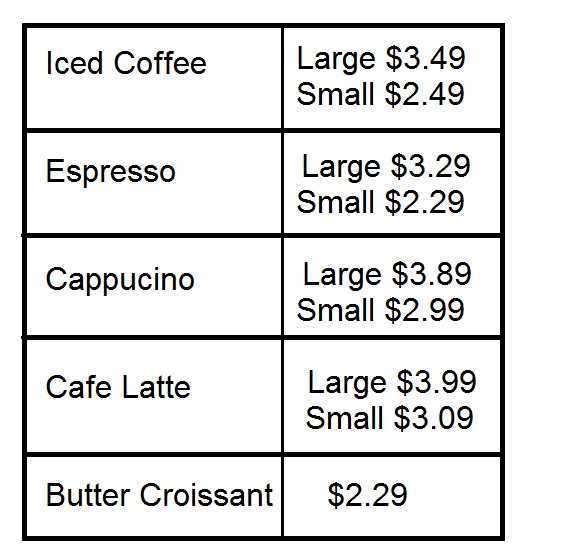
Above is the menu at a coffee shop.
Delia has a coupon that entitles her to a free butter croissant with the purchase of one large drink of any kind. The coupon says "limit one per coupon".
She decides to purchase two small espressos, two small cappucinos, and four butter croissants. Disregarding tax, how much will Delia spend?
Above is the menu at a coffee shop.
Delia has a coupon that entitles her to a free butter croissant with the purchase of one large drink of any kind. The coupon says "limit one per coupon".
She decides to purchase two small espressos, two small cappucinos, and four butter croissants. Disregarding tax, how much will Delia spend?
Tap to see back →
Delia will not use the coupon, since all four of her drinks are small. She will pay full price for:
Two small espressos: 
Two small cappucinos: 
Four butter croissants: 
The total price: 
Delia will not use the coupon, since all four of her drinks are small. She will pay full price for:
Two small espressos:
Two small cappucinos:
Four butter croissants:
The total price:
Find the sum.

Find the sum.
Tap to see back →

Find the sum.

Find the sum.
Tap to see back →

Convert 0.0004640 into scientific notation.
Convert 0.0004640 into scientific notation.
Tap to see back →
When written in scientific notation, a number will follow the format  in which
  is between one and ten and
  is an integer value.
To find  , take the first non-zero digit in your given number as the ones place. In 0.0004640 this would be the first 4. All subsequent digits fall into the tenths, hundredths, etc. places.

To find  , we must count the number of places that
  is removed. In 0.0004640, the first digit of
  is in the ten-thousandths place. This indicates that
  will be
  .
.
Together, the final scientific notation will be  .
.
When written in scientific notation, a number will follow the format
To find
To find
Together, the final scientific notation will be
Express 770,000,000,000 in scientific notation.
Express 770,000,000,000 in scientific notation.
Tap to see back →
Write the number with a decimal point and without commas:

Counting the number of places, move the decimal point to the left until it is after the first nonzero digit:

The resulting number is 7.7; the number of places the decimal point moved to the left was 11. In scientific notation, this number is  .
.
Write the number with a decimal point and without commas:
Counting the number of places, move the decimal point to the left until it is after the first nonzero digit:
The resulting number is 7.7; the number of places the decimal point moved to the left was 11. In scientific notation, this number is
Convert  into scientific notation.
Convert
Tap to see back →
To convert a number into scientific notation, the decimal must be moved until our base number is greater than 1 and less than 10. Next, we must count the number of places we moved it and multiply it by 10 to that number. Thus, our answer is:

To convert a number into scientific notation, the decimal must be moved until our base number is greater than 1 and less than 10. Next, we must count the number of places we moved it and multiply it by 10 to that number. Thus, our answer is:
Represent  in scientific notation.
Represent
Tap to see back →

Trick: Count how many times you move the decimal to get 3.452. We moved the decimal 6 times to the right so the exponent above 10 will be -6. If we move the decimal to the left then our exponent would be positive.
Another way to remember whether the exponent will be negative or possitive is whether or not the original number is less than or greater than one. If the original number is less than one, when you put it in scientific notation the exponent above the 10 will be negative. On the other hand, if the original number is greater than one, then the exponent above the 10 will be positive.
Trick: Count how many times you move the decimal to get 3.452. We moved the decimal 6 times to the right so the exponent above 10 will be -6. If we move the decimal to the left then our exponent would be positive.
Another way to remember whether the exponent will be negative or possitive is whether or not the original number is less than or greater than one. If the original number is less than one, when you put it in scientific notation the exponent above the 10 will be negative. On the other hand, if the original number is greater than one, then the exponent above the 10 will be positive.
12 grams of oxygen are equal to  atoms. Which of the following comes closest to the mass, in grams, of one million atoms of oxygen?
12 grams of oxygen are equal to
Tap to see back →
In scientific notation, one million atoms is equal to  atoms. To find the mass
  of this many atoms, we can solve the proportion statement


In scientific notation, one million atoms is equal to
Define an operation  as follows:
For all real numbers  ,
,

Which of the following is equal to  ?
?
Define an operation
For all real numbers
Which of the following is equal to
Tap to see back →
Substitute and execute the operations:


Move the decimal point right five places to get it after the first nonzero digit; the scientific notation equivalent is

Substitute and execute the operations:
Move the decimal point right five places to get it after the first nonzero digit; the scientific notation equivalent is
Define an operation as follows:
For all real numbers ,

Which of the following is equal to  ?
?
Define an operation
For all real numbers
Which of the following is equal to
Tap to see back →
Substitute and execute the operations:


Move the decimal point right two places to get it after the first nonzero digit; the scientific notation equivalent is

Substitute and execute the operations:
Move the decimal point right two places to get it after the first nonzero digit; the scientific notation equivalent is
Define an operation as follows:
For all real numbers  ,
,

Which of the following is equal to  ?
?
Define an operation
For all real numbers
Which of the following is equal to
Tap to see back →
Substitute and execute the operations:


Move the decimal point right four places to get it after the first nonzero digit; the scientific notation equivalent is

Substitute and execute the operations:
Move the decimal point right four places to get it after the first nonzero digit; the scientific notation equivalent is
 can be represented by which of the following notations?
Tap to see back →
In order to convert the decimal to scientific notation, count the number of spaces from the decimal point to the space between the 4 and the 6 (scientific notation requires that the leftmost number be a number between 1 and 10). In this instance it is 3 spaces. Since the decimal point will be moving from left to right, we know that our exponent will be negative, and in this case -3.
 then becomes
  X
X  .
.
In order to convert the decimal to scientific notation, count the number of spaces from the decimal point to the space between the 4 and the 6 (scientific notation requires that the leftmost number be a number between 1 and 10). In this instance it is 3 spaces. Since the decimal point will be moving from left to right, we know that our exponent will be negative, and in this case -3.
simplify: 0.2 ÷ 0.04
simplify: 0.2 ÷ 0.04
Tap to see back →
0.2 ÷ 0.04 <- easiest way to approach is to move the decimal to the right (the same amount of spaces on each side) so that the decimal disappears
since 0.04 has 2 spaces and 0.2 only has 1, move the decimal 2 spaces to the right on each side
0.2 ÷ 0.04 = 20 ÷ 4 = 5
0.2 ÷ 0.04 <- easiest way to approach is to move the decimal to the right (the same amount of spaces on each side) so that the decimal disappears
since 0.04 has 2 spaces and 0.2 only has 1, move the decimal 2 spaces to the right on each side
0.2 ÷ 0.04 = 20 ÷ 4 = 5
If the cost of 20 equally priced pencils cost $5.80, then at the same rate what is the greatest number of pencils you can purchase for $50?
If the cost of 20 equally priced pencils cost $5.80, then at the same rate what is the greatest number of pencils you can purchase for $50?
Tap to see back →
Remeber for this problem that you cannot spend more than $50. First find the price of each pencil by 5.80/20 = 29 cents. And then use this to do 50/0.29 = 172.41. So the greatest number of pencils you can purchase for $50 is 172 pencils.
Remeber for this problem that you cannot spend more than $50. First find the price of each pencil by 5.80/20 = 29 cents. And then use this to do 50/0.29 = 172.41. So the greatest number of pencils you can purchase for $50 is 172 pencils.
Simplify:

Simplify:
Tap to see back →
Multiply both the numerator and denominator by some power of 10 to get rid of the decimals; in this case, multiply both by 10,000.
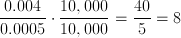
Multiply both the numerator and denominator by some power of 10 to get rid of the decimals; in this case, multiply both by 10,000.
Charlie has charges on his credit card of $63.70, $37.32, and $81.78. If he pays down half his bill at once, and then pays the rest in four equal monthly installments, how much is each monthly installment?
Charlie has charges on his credit card of $63.70, $37.32, and $81.78. If he pays down half his bill at once, and then pays the rest in four equal monthly installments, how much is each monthly installment?
Tap to see back →
Adding all the charges together and dividing by 2 yields $91.40. Dividing this by 4 yields a monthly installment of $22.85.
Adding all the charges together and dividing by 2 yields $91.40. Dividing this by 4 yields a monthly installment of $22.85.
Which number has 2.8 as its reciprocal?
Which number has 2.8 as its reciprocal?
Tap to see back →
The number that has 2.8 as its reciprocal is, in return, the reciprocal of 2.8.
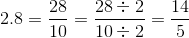
The reciprocal of this can be found by switching the numerator and the denominator. This is  .
.
The number that has 2.8 as its reciprocal is, in return, the reciprocal of 2.8.
The reciprocal of this can be found by switching the numerator and the denominator. This is