Inequalities - PSAT Math
Card 0 of 350
(√(8) / -x ) < 2. Which of the following values could be x?
(√(8) / -x ) < 2. Which of the following values could be x?
Tap to see back →
The equation simplifies to x > -1.41. -1 is the answer.
The equation simplifies to x > -1.41. -1 is the answer.
|12x + 3y| < 15
What is the range of values for y, expressed in terms of x?
|12x + 3y| < 15
What is the range of values for y, expressed in terms of x?
Tap to see back →
Recall that with absolute values and "less than" inequalities, we have to hold the following:
12x + 3y < 15
AND
12x + 3y > –15
Otherwise written, this is:
–15 < 12x + 3y < 15
In this form, we can solve for y. First, we have to subtract x from all 3 parts of the inequality:
–15 – 12x < 3y < 15 – 12x
Now, we have to divide each element by 3:
(–15 – 12x)/3 < y < (15 – 12x)/3
This simplifies to:
–5 – 4x < y < 5 – 4x
Recall that with absolute values and "less than" inequalities, we have to hold the following:
12x + 3y < 15
AND
12x + 3y > –15
Otherwise written, this is:
–15 < 12x + 3y < 15
In this form, we can solve for y. First, we have to subtract x from all 3 parts of the inequality:
–15 – 12x < 3y < 15 – 12x
Now, we have to divide each element by 3:
(–15 – 12x)/3 < y < (15 – 12x)/3
This simplifies to:
–5 – 4x < y < 5 – 4x
|4x + 14| > 30
What is a possible valid value of x?
|4x + 14| > 30
What is a possible valid value of x?
Tap to see back →
This inequality could be rewritten as:
4x + 14 > 30 OR 4x + 14 < –30
Solve each for x:
4x + 14 > 30; 4x > 16; x > 4
4x + 14 < –30; 4x < –44; x < –11
Therefore, anything between –11 and 4 (inclusive) will not work. Hence, the answer is 7.
This inequality could be rewritten as:
4x + 14 > 30 OR 4x + 14 < –30
Solve each for x:
4x + 14 > 30; 4x > 16; x > 4
4x + 14 < –30; 4x < –44; x < –11
Therefore, anything between –11 and 4 (inclusive) will not work. Hence, the answer is 7.
Given the inequality, |2_x_ – 2| > 20,
what is a possible value for x?
Given the inequality, |2_x_ – 2| > 20,
what is a possible value for x?
Tap to see back →
For this problem, we must take into account the absolute value.
First, we solve for 2_x_ – 2 > 20. But we must also solve for 2_x_ – 2 < –20 (please notice that we negate 20 and we also flip the inequality sign).
First step:
2_x_ – 2 > 20
2_x_ > 22
x > 11
Second step:
2_x_ – 2 < –20
2_x_ < –18
x < –9
Therefore, x > 11 and x < –9.
A possible value for x would be –10 since that is less than –9.
Note: the value 11 would not be a possible value for x because the inequality sign given does not include an equal sign.
For this problem, we must take into account the absolute value.
First, we solve for 2_x_ – 2 > 20. But we must also solve for 2_x_ – 2 < –20 (please notice that we negate 20 and we also flip the inequality sign).
First step:
2_x_ – 2 > 20
2_x_ > 22
x > 11
Second step:
2_x_ – 2 < –20
2_x_ < –18
x < –9
Therefore, x > 11 and x < –9.
A possible value for x would be –10 since that is less than –9.
Note: the value 11 would not be a possible value for x because the inequality sign given does not include an equal sign.
-2y+7>-7+y
Given the inequality above, which of the following MUST be true?
-2y+7>-7+y
Given the inequality above, which of the following MUST be true?
Tap to see back →
-2y+7>-7+ySubtract  from both sides:


Subtract 7 from both sides:


Divide both sides by -3:

Remember to switch the inequality when dividing by a negative number:

Since y<$\frac{14}{3}$ is not an answer, we must find an answer that, at the very least, does not contradict the fact that  is less than (approximately) 4.67. Since any number that is less than 4.67 is also less than any number that is bigger than 4.67, we can be sure that
  is less than 5.
-2y+7>-7+ySubtract
Subtract 7 from both sides:
Divide both sides by -3:
Remember to switch the inequality when dividing by a negative number:
Since y<$\frac{14}{3}$ is not an answer, we must find an answer that, at the very least, does not contradict the fact that
What values of x make the following statement true?
|x – 3| < 9
What values of x make the following statement true?
|x – 3| < 9
Tap to see back →
Solve the inequality by adding 3 to both sides to get x < 12. Since it is absolute value, x – 3 > –9 must also be solved by adding 3 to both sides so: x > –6 so combined.
Solve the inequality by adding 3 to both sides to get x < 12. Since it is absolute value, x – 3 > –9 must also be solved by adding 3 to both sides so: x > –6 so combined.
Solve the inequality.

Solve the inequality.
Tap to see back →


* Notice that when we multiply or divide both sides by a negative number the ineqaulity sign changes orientation.

* Notice that when we multiply or divide both sides by a negative number the ineqaulity sign changes orientation.
Solve for  .
.

Solve for
Tap to see back →
Absolute value problems always have two sides: one positive and one negative.
First, take the problem as is and drop the absolute value signs for the positive side: z – 3 ≥ 5. When the original inequality is multiplied by –1 we get z – 3 ≤ –5.
Solve each inequality separately to get z ≤ –2 or z ≥ 8 (the inequality sign flips when multiplying or dividing by a negative number).
We can verify the solution by substituting in 0 for z to see if we get a true or false statement. Since –3 ≥ 5 is always false we know we want the two outside inequalities, rather than their intersection.
Absolute value problems always have two sides: one positive and one negative.
First, take the problem as is and drop the absolute value signs for the positive side: z – 3 ≥ 5. When the original inequality is multiplied by –1 we get z – 3 ≤ –5.
Solve each inequality separately to get z ≤ –2 or z ≥ 8 (the inequality sign flips when multiplying or dividing by a negative number).
We can verify the solution by substituting in 0 for z to see if we get a true or false statement. Since –3 ≥ 5 is always false we know we want the two outside inequalities, rather than their intersection.
If –1 < w < 1, all of the following must also be greater than –1 and less than 1 EXCEPT for which choice?
If –1 < w < 1, all of the following must also be greater than –1 and less than 1 EXCEPT for which choice?
Tap to see back →
3_w_/2 will become greater than 1 as soon as w is greater than two thirds. It will likewise become less than –1 as soon as w is less than negative two thirds. All the other options always return values between –1 and 1.
3_w_/2 will become greater than 1 as soon as w is greater than two thirds. It will likewise become less than –1 as soon as w is less than negative two thirds. All the other options always return values between –1 and 1.
If x+1< 4 and y-2<-1 , then which of the following could be the value of  ?
?
If x+1< 4 and y-2<-1 , then which of the following could be the value of
Tap to see back →
To solve this problem, add the two equations together:
x+1<4
y-2<-1
x+1+y-2<4-1
x+y-1<3
x+y<4
The only answer choice that satisfies this equation is 0, because 0 is less than 4.
To solve this problem, add the two equations together:
x+1<4
y-2<-1
x+1+y-2<4-1
x+y-1<3
x+y<4
The only answer choice that satisfies this equation is 0, because 0 is less than 4.
If  , which of the following could be a value of
  ?
?
If
Tap to see back →
In order to solve this inequality, you must isolate  on one side of the equation.


Therefore, the only option that solves the inequality is  .
.
In order to solve this inequality, you must isolate
Therefore, the only option that solves the inequality is
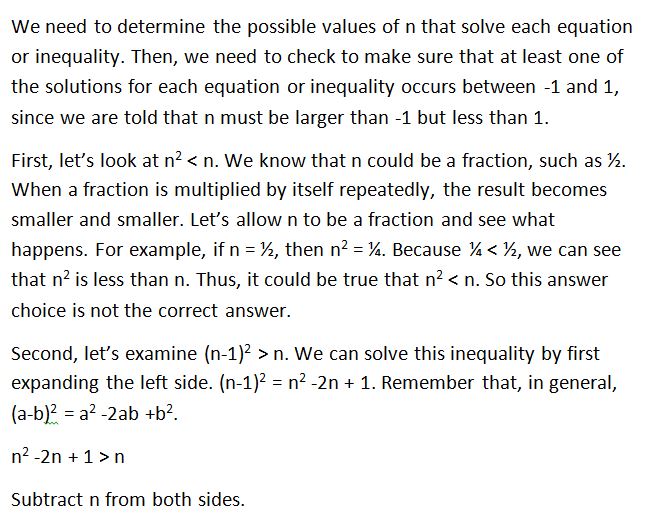
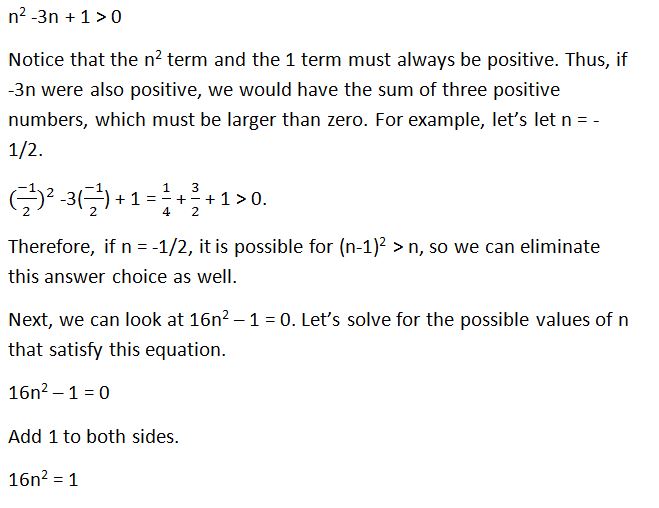
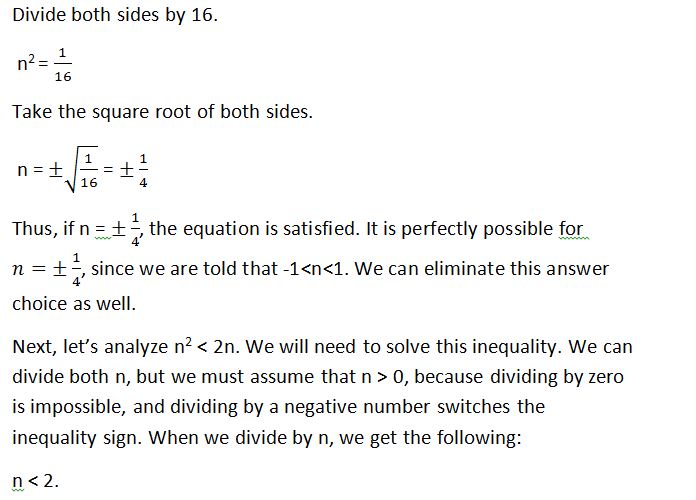
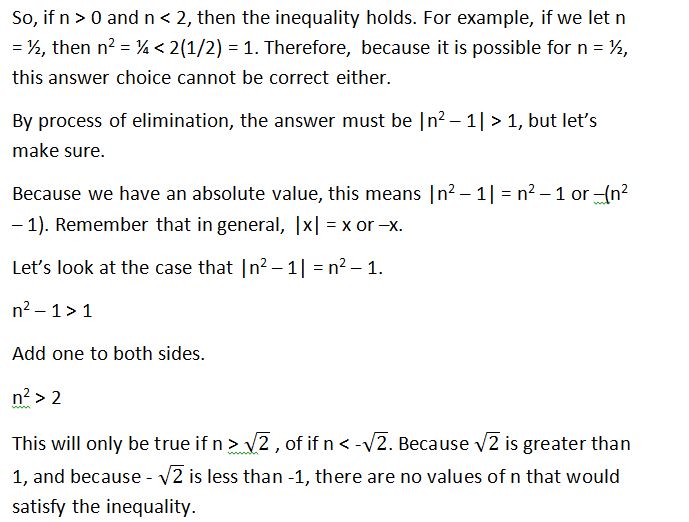
If –1 < n < 1, all of the following could be true EXCEPT:
If –1 < n < 1, all of the following could be true EXCEPT:
Tap to see back →
What values of  make the statement
  true?
true?
What values of
Tap to see back →
First, solve the inequality  :
:


Since we are dealing with absolute value,  must also be true; therefore:


First, solve the inequality
Since we are dealing with absolute value,
Each of the following is equivalent to
xy/z * (5(x + y)) EXCEPT:
Each of the following is equivalent to
xy/z * (5(x + y)) EXCEPT:
Tap to see back →
Choice a is equivalent because we can say that technically we are multiplying two fractions together: (xy)/z and (5(x + y))/1. We multiply the numerators together and the denominators together and end up with xy (5x + 5y)/z. xy (5y + 5x)/z is also equivalent because it is only simplifying what is inside the parentheses and switching the order- the commutative property tells us this is still the same expression. 5x²y + 5xy²/z is equivalent as it is just a simplified version when the numerators are multiplied out. Choice 5x² + y²/z is not equivalent because it does not account for all the variables that were in the given expression and it does not use FOIL correctly.
Choice a is equivalent because we can say that technically we are multiplying two fractions together: (xy)/z and (5(x + y))/1. We multiply the numerators together and the denominators together and end up with xy (5x + 5y)/z. xy (5y + 5x)/z is also equivalent because it is only simplifying what is inside the parentheses and switching the order- the commutative property tells us this is still the same expression. 5x²y + 5xy²/z is equivalent as it is just a simplified version when the numerators are multiplied out. Choice 5x² + y²/z is not equivalent because it does not account for all the variables that were in the given expression and it does not use FOIL correctly.
Let S be the set of numbers that contains all of values of x such that 2x + 4 < 8. Let T contain all of the values of x such that -2x +3 < 8. What is the sum of all of the integer values that belong to the intersection of S and T?
Let S be the set of numbers that contains all of values of x such that 2x + 4 < 8. Let T contain all of the values of x such that -2x +3 < 8. What is the sum of all of the integer values that belong to the intersection of S and T?
Tap to see back →
First, we need to find all of the values that are in the set S, and then we need to find the values in T. Once we do this, we must find the numbers in the intersection of S and T, which means we must find the values contained in BOTH sets S and T.
S contains all of the values of x such that 2x + 4 < 8. We need to solve this inequality.
2x + 4 < 8
Subtract 4 from both sides.
2x < 4
Divide by 2.
x < 2
Thus, S contains all of the values of x that are less than (but not equal to) 2.
Now, we need to do the same thing to find the values contained in T.
-2x + 3 < 8
Subtract 3 from both sides.
-2x < 5
Divide both sides by -2. Remember, when multiplying or dividing an inequality by a negative number, we must switch the sign.
x > -5/2
Therefore, T contains all of the values of x that are greater than -5/2, or -2.5.
Next, we must find the values that are contained in both S and T. In order to be in both sets, these numbers must be less than 2, but also greater than -2.5. Thus, the intersection of S and T consists of all numbers between -2.5 and 2.
The question asks us to find the sum of the integers in the intersection of S and T. This means we must find all of the integers between -2.5 and 2.
The integers between -2.5 and 2 are the following: -2, -1, 0, and 1. We cannot include 2, because the values in S are LESS than but not equal to 2.
Lastly, we add up the values -2, -1, 0, and 1. The sum of these is -2.
The answer is -2.
First, we need to find all of the values that are in the set S, and then we need to find the values in T. Once we do this, we must find the numbers in the intersection of S and T, which means we must find the values contained in BOTH sets S and T.
S contains all of the values of x such that 2x + 4 < 8. We need to solve this inequality.
2x + 4 < 8
Subtract 4 from both sides.
2x < 4
Divide by 2.
x < 2
Thus, S contains all of the values of x that are less than (but not equal to) 2.
Now, we need to do the same thing to find the values contained in T.
-2x + 3 < 8
Subtract 3 from both sides.
-2x < 5
Divide both sides by -2. Remember, when multiplying or dividing an inequality by a negative number, we must switch the sign.
x > -5/2
Therefore, T contains all of the values of x that are greater than -5/2, or -2.5.
Next, we must find the values that are contained in both S and T. In order to be in both sets, these numbers must be less than 2, but also greater than -2.5. Thus, the intersection of S and T consists of all numbers between -2.5 and 2.
The question asks us to find the sum of the integers in the intersection of S and T. This means we must find all of the integers between -2.5 and 2.
The integers between -2.5 and 2 are the following: -2, -1, 0, and 1. We cannot include 2, because the values in S are LESS than but not equal to 2.
Lastly, we add up the values -2, -1, 0, and 1. The sum of these is -2.
The answer is -2.
What is the solution set of the inequality 3x+8<35 ?
What is the solution set of the inequality 3x+8<35 ?
Tap to see back →
We simplify this inequality similarly to how we would simplify an equation
3x+8-8<35-8
$\frac{3x}{3}$<$\frac{27}{3}$
Thus x<9
We simplify this inequality similarly to how we would simplify an equation
3x+8-8<35-8
$\frac{3x}{3}$<$\frac{27}{3}$
Thus x<9
The Spanish club wants to make and sell some pizzas for a fundraiser. It will cost $300 to rent the equipment to make the pizzas and $2 worth of ingredients to make each pizza. The pizzas will be sold for $5.50 apiece.
How many pizzas must be made and sold for the Spanish club to make a profit of at least $600?
The Spanish club wants to make and sell some pizzas for a fundraiser. It will cost $300 to rent the equipment to make the pizzas and $2 worth of ingredients to make each pizza. The pizzas will be sold for $5.50 apiece.
How many pizzas must be made and sold for the Spanish club to make a profit of at least $600?
Tap to see back →
Let  be the number of pizzas made and sold. Each pizza will require $2 worth of ingredients, so the ingredients in total will cost
  . Add this to the cost to rent the equipment and the cost will be
  .
.
The pizzas will cost $5.50 each, so the money raised will be  .
.
The profit will be the difference between the revenue and the cost -

The Spanish club wants a profit of at least $600, so we set up and solve the inequality:


The Spanish club must sell at least 258 pizzas to earn a profit.
Let
The pizzas will cost $5.50 each, so the money raised will be
The profit will be the difference between the revenue and the cost -
The Spanish club wants a profit of at least $600, so we set up and solve the inequality:
The Spanish club must sell at least 258 pizzas to earn a profit.
Solve the inequality

Solve the inequality
Tap to see back →
First, multiplying each side of the equality by  gives
gives  . Next, dividing each side of the inequality by
  will solve for
  ;
;  .
.
First, multiplying each side of the equality by
What is a solution set of the inequality  ?
?
What is a solution set of the inequality
Tap to see back →
In order to find the solution set, we solve  as we would an equation:



Therefore, the solution set is any value of  .
.
In order to find the solution set, we solve
Therefore, the solution set is any value of
Solve for  :
:

Solve for
Tap to see back →
Begin by moving all of the  values to the left side of the inequality:

becomes

Next, move the  to the right side:

Finally, divide both sides by  :
:

Begin by moving all of the
becomes
Next, move the
Finally, divide both sides by