How to divide exponents - PSAT Math
Card 0 of 119
Tap to see back →
54 / 25 =
54 / 25 =
Tap to see back →
25 = 5 * 5 = 52. Then 54 / 25 = 54 / 52.
Now we can subtract the exponents because the operation is division. 54 / 52 = 54 – 2 = 52 = 25. The answer is therefore 25.
25 = 5 * 5 = 52. Then 54 / 25 = 54 / 52.
Now we can subtract the exponents because the operation is division. 54 / 52 = 54 – 2 = 52 = 25. The answer is therefore 25.
- 5. Simplify the problem (x4y2/x5)3
- 5. Simplify the problem (x4y2/x5)3
Tap to see back →
Properties of exponents suggests that when multiplying the same base, add the exponents, when dividing, subtract the exponents on bottom from those on top, and when raising an exponent to another power, multiply the exponents. Remember that (x4/x5) = x–1 = 1/x; Still using order of operations (PEMDAS) we get the following:(x4y2/x5)3= (y2/x)3 = y6/(x3).
Properties of exponents suggests that when multiplying the same base, add the exponents, when dividing, subtract the exponents on bottom from those on top, and when raising an exponent to another power, multiply the exponents. Remember that (x4/x5) = x–1 = 1/x; Still using order of operations (PEMDAS) we get the following:(x4y2/x5)3= (y2/x)3 = y6/(x3).
If x7 / x-3/2 = xn, what is the value of n?
If x7 / x-3/2 = xn, what is the value of n?
Tap to see back →
x7 / x-3/2 = x7 (x+3/2) based on the fact that division changes the sign of an exponent.
x7 (x+3/2) = x7+3/2 due to the additive property of exponent numbers that are multiplied.
7+3/2= 14/2 + 3/2 = 17/2 so
x7 / x-3/2 = x7+3/2 = x17/2
Since x7 / x-3/2 = xn, xn = x17/2
So n = 17/2
x7 / x-3/2 = x7 (x+3/2) based on the fact that division changes the sign of an exponent.
x7 (x+3/2) = x7+3/2 due to the additive property of exponent numbers that are multiplied.
7+3/2= 14/2 + 3/2 = 17/2 so
x7 / x-3/2 = x7+3/2 = x17/2
Since x7 / x-3/2 = xn, xn = x17/2
So n = 17/2
Simplify x2x4y/y2x
Simplify x2x4y/y2x
Tap to see back →
-
According to the rules of exponents, one can add the exponents when adding to variables with the same base. So, x2x4 becomes x6.
-
The rules of exponents also state that if the bases are the same, one can substract the exponents when dividing. So, x6/x becomes x5. Similarly, y/y2 becomes 1/y.
-
When combining these operations, one gets x5/y.
-
According to the rules of exponents, one can add the exponents when adding to variables with the same base. So, x2x4 becomes x6.
-
The rules of exponents also state that if the bases are the same, one can substract the exponents when dividing. So, x6/x becomes x5. Similarly, y/y2 becomes 1/y.
-
When combining these operations, one gets x5/y.
For all real numbers n, (2_n_ * 2) / (2_n_ * 2_n_) =
For all real numbers n, (2_n_ * 2) / (2_n_ * 2_n_) =
Tap to see back →
(2_n_ * 2) / (2_n_ * 2_n_) simplifies to 2/2_n_ or 21/2_n_.
When dividing exponents with the same base, you subtract the divisor from the dividend, giving 21–n.
(2_n_ * 2) / (2_n_ * 2_n_) simplifies to 2/2_n_ or 21/2_n_.
When dividing exponents with the same base, you subtract the divisor from the dividend, giving 21–n.
If x9/x3 = xn, solve for n.
If x9/x3 = xn, solve for n.
Tap to see back →
When dividing terms with the same base, we can subtract the exponents:
9 – 3 = 6
When dividing terms with the same base, we can subtract the exponents:
9 – 3 = 6
If  , then
If
Tap to see back →
Start by simplifying the numerator and denominator separately. In the numerator, (c3)2 is equal to c6. In the denominator, c2 * c4 equals c6 as well. Dividing the numerator by the denominator, c6/c6, gives an answer of 1, because the numerator and the denominator are the equivalent.
Start by simplifying the numerator and denominator separately. In the numerator, (c3)2 is equal to c6. In the denominator, c2 * c4 equals c6 as well. Dividing the numerator by the denominator, c6/c6, gives an answer of 1, because the numerator and the denominator are the equivalent.
Simplify the following expression: (x2y4)/(x3y3z2)
Simplify the following expression: (x2y4)/(x3y3z2)
Tap to see back →
According to the rules of exponents, ax/ay = ax-y
In this expression, we can follow this rule to simplify x2/x3 and y4/y3
x2–3 = x–1 = 1/x. y4–3 = y1 = y.
Therefore, y/xz2
According to the rules of exponents, ax/ay = ax-y
In this expression, we can follow this rule to simplify x2/x3 and y4/y3
x2–3 = x–1 = 1/x. y4–3 = y1 = y.
Therefore, y/xz2
Simplify:
Simplify:
Tap to see back →
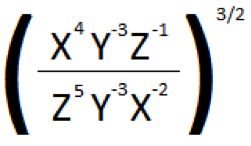
When dividing, subtract exponents (xa/xb = x(a – b).) Therefore, the quantity in the parenthesis is: x(4 – (–2)) * y(–3 – (–3)) * z(–1 – 5) = x6/z6. Raising this to the 3/2 power results in multiplying the exponents by 3/2: x6 * 3/2/z6 * 3/2 = x9/z9.
When dividing, subtract exponents (xa/xb = x(a – b).) Therefore, the quantity in the parenthesis is: x(4 – (–2)) * y(–3 – (–3)) * z(–1 – 5) = x6/z6. Raising this to the 3/2 power results in multiplying the exponents by 3/2: x6 * 3/2/z6 * 3/2 = x9/z9.
Half of the radioactive nuclei of a substance decays in a week. If a sample started with 1010 nuclei, how many have decayed after 28 days?
Half of the radioactive nuclei of a substance decays in a week. If a sample started with 1010 nuclei, how many have decayed after 28 days?
Tap to see back →
If half of the sample decays each week: 1/2 is left after one week, 1/4 is left after two weeks, 1/8 is left after three weeks and 1/16 is left after four weeks (28 days.) That means that 15/16 has decayed. 15/16 x 1010 = 9. 375 x 109
If half of the sample decays each week: 1/2 is left after one week, 1/4 is left after two weeks, 1/8 is left after three weeks and 1/16 is left after four weeks (28 days.) That means that 15/16 has decayed. 15/16 x 1010 = 9. 375 x 109
If  , which of the following is equal to
  ?
?
If
Tap to see back →
The numerator is simplified to  (by adding the exponents), then cube the result. a24/a6 can then be simplified to
  .
.
The numerator is simplified to
Simplify
$$\frac{20x^{4}$$$y^{-3}$$z^{2}$$}{5z^{-1}$$y^{2}$$x^{2}$}=
Simplify
$$\frac{20x^{4}$$$y^{-3}$$z^{2}$$}{5z^{-1}$$y^{2}$$x^{2}$}=
Tap to see back →
Divide the coefficients and subtract the exponents.
Divide the coefficients and subtract the exponents.
Which of the following is equal to the expression  , where
xyz ≠ 0?
Which of the following is equal to the expression , where
xyz ≠ 0?
Tap to see back →
(xy)4 can be rewritten as x4y4 and z0 = 1 because a number to the zero power equals 1. After simplifying, you get 1/y.
(xy)4 can be rewritten as x4y4 and z0 = 1 because a number to the zero power equals 1. After simplifying, you get 1/y.

Tap to see back →
The easiest way to solve this is to simplify the fraction as much as possible. We can do this by factoring out the greatest common factor of the numerator and the denominator. In this case, the GCF is  .
.

Now, we can cancel out the  from the numerator and denominator and continue simplifying the expression.

The easiest way to solve this is to simplify the fraction as much as possible. We can do this by factoring out the greatest common factor of the numerator and the denominator. In this case, the GCF is
Now, we can cancel out the
54 / 25 =
54 / 25 =
Tap to see back →
25 = 5 * 5 = 52. Then 54 / 25 = 54 / 52.
Now we can subtract the exponents because the operation is division. 54 / 52 = 54 – 2 = 52 = 25. The answer is therefore 25.
25 = 5 * 5 = 52. Then 54 / 25 = 54 / 52.
Now we can subtract the exponents because the operation is division. 54 / 52 = 54 – 2 = 52 = 25. The answer is therefore 25.

Tap to see back →
The key to this problem is understanding how exponents divide. When two exponents have the same base, then the exponent on the bottom can simply be subtracted from the exponent on top. I.e.:

Keeping this in mind, we simply break the problem down into prime factors, multiply out the exponents, and solve.

The key to this problem is understanding how exponents divide. When two exponents have the same base, then the exponent on the bottom can simply be subtracted from the exponent on top. I.e.:
Keeping this in mind, we simply break the problem down into prime factors, multiply out the exponents, and solve.
Simplify
$$\frac{20x^{4}$$$y^{-3}$$z^{2}$$}{5z^{-1}$$y^{2}$$x^{2}$}=
Simplify
$$\frac{20x^{4}$$$y^{-3}$$z^{2}$$}{5z^{-1}$$y^{2}$$x^{2}$}=
Tap to see back →
Divide the coefficients and subtract the exponents.
Divide the coefficients and subtract the exponents.
Which of the following is equal to the expression , where
xyz ≠ 0?
Which of the following is equal to the expression , where
xyz ≠ 0?
Tap to see back →
(xy)4 can be rewritten as x4y4 and z0 = 1 because a number to the zero power equals 1. After simplifying, you get 1/y.
(xy)4 can be rewritten as x4y4 and z0 = 1 because a number to the zero power equals 1. After simplifying, you get 1/y.
Tap to see back →