How to evaluate a fraction - PSAT Math
Card 0 of 126
Simplify: 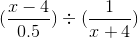
Simplify:
Tap to see back →
Recall that dividing is equivalent multiplying by the reciprocal. Therefore, ((x - 4) / (1 / 2)) / (1 / (x + 4)) = ((x - 4) * 2) * (x + 4) / 1.
Let's simplify this further:
(2x – 8) * (x + 4) = 2x2 – 8x + 8x – 32 = 2x2 – 32
Recall that dividing is equivalent multiplying by the reciprocal. Therefore, ((x - 4) / (1 / 2)) / (1 / (x + 4)) = ((x - 4) * 2) * (x + 4) / 1.
Let's simplify this further:
(2x – 8) * (x + 4) = 2x2 – 8x + 8x – 32 = 2x2 – 32
If 3x = 12, y/4 = 10, and 4z = 9, what is the value of (10xyz)/xy?
If 3x = 12, y/4 = 10, and 4z = 9, what is the value of (10xyz)/xy?
Tap to see back →
Solve for the variables, the plug into formula.
x = 12/3 = 4
y = 10 * 4 = 40
z= 9/4 = 2 1/4
10xyz = 3600
Xy = 160
3600/160 = 22 1/2
Solve for the variables, the plug into formula.
x = 12/3 = 4
y = 10 * 4 = 40
z= 9/4 = 2 1/4
10xyz = 3600
Xy = 160
3600/160 = 22 1/2
Evaluate  when x=11. Round to the nearest tenth.
Evaluate when x=11. Round to the nearest tenth.
Tap to see back →
Wherever there is an x, plug in 11 and perform the given operations. The numerator will be equal to 83 and the denominator will be equal to 46. 83 divided by 46 is equal to 1.804… and since the second decimal place is not greater than or equal to 5, the first decimal place stays the same when rounding so the final answer is 1.8.
Wherever there is an x, plug in 11 and perform the given operations. The numerator will be equal to 83 and the denominator will be equal to 46. 83 divided by 46 is equal to 1.804… and since the second decimal place is not greater than or equal to 5, the first decimal place stays the same when rounding so the final answer is 1.8.
Solve 
Solve
Tap to see back →
The common denominator of the left side is x(x–1). Multiplying the top and bottom of 1/x by (x–1) yields


Since this statement is true, there are infinitely many solutions.
The common denominator of the left side is x(x–1). Multiplying the top and bottom of 1/x by (x–1) yields
Since this statement is true, there are infinitely many solutions.
Mary walked to school at an average speed of 2 miles per hour and jogged back along the same route at an average speed of 6 miles per hour. If her total traveling time was 1 hour, what was the total number of miles in the round trip?
Mary walked to school at an average speed of 2 miles per hour and jogged back along the same route at an average speed of 6 miles per hour. If her total traveling time was 1 hour, what was the total number of miles in the round trip?
Tap to see back →
Since Mary traveled 3 times as quickly coming from school as she did going to school (6 miles per hour compared to 2 miles per hour), we know that Mary spent only a third of the time coming from school as she did going. If x represents the number of hours it took to get to school, then x/3 represents the number of hours it took her to return.
Knowing that the total trip took 1 hour, we have:
x + x/3 = 1
3x/3 + 1x/3 = 1
4_x_/3 = 1
x = 3/4
So we know it took Mary 3/4 of an hour to travel to school (and the remaining 1/4 of an hour to get back).
Remembering that distance = rate * time, the distance Mary traveled on her way to school was (2 miles per hour) * (3/4 of an hour) = 3/2 miles. Furthermore, since she took the same route coming back, she must have traveled 3/2 of a mile to return as well.
Therefore, the the total number of miles in Mary's round trip is 3/2 miles + 3/2 miles = 6/2 miles = 3 miles.
Since Mary traveled 3 times as quickly coming from school as she did going to school (6 miles per hour compared to 2 miles per hour), we know that Mary spent only a third of the time coming from school as she did going. If x represents the number of hours it took to get to school, then x/3 represents the number of hours it took her to return.
Knowing that the total trip took 1 hour, we have:
x + x/3 = 1
3x/3 + 1x/3 = 1
4_x_/3 = 1
x = 3/4
So we know it took Mary 3/4 of an hour to travel to school (and the remaining 1/4 of an hour to get back).
Remembering that distance = rate * time, the distance Mary traveled on her way to school was (2 miles per hour) * (3/4 of an hour) = 3/2 miles. Furthermore, since she took the same route coming back, she must have traveled 3/2 of a mile to return as well.
Therefore, the the total number of miles in Mary's round trip is 3/2 miles + 3/2 miles = 6/2 miles = 3 miles.
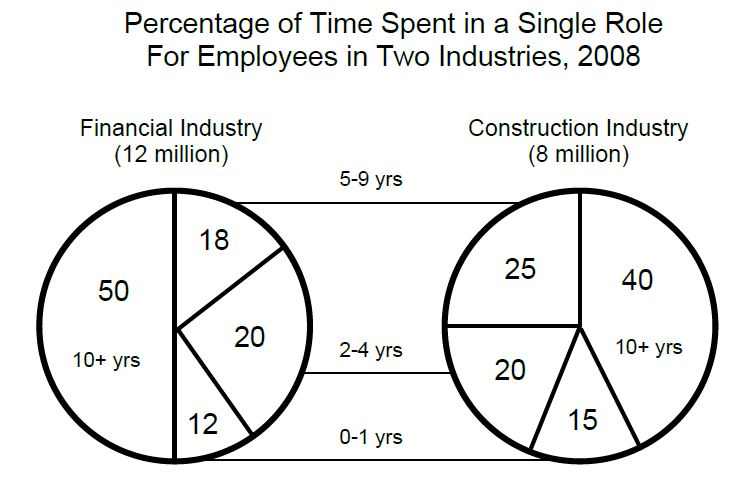
According the pie chart, the degree measure of the sector representing the number of workers spending 5 to 9 years in the same role is how much greater in the construction industry chart than in the financial industry chart?
According the pie chart, the degree measure of the sector representing the number of workers spending 5 to 9 years in the same role is how much greater in the construction industry chart than in the financial industry chart?
Tap to see back →
Since the values in the pie charts are currently in terms of percentages (/100), we must convert them to degrees (/360, since within a circle) to solve the question. The "5 to 9 years" portion for the financial and construction industries are 18 and 25 percent, respectively. As such, we can cross-multiply both:
18/100 = x/360
x = 65 degrees
25/100 = y/360
y = 90 degrees
Subtract: 90 – 65 = 25 degrees
Alternatively, we could first subtract the percentages (25 – 18 = 7), then convert the 7% to degree form via the same method of cross-multiplication.
Since the values in the pie charts are currently in terms of percentages (/100), we must convert them to degrees (/360, since within a circle) to solve the question. The "5 to 9 years" portion for the financial and construction industries are 18 and 25 percent, respectively. As such, we can cross-multiply both:
18/100 = x/360
x = 65 degrees
25/100 = y/360
y = 90 degrees
Subtract: 90 – 65 = 25 degrees
Alternatively, we could first subtract the percentages (25 – 18 = 7), then convert the 7% to degree form via the same method of cross-multiplication.
6 contestants have an equal chance of winning a game. One contestant is disqualified, so now the 5 remaining contestants again have an equal chance of winning. How much more likely is a contestant to win after the disqualification?
6 contestants have an equal chance of winning a game. One contestant is disqualified, so now the 5 remaining contestants again have an equal chance of winning. How much more likely is a contestant to win after the disqualification?
Tap to see back →
When there are 6 people playing, each contestant has a 1/6 chance of winning. After the disqualification, the remaining contestants have a 1/5 chance of winning.
1/5 – 1/6 = 6/30 – 5/30 = 1/30.
When there are 6 people playing, each contestant has a 1/6 chance of winning. After the disqualification, the remaining contestants have a 1/5 chance of winning.
1/5 – 1/6 = 6/30 – 5/30 = 1/30.
If w=\frac{1}{8}$ then which of the following is equal to  ?
?
If w=\frac{1}{8}$ then which of the following is equal to
Tap to see back →
To raise $\frac{1}{8}$ to the exponent $\frac{2}{3}$, square $\frac{1}{8}$ and then take the cube root.

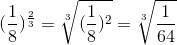


To raise $\frac{1}{8}$ to the exponent $\frac{2}{3}$, square $\frac{1}{8}$ and then take the cube root.
For this question, the following trigonometric identities apply:
 ,
,


Simplify: 
For this question, the following trigonometric identities apply:
Simplify:
Tap to see back →
To begin a problem like this, you must first convert everything to  and
and  alone. This way, you can begin to cancel and combine to its most simplified form.
Since  and
and  , we insert those identities into the equation as follows.

From here we combine the numerator and denominators of each fraction together to easily see what we can combine and cancel.

Since there is a  in the numerator and the denominator, we can cancel them as they divide to equal 1. All we have left is
  , the answer.
To begin a problem like this, you must first convert everything to
Since
From here we combine the numerator and denominators of each fraction together to easily see what we can combine and cancel.
Since there is a
If  pizzas cost
  dollars and
  sodas cost
  dollars, what is the cost of
  pizzas and
  sodas in terms of
  and
and  ?
?
If
Tap to see back →
If 10 pizzas cost x dollars, then each pizza costs x/10. Similarly, each soda costs y/6. We can add the pizzas and sodas together by finding a common denominator:

If 10 pizzas cost x dollars, then each pizza costs x/10. Similarly, each soda costs y/6. We can add the pizzas and sodas together by finding a common denominator:
$$\frac{7^{12}$$$-7^{10}$$}{7^{11}$$-7^{9}$}=
$$\frac{7^{12}$$$-7^{10}$$}{7^{11}$$-7^{9}$}=
Tap to see back →
Factor out 7 from the numerator: $$\frac{7(7^{11}$$$-7^{9}$$)}{7^{11}$$-7^{9}$}
This simplifies to 7.
Factor out 7 from the numerator: $$\frac{7(7^{11}$$$-7^{9}$$)}{7^{11}$$-7^{9}$}
This simplifies to 7.
If  and
and  , then which of the following is equal to
  ?
?
If
Tap to see back →
In order to solve  , first substitute the values of
  and
and  provided in the problem:

Find the Least Common Multiple (LCM) of the fractional terms in the denominator and find the equivalent fractions with the same common denominator:


Finally, in order to divide by a fraction, we must multiply by the reciprocal of the fraction:


In order to solve
Find the Least Common Multiple (LCM) of the fractional terms in the denominator and find the equivalent fractions with the same common denominator:
Finally, in order to divide by a fraction, we must multiply by the reciprocal of the fraction:
Simplify:

Simplify:
Tap to see back →
Begin by simplifying the numerator and the denominator.
Numerator
 has a common denominator of
  . Therefore, we have:
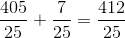
Denominator
 has a common denominator of
  . Therefore, we have:
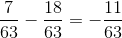
Now, reconstructing our fraction, we have:

To make this division work, you multiply the numerator by the reciprocal of the denominator:

Begin by simplifying the numerator and the denominator.
Numerator
Denominator
Now, reconstructing our fraction, we have:
To make this division work, you multiply the numerator by the reciprocal of the denominator:
If  ,
,  , and
, and  , find the value of
  .
.
If
Tap to see back →
In order to solve  , we must first find the values of
  ,
,  , and
, and  using the initial equations provided. Starting with
  :
:

Then:


Finally:


With the values of  ,
,  , and
, and  in hand, we can solve the final equation:


In order to solve
Then:
Finally:
With the values of
Find the value of  if
if  and
and  .
.
Find the value of
Tap to see back →
In order to solve for  , first substitute
  into the equation for
  :
:


Then, find the Least Common Multiple (LCM) of the two fractions and generate equivalent fractions with the same denominator:

Finally, simplify the equation:


In order to solve for
Then, find the Least Common Multiple (LCM) of the two fractions and generate equivalent fractions with the same denominator:
Finally, simplify the equation:
Evaluate the following equation when  and round your answer to the nearest hundredth.
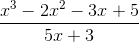
Evaluate the following equation when
Tap to see back →
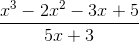
1. Plug in  wherever there is an
  in the above equation.
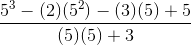
2. Perform the above operations.
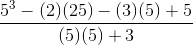
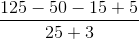

1. Plug in
2. Perform the above operations.
Simplify:

Simplify:
Tap to see back →
Begin by simplifying the numerator.
 has a common denominator of
  . Therefore, we can rewrite it as:
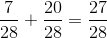
Now, in our original problem this is really is:

When you divide by a fraction, you really multiply by the reciprocal:
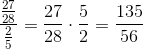
Begin by simplifying the numerator.
Now, in our original problem this is really is:
When you divide by a fraction, you really multiply by the reciprocal:
Solve for  :
:
Solve for
Tap to see back →
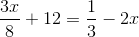
Begin by isolating the variables:
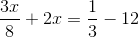
Now, the common denominator of the variable terms is  . The common denominator of the constant values is
  . Thus, you can rewrite your equation:
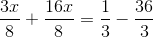
Simplify:

Cross-multiply:

Simplify:

Finally, solve for  :
:

Begin by isolating the variables:
Now, the common denominator of the variable terms is
Simplify:
Cross-multiply:
Simplify:
Finally, solve for
Evaluate when x=11. Round to the nearest tenth.
Evaluate when x=11. Round to the nearest tenth.
Tap to see back →
Wherever there is an x, plug in 11 and perform the given operations. The numerator will be equal to 83 and the denominator will be equal to 46. 83 divided by 46 is equal to 1.804… and since the second decimal place is not greater than or equal to 5, the first decimal place stays the same when rounding so the final answer is 1.8.
Wherever there is an x, plug in 11 and perform the given operations. The numerator will be equal to 83 and the denominator will be equal to 46. 83 divided by 46 is equal to 1.804… and since the second decimal place is not greater than or equal to 5, the first decimal place stays the same when rounding so the final answer is 1.8.
Solve
Solve
Tap to see back →
The common denominator of the left side is x(x–1). Multiplying the top and bottom of 1/x by (x–1) yields
Since this statement is true, there are infinitely many solutions.
The common denominator of the left side is x(x–1). Multiplying the top and bottom of 1/x by (x–1) yields
Since this statement is true, there are infinitely many solutions.