How to find inverse variation - PSAT Math
Card 0 of 84
Find the inverse equation of:

Find the inverse equation of:
Tap to see back →
To solve for an inverse, we switch x and y and solve for y. Doing so yields:

To solve for an inverse, we switch x and y and solve for y. Doing so yields:
A school's tornado shelter has enough food to last 20 children for 6 days. If 24 children ended up taking shelter together, for how many fewer days will the food last?
A school's tornado shelter has enough food to last 20 children for 6 days. If 24 children ended up taking shelter together, for how many fewer days will the food last?
Tap to see back →
Because the number of days goes down as the number of children goes up, this problem type is inverse variation. We can solve this problem by the following steps:
20*6=24*x
120=24x
x=120/24
x=5
In this equation, x represents the total number of days that can be weathered by 24 students. This is down from the 6 days that 20 students could take shelter together. So the difference is 1 day less.
Because the number of days goes down as the number of children goes up, this problem type is inverse variation. We can solve this problem by the following steps:
20*6=24*x
120=24x
x=120/24
x=5
In this equation, x represents the total number of days that can be weathered by 24 students. This is down from the 6 days that 20 students could take shelter together. So the difference is 1 day less.
x y 


If  varies inversely with
  , what is the value of
  ?
?
| x | y |
|---|---|
| |
| |
| |
| |
If
Tap to see back →
An inverse variation is a function in the form:  or
or  , where
  is not equal to 0.
Substitute each  in
in  .
.



Therefore, the constant of variation,  , must equal 24. If
  varies inversely as
  ,
,  must equal 24. Solve for
  .
.


An inverse variation is a function in the form:
Substitute each
Therefore, the constant of variation,
 varies inversely with the square root of
  .
.
If  when
when  , then evaluate
  when
when  . (Nearest tenth)
If
Tap to see back →
If  varies inversely with the square root of
  , then, if
  are the initial values of the variables and
  are the final values,
 .
.
Substitute  and find
  :
:


If
Substitute
 varies inversely as the square of
  .
.
If  when
when  , then evaluate
  when
when  . (Nearest tenth)
If
Tap to see back →
If  varies inversely as the square of
  , then, if
  are the initial values of the variables and
  are the final values,
 .
.
Substitute  and find
  :
:


This rounds to 3.5.
If
Substitute
This rounds to 3.5.
 varies inversely as the cube of
  .
.
If  when
when  , then evaluate
  when
when  . (Nearest tenth)
If
Tap to see back →
If  varies inversely as the cube of
  , then, if
  are the initial values of the variables and
  are the final values,

Substitute  and find
  :
:


This rounds to 2.3.
If
Substitute
This rounds to 2.3.
 varies inversely as the cube root of
  .
.
If  when
when  , then evaluate
  when
when  . (Nearest tenth)
If
Tap to see back →
If  varies inversely as the cube root of
  , then, if
  are the initial values of the variables and
  are the final values,

Substitute  and find
  :
:


If
Substitute
Find the inverse of  .
.
Find the inverse of
Tap to see back →
To find the inverse of a function we need to first switch the  and
and  . Therefore,
  becomes

We now solve for y by subtracting 1 from each side

From here we divide both sides by 2 which results in

To find the inverse of a function we need to first switch the
We now solve for y by subtracting 1 from each side
From here we divide both sides by 2 which results in
Find the inverse of  .
.
Find the inverse of
Tap to see back →
To find the inverse we first switch the variables then solve for y.

Then we subtract  from each side

Now we divide by  to get our final answer. When we divide
  by
by  we are left with
  . When we divide
  by
by  we are left with
  . Thus resulting in:

To find the inverse we first switch the variables then solve for y.
Then we subtract
Now we divide by
Find the inverse of

Find the inverse of
Tap to see back →
To find the inverse we first switch the x and y variables

Now we add 4 to each side

From here to isolate y we need to multiply each side by 2

By distributing the 2 we get our final solution:

To find the inverse we first switch the x and y variables
Now we add 4 to each side
From here to isolate y we need to multiply each side by 2
By distributing the 2 we get our final solution:
Find the inverse equation of  .
.
Find the inverse equation of
Tap to see back →

1. Switch the  and
and  variables in the above equation.

2. Solve for  :
:



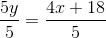

1. Switch the
2. Solve for
 When
When  ,
,  .
.
When  ,
,  .
.
If  varies inversely with
  , what is the value of
  when
when  ?
?
When
If
Tap to see back →
If  varies inversely with
  ,
,  .
.
1. Using any of the two  combinations given, solve for
  :
:
Using  :
:


2. Use your new equation  and solve when
  :
:

If
1. Using any of the two
Using
2. Use your new equation
A school's tornado shelter has enough food to last 20 children for 6 days. If 24 children ended up taking shelter together, for how many fewer days will the food last?
A school's tornado shelter has enough food to last 20 children for 6 days. If 24 children ended up taking shelter together, for how many fewer days will the food last?
Tap to see back →
Because the number of days goes down as the number of children goes up, this problem type is inverse variation. We can solve this problem by the following steps:
20*6=24*x
120=24x
x=120/24
x=5
In this equation, x represents the total number of days that can be weathered by 24 students. This is down from the 6 days that 20 students could take shelter together. So the difference is 1 day less.
Because the number of days goes down as the number of children goes up, this problem type is inverse variation. We can solve this problem by the following steps:
20*6=24*x
120=24x
x=120/24
x=5
In this equation, x represents the total number of days that can be weathered by 24 students. This is down from the 6 days that 20 students could take shelter together. So the difference is 1 day less.
Find the inverse equation of:
Find the inverse equation of:
Tap to see back →
To solve for an inverse, we switch x and y and solve for y. Doing so yields:
To solve for an inverse, we switch x and y and solve for y. Doing so yields:
x y
If varies inversely with , what is the value of ?
| x | y |
|---|---|
| |
| |
| |
| |
If
Tap to see back →
An inverse variation is a function in the form: or , where is not equal to 0.
Substitute each in .
Therefore, the constant of variation, , must equal 24. If varies inversely as , must equal 24. Solve for .
An inverse variation is a function in the form:
Substitute each
Therefore, the constant of variation,
varies inversely with the square root of .
If when , then evaluate when . (Nearest tenth)
If
Tap to see back →
If varies inversely with the square root of , then, if are the initial values of the variables and are the final values,
.
Substitute and find :
If
Substitute
varies inversely as the square of .
If when , then evaluate when . (Nearest tenth)
If
Tap to see back →
If varies inversely as the square of , then, if are the initial values of the variables and are the final values,
.
Substitute and find :
This rounds to 3.5.
If
Substitute
This rounds to 3.5.
varies inversely as the cube of .
If when , then evaluate when . (Nearest tenth)
If
Tap to see back →
If varies inversely as the cube of , then, if are the initial values of the variables and are the final values,
Substitute and find :
This rounds to 2.3.
If
Substitute
This rounds to 2.3.
varies inversely as the cube root of .
If when , then evaluate when . (Nearest tenth)
If
Tap to see back →
If varies inversely as the cube root of , then, if are the initial values of the variables and are the final values,
Substitute and find :
If
Substitute
Find the inverse of .
Find the inverse of
Tap to see back →
To find the inverse of a function we need to first switch the and . Therefore, becomes
We now solve for y by subtracting 1 from each side
From here we divide both sides by 2 which results in
To find the inverse of a function we need to first switch the
We now solve for y by subtracting 1 from each side
From here we divide both sides by 2 which results in