How to find out if lines are perpendicular - PSAT Math
Card 0 of 56
Which set of lines is perpendicular?
Which set of lines is perpendicular?
Tap to see back →
Two lines are perpendicular to each other if their slopes are negative reciprocals. For example, if one line has a slope of 2, the line perpendicular to it has a slope of –1/2. One easy way to eliminate answer choices is to check if the slopes have the same sign, i.e. both positive or both negative. If so, they cannot be perpendicular. Several of the lines in the answer choices are of the form y = mx + b, where m is the slope and b is the y-intercept. We are only worried about the slope for the purposes of this question.
y = 3_x_ + 5 and y = 5_x_ + 3 both have positive slopes (m = 3 and m = 5, respectively), so they aren't perpendicular.
y = 3_x_/5 – 3 and y = 5_x_/3 + 3 both have positive slopes, so again they aren't perpendicular.
y = x – 1/2 and y = –x + 1/2 have slopes of m = 1 and m = –1, respectively. One is positive and one is negative, so that is a good sign. Let's take the negative reciprocal of 1. 1 /–1 = –1. So these two slopes are in fact negative reciprocals, and these two lines are perpendicular to each other. Even though we have found the correct answer, let's go through the other two choices to be sure.
The line between the points (1,3) and (3,5), and y = 4_x_ + 7: We need to find the slope of the first line. slope = rise / run = (_y_2 – _y_1) / (_x_2 – x_1) = (5 – 3) / (3 – 1) = 1. The slope of y = 4_x + 7 is also positive (m = 4), so the lines are not perpendicular.
The line between the points (7,4) and (4,7), and the line between the points (3,9) and (4,8): the first slope = (7 – 4) / (4 – 7) = –1 and the second slope = (8 – 9) / (4 – 3) = –1. They have the same slope, making them parallel, not perpendicular.
Two lines are perpendicular to each other if their slopes are negative reciprocals. For example, if one line has a slope of 2, the line perpendicular to it has a slope of –1/2. One easy way to eliminate answer choices is to check if the slopes have the same sign, i.e. both positive or both negative. If so, they cannot be perpendicular. Several of the lines in the answer choices are of the form y = mx + b, where m is the slope and b is the y-intercept. We are only worried about the slope for the purposes of this question.
y = 3_x_ + 5 and y = 5_x_ + 3 both have positive slopes (m = 3 and m = 5, respectively), so they aren't perpendicular.
y = 3_x_/5 – 3 and y = 5_x_/3 + 3 both have positive slopes, so again they aren't perpendicular.
y = x – 1/2 and y = –x + 1/2 have slopes of m = 1 and m = –1, respectively. One is positive and one is negative, so that is a good sign. Let's take the negative reciprocal of 1. 1 /–1 = –1. So these two slopes are in fact negative reciprocals, and these two lines are perpendicular to each other. Even though we have found the correct answer, let's go through the other two choices to be sure.
The line between the points (1,3) and (3,5), and y = 4_x_ + 7: We need to find the slope of the first line. slope = rise / run = (_y_2 – _y_1) / (_x_2 – x_1) = (5 – 3) / (3 – 1) = 1. The slope of y = 4_x + 7 is also positive (m = 4), so the lines are not perpendicular.
The line between the points (7,4) and (4,7), and the line between the points (3,9) and (4,8): the first slope = (7 – 4) / (4 – 7) = –1 and the second slope = (8 – 9) / (4 – 3) = –1. They have the same slope, making them parallel, not perpendicular.
If two lines have slopes of -5 and $\frac{1}{5}$, which statement about the lines is true?
If two lines have slopes of -5 and $\frac{1}{5}$, which statement about the lines is true?
Tap to see back →
Perpendicular lines have slopes that are the negative reciprocals of each other.
Perpendicular lines have slopes that are the negative reciprocals of each other.
Which of the following lines is perpendicular to y=3x-4
Which of the following lines is perpendicular to y=3x-4
Tap to see back →
The line which is perpendicular has a slope which is the negative inverse of the slope of the original line.
The line which is perpendicular has a slope which is the negative inverse of the slope of the original line.
Which set of lines is perpendicular?
Which set of lines is perpendicular?
Tap to see back →
Two lines are perpendicular to each other if their slopes are negative reciprocals. For example, if one line has a slope of 2, the line perpendicular to it has a slope of –1/2. One easy way to eliminate answer choices is to check if the slopes have the same sign, i.e. both positive or both negative. If so, they cannot be perpendicular. Several of the lines in the answer choices are of the form y = mx + b, where m is the slope and b is the y-intercept. We are only worried about the slope for the purposes of this question.
y = 3_x_ + 5 and y = 5_x_ + 3 both have positive slopes (m = 3 and m = 5, respectively), so they aren't perpendicular.
y = 3_x_/5 – 3 and y = 5_x_/3 + 3 both have positive slopes, so again they aren't perpendicular.
y = x – 1/2 and y = –x + 1/2 have slopes of m = 1 and m = –1, respectively. One is positive and one is negative, so that is a good sign. Let's take the negative reciprocal of 1. 1 /–1 = –1. So these two slopes are in fact negative reciprocals, and these two lines are perpendicular to each other. Even though we have found the correct answer, let's go through the other two choices to be sure.
The line between the points (1,3) and (3,5), and y = 4_x_ + 7: We need to find the slope of the first line. slope = rise / run = (_y_2 – _y_1) / (_x_2 – x_1) = (5 – 3) / (3 – 1) = 1. The slope of y = 4_x + 7 is also positive (m = 4), so the lines are not perpendicular.
The line between the points (7,4) and (4,7), and the line between the points (3,9) and (4,8): the first slope = (7 – 4) / (4 – 7) = –1 and the second slope = (8 – 9) / (4 – 3) = –1. They have the same slope, making them parallel, not perpendicular.
Two lines are perpendicular to each other if their slopes are negative reciprocals. For example, if one line has a slope of 2, the line perpendicular to it has a slope of –1/2. One easy way to eliminate answer choices is to check if the slopes have the same sign, i.e. both positive or both negative. If so, they cannot be perpendicular. Several of the lines in the answer choices are of the form y = mx + b, where m is the slope and b is the y-intercept. We are only worried about the slope for the purposes of this question.
y = 3_x_ + 5 and y = 5_x_ + 3 both have positive slopes (m = 3 and m = 5, respectively), so they aren't perpendicular.
y = 3_x_/5 – 3 and y = 5_x_/3 + 3 both have positive slopes, so again they aren't perpendicular.
y = x – 1/2 and y = –x + 1/2 have slopes of m = 1 and m = –1, respectively. One is positive and one is negative, so that is a good sign. Let's take the negative reciprocal of 1. 1 /–1 = –1. So these two slopes are in fact negative reciprocals, and these two lines are perpendicular to each other. Even though we have found the correct answer, let's go through the other two choices to be sure.
The line between the points (1,3) and (3,5), and y = 4_x_ + 7: We need to find the slope of the first line. slope = rise / run = (_y_2 – _y_1) / (_x_2 – x_1) = (5 – 3) / (3 – 1) = 1. The slope of y = 4_x + 7 is also positive (m = 4), so the lines are not perpendicular.
The line between the points (7,4) and (4,7), and the line between the points (3,9) and (4,8): the first slope = (7 – 4) / (4 – 7) = –1 and the second slope = (8 – 9) / (4 – 3) = –1. They have the same slope, making them parallel, not perpendicular.
Line  includes the points
  and
and  . Line
  includes the points
  and
and  . Which of the following statements is true of these lines?
Line
Tap to see back →
We calculate the slopes of the lines using the slope formula.
The slope of line  is
is

The slope of line  is
is

Parallel lines and identical lines must have the same slope, so these can be eliminated as choices. The slopes of perpendicular lines must have product  . The slopes have product
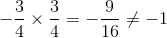
so they are not perpendicular.
The correct response is that the lines are distinct but neither parallel nor perpendicular.
We calculate the slopes of the lines using the slope formula.
The slope of line
The slope of line
Parallel lines and identical lines must have the same slope, so these can be eliminated as choices. The slopes of perpendicular lines must have product
so they are not perpendicular.
The correct response is that the lines are distinct but neither parallel nor perpendicular.
Line  includes the points
  and
and  . Line
  includes the points
  and
and  . Which of the following statements is true of these lines?
Line
Tap to see back →
We calculate the slopes of the lines using the slope formula.
The slope of line  is
is

The slope of line  is
is

The slopes are not the same, so the lines are neither parallel nor identical. We multiply their slopes to test for perpendicularity:
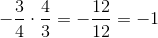
The product of the slopes is  , making the lines perpendicular.
We calculate the slopes of the lines using the slope formula.
The slope of line
The slope of line
The slopes are not the same, so the lines are neither parallel nor identical. We multiply their slopes to test for perpendicularity:
The product of the slopes is
Consider the equations  and
and  . Which of the following statements is true of the lines of these equations?
Consider the equations
Tap to see back →
We find the slope of each line by putting each equation in slope-intercept form  and examining the coefficient of
  .
.
 is already in slope-intercept form; its slope is
  .
.
To get  in slope-intercept form we solve for
  :
:



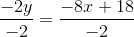

The slope of this line is also .
The slopes are equal; however, the  -intercepts are different - the
  -intercept of the first line is
  and that of the second line is
  . Therefore, the lines are parallel as opposed to being the same line.
We find the slope of each line by putting each equation in slope-intercept form
To get
The slope of this line is also
The slopes are equal; however, the
Which line is perpendicular to  ?
?
Which line is perpendicular to
Tap to see back →
To determine if lines are perpendicular, look at the slope. Perpendicular lines have slopes that are negative reciprocals. The slope of  is
is  . The negative reciprocal of
  is
is  . Therefore, the answer is
 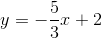 .
.
To determine if lines are perpendicular, look at the slope. Perpendicular lines have slopes that are negative reciprocals. The slope of
Which set of lines is perpendicular?
Which set of lines is perpendicular?
Tap to see back →
Two lines are perpendicular to each other if their slopes are negative reciprocals. For example, if one line has a slope of 2, the line perpendicular to it has a slope of –1/2. One easy way to eliminate answer choices is to check if the slopes have the same sign, i.e. both positive or both negative. If so, they cannot be perpendicular. Several of the lines in the answer choices are of the form y = mx + b, where m is the slope and b is the y-intercept. We are only worried about the slope for the purposes of this question.
y = 3_x_ + 5 and y = 5_x_ + 3 both have positive slopes (m = 3 and m = 5, respectively), so they aren't perpendicular.
y = 3_x_/5 – 3 and y = 5_x_/3 + 3 both have positive slopes, so again they aren't perpendicular.
y = x – 1/2 and y = –x + 1/2 have slopes of m = 1 and m = –1, respectively. One is positive and one is negative, so that is a good sign. Let's take the negative reciprocal of 1. 1 /–1 = –1. So these two slopes are in fact negative reciprocals, and these two lines are perpendicular to each other. Even though we have found the correct answer, let's go through the other two choices to be sure.
The line between the points (1,3) and (3,5), and y = 4_x_ + 7: We need to find the slope of the first line. slope = rise / run = (_y_2 – _y_1) / (_x_2 – x_1) = (5 – 3) / (3 – 1) = 1. The slope of y = 4_x + 7 is also positive (m = 4), so the lines are not perpendicular.
The line between the points (7,4) and (4,7), and the line between the points (3,9) and (4,8): the first slope = (7 – 4) / (4 – 7) = –1 and the second slope = (8 – 9) / (4 – 3) = –1. They have the same slope, making them parallel, not perpendicular.
Two lines are perpendicular to each other if their slopes are negative reciprocals. For example, if one line has a slope of 2, the line perpendicular to it has a slope of –1/2. One easy way to eliminate answer choices is to check if the slopes have the same sign, i.e. both positive or both negative. If so, they cannot be perpendicular. Several of the lines in the answer choices are of the form y = mx + b, where m is the slope and b is the y-intercept. We are only worried about the slope for the purposes of this question.
y = 3_x_ + 5 and y = 5_x_ + 3 both have positive slopes (m = 3 and m = 5, respectively), so they aren't perpendicular.
y = 3_x_/5 – 3 and y = 5_x_/3 + 3 both have positive slopes, so again they aren't perpendicular.
y = x – 1/2 and y = –x + 1/2 have slopes of m = 1 and m = –1, respectively. One is positive and one is negative, so that is a good sign. Let's take the negative reciprocal of 1. 1 /–1 = –1. So these two slopes are in fact negative reciprocals, and these two lines are perpendicular to each other. Even though we have found the correct answer, let's go through the other two choices to be sure.
The line between the points (1,3) and (3,5), and y = 4_x_ + 7: We need to find the slope of the first line. slope = rise / run = (_y_2 – _y_1) / (_x_2 – x_1) = (5 – 3) / (3 – 1) = 1. The slope of y = 4_x + 7 is also positive (m = 4), so the lines are not perpendicular.
The line between the points (7,4) and (4,7), and the line between the points (3,9) and (4,8): the first slope = (7 – 4) / (4 – 7) = –1 and the second slope = (8 – 9) / (4 – 3) = –1. They have the same slope, making them parallel, not perpendicular.
If two lines have slopes of -5 and $\frac{1}{5}$, which statement about the lines is true?
If two lines have slopes of -5 and $\frac{1}{5}$, which statement about the lines is true?
Tap to see back →
Perpendicular lines have slopes that are the negative reciprocals of each other.
Perpendicular lines have slopes that are the negative reciprocals of each other.
Which of the following lines is perpendicular to y=3x-4
Which of the following lines is perpendicular to y=3x-4
Tap to see back →
The line which is perpendicular has a slope which is the negative inverse of the slope of the original line.
The line which is perpendicular has a slope which is the negative inverse of the slope of the original line.
Which set of lines is perpendicular?
Which set of lines is perpendicular?
Tap to see back →
Two lines are perpendicular to each other if their slopes are negative reciprocals. For example, if one line has a slope of 2, the line perpendicular to it has a slope of –1/2. One easy way to eliminate answer choices is to check if the slopes have the same sign, i.e. both positive or both negative. If so, they cannot be perpendicular. Several of the lines in the answer choices are of the form y = mx + b, where m is the slope and b is the y-intercept. We are only worried about the slope for the purposes of this question.
y = 3_x_ + 5 and y = 5_x_ + 3 both have positive slopes (m = 3 and m = 5, respectively), so they aren't perpendicular.
y = 3_x_/5 – 3 and y = 5_x_/3 + 3 both have positive slopes, so again they aren't perpendicular.
y = x – 1/2 and y = –x + 1/2 have slopes of m = 1 and m = –1, respectively. One is positive and one is negative, so that is a good sign. Let's take the negative reciprocal of 1. 1 /–1 = –1. So these two slopes are in fact negative reciprocals, and these two lines are perpendicular to each other. Even though we have found the correct answer, let's go through the other two choices to be sure.
The line between the points (1,3) and (3,5), and y = 4_x_ + 7: We need to find the slope of the first line. slope = rise / run = (_y_2 – _y_1) / (_x_2 – x_1) = (5 – 3) / (3 – 1) = 1. The slope of y = 4_x + 7 is also positive (m = 4), so the lines are not perpendicular.
The line between the points (7,4) and (4,7), and the line between the points (3,9) and (4,8): the first slope = (7 – 4) / (4 – 7) = –1 and the second slope = (8 – 9) / (4 – 3) = –1. They have the same slope, making them parallel, not perpendicular.
Two lines are perpendicular to each other if their slopes are negative reciprocals. For example, if one line has a slope of 2, the line perpendicular to it has a slope of –1/2. One easy way to eliminate answer choices is to check if the slopes have the same sign, i.e. both positive or both negative. If so, they cannot be perpendicular. Several of the lines in the answer choices are of the form y = mx + b, where m is the slope and b is the y-intercept. We are only worried about the slope for the purposes of this question.
y = 3_x_ + 5 and y = 5_x_ + 3 both have positive slopes (m = 3 and m = 5, respectively), so they aren't perpendicular.
y = 3_x_/5 – 3 and y = 5_x_/3 + 3 both have positive slopes, so again they aren't perpendicular.
y = x – 1/2 and y = –x + 1/2 have slopes of m = 1 and m = –1, respectively. One is positive and one is negative, so that is a good sign. Let's take the negative reciprocal of 1. 1 /–1 = –1. So these two slopes are in fact negative reciprocals, and these two lines are perpendicular to each other. Even though we have found the correct answer, let's go through the other two choices to be sure.
The line between the points (1,3) and (3,5), and y = 4_x_ + 7: We need to find the slope of the first line. slope = rise / run = (_y_2 – _y_1) / (_x_2 – x_1) = (5 – 3) / (3 – 1) = 1. The slope of y = 4_x + 7 is also positive (m = 4), so the lines are not perpendicular.
The line between the points (7,4) and (4,7), and the line between the points (3,9) and (4,8): the first slope = (7 – 4) / (4 – 7) = –1 and the second slope = (8 – 9) / (4 – 3) = –1. They have the same slope, making them parallel, not perpendicular.
Line includes the points and . Line includes the points and . Which of the following statements is true of these lines?
Line
Tap to see back →
We calculate the slopes of the lines using the slope formula.
The slope of line is
The slope of line is
Parallel lines and identical lines must have the same slope, so these can be eliminated as choices. The slopes of perpendicular lines must have product . The slopes have product
so they are not perpendicular.
The correct response is that the lines are distinct but neither parallel nor perpendicular.
We calculate the slopes of the lines using the slope formula.
The slope of line
The slope of line
Parallel lines and identical lines must have the same slope, so these can be eliminated as choices. The slopes of perpendicular lines must have product
so they are not perpendicular.
The correct response is that the lines are distinct but neither parallel nor perpendicular.
Line includes the points and . Line includes the points and . Which of the following statements is true of these lines?
Line
Tap to see back →
We calculate the slopes of the lines using the slope formula.
The slope of line is
The slope of line is
The slopes are not the same, so the lines are neither parallel nor identical. We multiply their slopes to test for perpendicularity:
The product of the slopes is , making the lines perpendicular.
We calculate the slopes of the lines using the slope formula.
The slope of line
The slope of line
The slopes are not the same, so the lines are neither parallel nor identical. We multiply their slopes to test for perpendicularity:
The product of the slopes is
Consider the equations and . Which of the following statements is true of the lines of these equations?
Consider the equations
Tap to see back →
We find the slope of each line by putting each equation in slope-intercept form and examining the coefficient of .
is already in slope-intercept form; its slope is .
To get in slope-intercept form we solve for :
The slope of this line is also .
The slopes are equal; however, the -intercepts are different - the -intercept of the first line is and that of the second line is . Therefore, the lines are parallel as opposed to being the same line.
We find the slope of each line by putting each equation in slope-intercept form
To get
The slope of this line is also
The slopes are equal; however, the
Which line is perpendicular to ?
Which line is perpendicular to
Tap to see back →
To determine if lines are perpendicular, look at the slope. Perpendicular lines have slopes that are negative reciprocals. The slope of is . The negative reciprocal of is . Therefore, the answer is .
To determine if lines are perpendicular, look at the slope. Perpendicular lines have slopes that are negative reciprocals. The slope of
Which set of lines is perpendicular?
Which set of lines is perpendicular?
Tap to see back →
Two lines are perpendicular to each other if their slopes are negative reciprocals. For example, if one line has a slope of 2, the line perpendicular to it has a slope of –1/2. One easy way to eliminate answer choices is to check if the slopes have the same sign, i.e. both positive or both negative. If so, they cannot be perpendicular. Several of the lines in the answer choices are of the form y = mx + b, where m is the slope and b is the y-intercept. We are only worried about the slope for the purposes of this question.
y = 3_x_ + 5 and y = 5_x_ + 3 both have positive slopes (m = 3 and m = 5, respectively), so they aren't perpendicular.
y = 3_x_/5 – 3 and y = 5_x_/3 + 3 both have positive slopes, so again they aren't perpendicular.
y = x – 1/2 and y = –x + 1/2 have slopes of m = 1 and m = –1, respectively. One is positive and one is negative, so that is a good sign. Let's take the negative reciprocal of 1. 1 /–1 = –1. So these two slopes are in fact negative reciprocals, and these two lines are perpendicular to each other. Even though we have found the correct answer, let's go through the other two choices to be sure.
The line between the points (1,3) and (3,5), and y = 4_x_ + 7: We need to find the slope of the first line. slope = rise / run = (_y_2 – _y_1) / (_x_2 – x_1) = (5 – 3) / (3 – 1) = 1. The slope of y = 4_x + 7 is also positive (m = 4), so the lines are not perpendicular.
The line between the points (7,4) and (4,7), and the line between the points (3,9) and (4,8): the first slope = (7 – 4) / (4 – 7) = –1 and the second slope = (8 – 9) / (4 – 3) = –1. They have the same slope, making them parallel, not perpendicular.
Two lines are perpendicular to each other if their slopes are negative reciprocals. For example, if one line has a slope of 2, the line perpendicular to it has a slope of –1/2. One easy way to eliminate answer choices is to check if the slopes have the same sign, i.e. both positive or both negative. If so, they cannot be perpendicular. Several of the lines in the answer choices are of the form y = mx + b, where m is the slope and b is the y-intercept. We are only worried about the slope for the purposes of this question.
y = 3_x_ + 5 and y = 5_x_ + 3 both have positive slopes (m = 3 and m = 5, respectively), so they aren't perpendicular.
y = 3_x_/5 – 3 and y = 5_x_/3 + 3 both have positive slopes, so again they aren't perpendicular.
y = x – 1/2 and y = –x + 1/2 have slopes of m = 1 and m = –1, respectively. One is positive and one is negative, so that is a good sign. Let's take the negative reciprocal of 1. 1 /–1 = –1. So these two slopes are in fact negative reciprocals, and these two lines are perpendicular to each other. Even though we have found the correct answer, let's go through the other two choices to be sure.
The line between the points (1,3) and (3,5), and y = 4_x_ + 7: We need to find the slope of the first line. slope = rise / run = (_y_2 – _y_1) / (_x_2 – x_1) = (5 – 3) / (3 – 1) = 1. The slope of y = 4_x + 7 is also positive (m = 4), so the lines are not perpendicular.
The line between the points (7,4) and (4,7), and the line between the points (3,9) and (4,8): the first slope = (7 – 4) / (4 – 7) = –1 and the second slope = (8 – 9) / (4 – 3) = –1. They have the same slope, making them parallel, not perpendicular.
If two lines have slopes of -5 and $\frac{1}{5}$, which statement about the lines is true?
If two lines have slopes of -5 and $\frac{1}{5}$, which statement about the lines is true?
Tap to see back →
Perpendicular lines have slopes that are the negative reciprocals of each other.
Perpendicular lines have slopes that are the negative reciprocals of each other.
Which of the following lines is perpendicular to y=3x-4
Which of the following lines is perpendicular to y=3x-4
Tap to see back →
The line which is perpendicular has a slope which is the negative inverse of the slope of the original line.
The line which is perpendicular has a slope which is the negative inverse of the slope of the original line.
Which set of lines is perpendicular?
Which set of lines is perpendicular?
Tap to see back →
Two lines are perpendicular to each other if their slopes are negative reciprocals. For example, if one line has a slope of 2, the line perpendicular to it has a slope of –1/2. One easy way to eliminate answer choices is to check if the slopes have the same sign, i.e. both positive or both negative. If so, they cannot be perpendicular. Several of the lines in the answer choices are of the form y = mx + b, where m is the slope and b is the y-intercept. We are only worried about the slope for the purposes of this question.
y = 3_x_ + 5 and y = 5_x_ + 3 both have positive slopes (m = 3 and m = 5, respectively), so they aren't perpendicular.
y = 3_x_/5 – 3 and y = 5_x_/3 + 3 both have positive slopes, so again they aren't perpendicular.
y = x – 1/2 and y = –x + 1/2 have slopes of m = 1 and m = –1, respectively. One is positive and one is negative, so that is a good sign. Let's take the negative reciprocal of 1. 1 /–1 = –1. So these two slopes are in fact negative reciprocals, and these two lines are perpendicular to each other. Even though we have found the correct answer, let's go through the other two choices to be sure.
The line between the points (1,3) and (3,5), and y = 4_x_ + 7: We need to find the slope of the first line. slope = rise / run = (_y_2 – _y_1) / (_x_2 – x_1) = (5 – 3) / (3 – 1) = 1. The slope of y = 4_x + 7 is also positive (m = 4), so the lines are not perpendicular.
The line between the points (7,4) and (4,7), and the line between the points (3,9) and (4,8): the first slope = (7 – 4) / (4 – 7) = –1 and the second slope = (8 – 9) / (4 – 3) = –1. They have the same slope, making them parallel, not perpendicular.
Two lines are perpendicular to each other if their slopes are negative reciprocals. For example, if one line has a slope of 2, the line perpendicular to it has a slope of –1/2. One easy way to eliminate answer choices is to check if the slopes have the same sign, i.e. both positive or both negative. If so, they cannot be perpendicular. Several of the lines in the answer choices are of the form y = mx + b, where m is the slope and b is the y-intercept. We are only worried about the slope for the purposes of this question.
y = 3_x_ + 5 and y = 5_x_ + 3 both have positive slopes (m = 3 and m = 5, respectively), so they aren't perpendicular.
y = 3_x_/5 – 3 and y = 5_x_/3 + 3 both have positive slopes, so again they aren't perpendicular.
y = x – 1/2 and y = –x + 1/2 have slopes of m = 1 and m = –1, respectively. One is positive and one is negative, so that is a good sign. Let's take the negative reciprocal of 1. 1 /–1 = –1. So these two slopes are in fact negative reciprocals, and these two lines are perpendicular to each other. Even though we have found the correct answer, let's go through the other two choices to be sure.
The line between the points (1,3) and (3,5), and y = 4_x_ + 7: We need to find the slope of the first line. slope = rise / run = (_y_2 – _y_1) / (_x_2 – x_1) = (5 – 3) / (3 – 1) = 1. The slope of y = 4_x + 7 is also positive (m = 4), so the lines are not perpendicular.
The line between the points (7,4) and (4,7), and the line between the points (3,9) and (4,8): the first slope = (7 – 4) / (4 – 7) = –1 and the second slope = (8 – 9) / (4 – 3) = –1. They have the same slope, making them parallel, not perpendicular.