How to find patterns in exponents - PSAT Math
Card 0 of 126
If p and q are positive integrers and 27p = 9q, then what is the value of q in terms of p?
If p and q are positive integrers and 27p = 9q, then what is the value of q in terms of p?
Tap to see back →
The first step is to express both sides of the equation with equal bases, in this case 3. The equation becomes 33p = 32q. So then 3p = 2q, and q = (3/2)p is our answer.
The first step is to express both sides of the equation with equal bases, in this case 3. The equation becomes 33p = 32q. So then 3p = 2q, and q = (3/2)p is our answer.
Simplify 272/3.
Simplify 272/3.
Tap to see back →
272/3 is 27 squared and cube-rooted. We want to pick the easier operation first. Here that is the cube root. To see that, try both operations.
272/3 = (272)1/3 = 7291/3 OR
272/3 = (271/3)2 = 32
Obviously 32 is much easier. Either 32 or 7291/3 will give us the correct answer of 9, but with 32 it is readily apparent.
272/3 is 27 squared and cube-rooted. We want to pick the easier operation first. Here that is the cube root. To see that, try both operations.
272/3 = (272)1/3 = 7291/3 OR
272/3 = (271/3)2 = 32
Obviously 32 is much easier. Either 32 or 7291/3 will give us the correct answer of 9, but with 32 it is readily apparent.
Which of the following statements is the same as:


Which of the following statements is the same as:
Tap to see back →
Remember the laws of exponents. In particular, when the base is nonzero:

An effective way to compare these statements, is to convert them all into exponents with base 2. The original statement becomes:

This is identical to statement I. Now consider statement II:

Therefore, statement II is not identical to the original statement. Finally, consider statement III:

which is also identical to the original statement. As a result, only I and III are the same as the original statement.
Remember the laws of exponents. In particular, when the base is nonzero:
An effective way to compare these statements, is to convert them all into exponents with base 2. The original statement becomes:
This is identical to statement I. Now consider statement II:
Therefore, statement II is not identical to the original statement. Finally, consider statement III:
which is also identical to the original statement. As a result, only I and III are the same as the original statement.
If  is the complex number such that
  , evaluate the following expression:

If
Tap to see back →
The powers of i form a sequence that repeats every four terms.
i1 = i
i2 = -1
i3 = -i
i4 = 1
i5 = i
Thus:
i25 = i
i23 = -i
i21 = i
i19= -i
Now we can evalulate the expression.
i25 - i23 + i21 - i19 + i17..... + i
= i + (-1)(-i) + i + (-1)(i) ..... + i
= i + i + i + i + ..... + i
Each term reduces to +i. Since there are 13 terms in the expression, the final result is 13i.
The powers of i form a sequence that repeats every four terms.
i1 = i
i2 = -1
i3 = -i
i4 = 1
i5 = i
Thus:
i25 = i
i23 = -i
i21 = i
i19= -i
Now we can evalulate the expression.
i25 - i23 + i21 - i19 + i17..... + i
= i + (-1)(-i) + i + (-1)(i) ..... + i
= i + i + i + i + ..... + i
Each term reduces to +i. Since there are 13 terms in the expression, the final result is 13i.
If ax·a4 = a12 and (by)3 = b15, what is the value of x - y?
If ax·a4 = a12 and (by)3 = b15, what is the value of x - y?
Tap to see back →
Multiplying like bases means add the exponents, so x+4 = 12, or x = 8.
Raising a power to a power means multiply the exponents, so 3y = 15, or y = 5.
x - y = 8 - 5 = 3.
Multiplying like bases means add the exponents, so x+4 = 12, or x = 8.
Raising a power to a power means multiply the exponents, so 3y = 15, or y = 5.
x - y = 8 - 5 = 3.
If  and
and  are integers and

what is the value of  ?
?
If
what is the value of
Tap to see back →
To solve this problem, we will have to take the log of both sides to bring down our exponents. By doing this, we will get aast logleft ($\frac{1}{3}$ right )= bast logleft ( 27 right ).
To solve for $\frac{a}{b}$ we will have to divide both sides of our equation by log$\frac{1}{3}$ to get $\frac{a}{b}$=\frac{logleft ( 27 right )}{logleft ( frac{1}${3} right )}.
$\frac{logleft ( 27 right )}{logleft ( frac{1}${3} right )} will give you the answer of –3.
To solve this problem, we will have to take the log of both sides to bring down our exponents. By doing this, we will get aast logleft ($\frac{1}{3}$ right )= bast logleft ( 27 right ).
To solve for $\frac{a}{b}$ we will have to divide both sides of our equation by log$\frac{1}{3}$ to get $\frac{a}{b}$=\frac{logleft ( 27 right )}{logleft ( frac{1}${3} right )}.
$\frac{logleft ( 27 right )}{logleft ( frac{1}${3} right )} will give you the answer of –3.
If and
and  , then what is
  ?
?
If
Tap to see back →
We use two properties of logarithms:
log(xy) = log (x) + log (y)
$log(x^{n}$) = nlog (x)
So 
We use two properties of logarithms:
log(xy) = log (x) + log (y)
$log(x^{n}$) = nlog (x)
So
Evaluate:
$x^{-3}$$x^{6}$
Evaluate:
$x^{-3}$$x^{6}$
Tap to see back →
$x^{m}$ast $x^{n}$ = $x^{m + n}$, here  and
and  , hence
  .
.
$x^{m}$ast $x^{n}$ = $x^{m + n}$, here
Solve for 
left ( $\frac{2}{3}$ right $)^{x+1}$ = $\frac{27}{8}$
Solve for
left ( $\frac{2}{3}$ right $)^{x+1}$ = $\frac{27}{8}$
Tap to see back →
left ( $\frac{2}{3}$ right $)^{x+1}$ = $\frac{27}{8}$ = left ( $\frac{3}{2}$ right $)^{3}$ = left ( $\frac{2}{3}$ right $)^{-3}$
 which means
left ( $\frac{2}{3}$ right $)^{x+1}$ = $\frac{27}{8}$ = left ( $\frac{3}{2}$ right $)^{3}$ = left ( $\frac{2}{3}$ right $)^{-3}$
Write in exponential form:

Write in exponential form:
Tap to see back →
Using properties of radicals e.g., 
we get 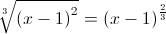
Using properties of radicals e.g.,
we get
Write in exponential form:

Write in exponential form:
Tap to see back →
Properties of Radicals


Properties of Radicals
Write in radical notation:

Write in radical notation:
Tap to see back →
Properties of Radicals
Properties of Radicals
Express in radical form : 
Express in radical form :
Tap to see back →
Properties of Radicals

Properties of Radicals
Simplify: 
Simplify:
Tap to see back →

Simplify:

Simplify:
Tap to see back →
Convert the given expression into a single radical e.g.  the expression inside the radical is:

and the cube root of this is :

Convert the given expression into a single radical e.g.
and the cube root of this is :
Solve for  .
.

Solve for
Tap to see back →

Hence  must be equal to 2.
Hence
Simplify:

Simplify:
Tap to see back →

Now 
Hence the correct answer is 
Now
Hence the correct answer is
Solve for  .
.

Solve for
Tap to see back →
If we combine into a single logarithmic function we get:
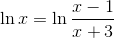

Solving for  we get
  .
.
If we combine into a single logarithmic function we get:
Solving for
Which of the following statements is the same as:
Which of the following statements is the same as:
Tap to see back →
Remember the laws of exponents. In particular, when the base is nonzero:
An effective way to compare these statements, is to convert them all into exponents with base 2. The original statement becomes:
This is identical to statement I. Now consider statement II:
Therefore, statement II is not identical to the original statement. Finally, consider statement III:
which is also identical to the original statement. As a result, only I and III are the same as the original statement.
Remember the laws of exponents. In particular, when the base is nonzero:
An effective way to compare these statements, is to convert them all into exponents with base 2. The original statement becomes:
This is identical to statement I. Now consider statement II:
Therefore, statement II is not identical to the original statement. Finally, consider statement III:
which is also identical to the original statement. As a result, only I and III are the same as the original statement.
If is the complex number such that , evaluate the following expression:
If
Tap to see back →
The powers of i form a sequence that repeats every four terms.
i1 = i
i2 = -1
i3 = -i
i4 = 1
i5 = i
Thus:
i25 = i
i23 = -i
i21 = i
i19= -i
Now we can evalulate the expression.
i25 - i23 + i21 - i19 + i17..... + i
= i + (-1)(-i) + i + (-1)(i) ..... + i
= i + i + i + i + ..... + i
Each term reduces to +i. Since there are 13 terms in the expression, the final result is 13i.
The powers of i form a sequence that repeats every four terms.
i1 = i
i2 = -1
i3 = -i
i4 = 1
i5 = i
Thus:
i25 = i
i23 = -i
i21 = i
i19= -i
Now we can evalulate the expression.
i25 - i23 + i21 - i19 + i17..... + i
= i + (-1)(-i) + i + (-1)(i) ..... + i
= i + i + i + i + ..... + i
Each term reduces to +i. Since there are 13 terms in the expression, the final result is 13i.