How to find percentage from a fraction - PSAT Math
Card 0 of 49
If there are 3 boys in a class and 7 girls. What percent of the class is made up of boys?
If there are 3 boys in a class and 7 girls. What percent of the class is made up of boys?
Tap to see back →
To solve this problem we set up a ratio of part of total. The part is the number of boys in the class and the total is the number of boys and girls in the class.

now to find the percent we can multiply this fraction by 10/10
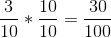
From here we can see that it is 30%
To solve this problem we set up a ratio of part of total. The part is the number of boys in the class and the total is the number of boys and girls in the class.
now to find the percent we can multiply this fraction by 10/10
From here we can see that it is 30%
Marker Colors Students Blue 13 Pink 10 Orange 5 Brown 5 Green 7
The above chart shows the number of students in a class who chose each of the five marker colors available.
What percentage of the class chose a green marker?
| Marker Colors | Students |
|---|---|
| Blue | 13 |
| Pink | 10 |
| Orange | 5 |
| Brown | 5 |
| Green | 7 |
The above chart shows the number of students in a class who chose each of the five marker colors available.
What percentage of the class chose a green marker?
Tap to see back →
To figure out what percentage of the class chose green markers, you must first figure out what fraction of the class chose green markers. Then, you must convert that fraction into a percentage.
Figure out the fraction:
7 students chose green markers
40 students total
Fraction of students who chose green: 
To convert this fraction to a percentage, you must multiply the fraction times 100, then divide the numerator by the denominator. You multiply the fraction times 100 because in order to figure out the percent, you must figure out what the fraction means "for (per) every hundred (cent)".

Multiply times 100
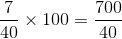

Therefore, the answer is  .
.
To figure out what percentage of the class chose green markers, you must first figure out what fraction of the class chose green markers. Then, you must convert that fraction into a percentage.
Figure out the fraction:
7 students chose green markers
40 students total
Fraction of students who chose green:
To convert this fraction to a percentage, you must multiply the fraction times 100, then divide the numerator by the denominator. You multiply the fraction times 100 because in order to figure out the percent, you must figure out what the fraction means "for (per) every hundred (cent)".
Multiply times 100
Therefore, the answer is
Three hens each lay 20 eggs for a farmer. Two-fifths of the first hen's eggs are brown. One-fourth of the second hen's eggs are brown. Seven-tenths of the third hen's eggs are white. What percentage of all the eggs are brown?
Three hens each lay 20 eggs for a farmer. Two-fifths of the first hen's eggs are brown. One-fourth of the second hen's eggs are brown. Seven-tenths of the third hen's eggs are white. What percentage of all the eggs are brown?
Tap to see back →
The first hen lays 8 brown eggs: 2/5 * 20 = 8
The second lays 5 brown eggs: 1/4 * 20 = 5
The third lays 6 brown eggs: 3/10 * 20 = 6
Add up the brown eggs and divide by 60, the total number of eggs:
19/60 = 0.31666667 = 31.67%, or 32%.
The first hen lays 8 brown eggs: 2/5 * 20 = 8
The second lays 5 brown eggs: 1/4 * 20 = 5
The third lays 6 brown eggs: 3/10 * 20 = 6
Add up the brown eggs and divide by 60, the total number of eggs:
19/60 = 0.31666667 = 31.67%, or 32%.
What is  as a percentage?
What is
Tap to see back →
Convert the improper fraction  to the mixed numeral
  or as the decimal
  .
.  as a percentage is
Convert the improper fraction
A family with 6 children, aged 4, 4, 5, 7, 12, and 13 are moving to a new home. They all want the same bedroom, so the parents have a lottery. Each child places their name in once for every year of age (the four year olds each put their name in 4 times, the seven year old puts his name in 7 times, etc.) What is the probability of the chosen child being 4 years old?
A family with 6 children, aged 4, 4, 5, 7, 12, and 13 are moving to a new home. They all want the same bedroom, so the parents have a lottery. Each child places their name in once for every year of age (the four year olds each put their name in 4 times, the seven year old puts his name in 7 times, etc.) What is the probability of the chosen child being 4 years old?
Tap to see back →
First, we will determine the total number of ballots:
4+4+5+7+12+13=45hspace{1 mm}ballots
Since there are two four year olds, and this question is asking the probability of the chosen child being four, the probability is:
$\frac{4+4}{45}$=\frac{8}{45}$=0.1$\overline{7}$=17.$\overline{7}$%
First, we will determine the total number of ballots:
4+4+5+7+12+13=45hspace{1 mm}ballots
Since there are two four year olds, and this question is asking the probability of the chosen child being four, the probability is:
$\frac{4+4}{45}$=\frac{8}{45}$=0.1$\overline{7}$=17.$\overline{7}$%
There is a sale in a store and every item is discounted 23%. If a shirt is normally $18.59, what is the price of it after the discount?
There is a sale in a store and every item is discounted 23%. If a shirt is normally $18.59, what is the price of it after the discount?
Tap to see back →
We can right 23% as a fraction and set that equal to  over the original price.

From here we cross multiply and divide.
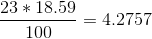
We round this number to $4.28. This is the amount of discoount we need to apply to the original price. To do this we subtract 4.28 from 18.59.

We can right 23% as a fraction and set that equal to
From here we cross multiply and divide.
We round this number to $4.28. This is the amount of discoount we need to apply to the original price. To do this we subtract 4.28 from 18.59.
Louisa and Caroline are trying to save up to start a small business together. Louisa has saved  of their goal money, and Carolina has saved
  of their goal money. About how much of their goal money have they saved up together?
Louisa and Caroline are trying to save up to start a small business together. Louisa has saved
Tap to see back →
The goal of this problem is to solve for how much Louisa and Caroline have saved, together, towards their goal money for starting a small business. In order to do that, you must add what Louisa has saved to what Caroline has saved, then convert the fraction into a percentage.
Add Louisa and Caroline:

Find the lowest common multiple for the denominator:

Add:

Simplify:

To convert a fraction into a percentage, simply multiply the numerator by 100 and divide by the denominator. There are other methods, but this is the easiest.

Equals


78% is your answer.
The goal of this problem is to solve for how much Louisa and Caroline have saved, together, towards their goal money for starting a small business. In order to do that, you must add what Louisa has saved to what Caroline has saved, then convert the fraction into a percentage.
Add Louisa and Caroline:
Find the lowest common multiple for the denominator:
Add:
Simplify:
To convert a fraction into a percentage, simply multiply the numerator by 100 and divide by the denominator. There are other methods, but this is the easiest.
Equals
78% is your answer.
If there are 3 boys in a class and 7 girls. What percent of the class is made up of boys?
If there are 3 boys in a class and 7 girls. What percent of the class is made up of boys?
Tap to see back →
To solve this problem we set up a ratio of part of total. The part is the number of boys in the class and the total is the number of boys and girls in the class.
now to find the percent we can multiply this fraction by 10/10
From here we can see that it is 30%
To solve this problem we set up a ratio of part of total. The part is the number of boys in the class and the total is the number of boys and girls in the class.
now to find the percent we can multiply this fraction by 10/10
From here we can see that it is 30%
Marker Colors Students Blue 13 Pink 10 Orange 5 Brown 5 Green 7
The above chart shows the number of students in a class who chose each of the five marker colors available.
What percentage of the class chose a green marker?
| Marker Colors | Students |
|---|---|
| Blue | 13 |
| Pink | 10 |
| Orange | 5 |
| Brown | 5 |
| Green | 7 |
The above chart shows the number of students in a class who chose each of the five marker colors available.
What percentage of the class chose a green marker?
Tap to see back →
To figure out what percentage of the class chose green markers, you must first figure out what fraction of the class chose green markers. Then, you must convert that fraction into a percentage.
Figure out the fraction:
7 students chose green markers
40 students total
Fraction of students who chose green:
To convert this fraction to a percentage, you must multiply the fraction times 100, then divide the numerator by the denominator. You multiply the fraction times 100 because in order to figure out the percent, you must figure out what the fraction means "for (per) every hundred (cent)".
Multiply times 100
Therefore, the answer is .
To figure out what percentage of the class chose green markers, you must first figure out what fraction of the class chose green markers. Then, you must convert that fraction into a percentage.
Figure out the fraction:
7 students chose green markers
40 students total
Fraction of students who chose green:
To convert this fraction to a percentage, you must multiply the fraction times 100, then divide the numerator by the denominator. You multiply the fraction times 100 because in order to figure out the percent, you must figure out what the fraction means "for (per) every hundred (cent)".
Multiply times 100
Therefore, the answer is
Three hens each lay 20 eggs for a farmer. Two-fifths of the first hen's eggs are brown. One-fourth of the second hen's eggs are brown. Seven-tenths of the third hen's eggs are white. What percentage of all the eggs are brown?
Three hens each lay 20 eggs for a farmer. Two-fifths of the first hen's eggs are brown. One-fourth of the second hen's eggs are brown. Seven-tenths of the third hen's eggs are white. What percentage of all the eggs are brown?
Tap to see back →
The first hen lays 8 brown eggs: 2/5 * 20 = 8
The second lays 5 brown eggs: 1/4 * 20 = 5
The third lays 6 brown eggs: 3/10 * 20 = 6
Add up the brown eggs and divide by 60, the total number of eggs:
19/60 = 0.31666667 = 31.67%, or 32%.
The first hen lays 8 brown eggs: 2/5 * 20 = 8
The second lays 5 brown eggs: 1/4 * 20 = 5
The third lays 6 brown eggs: 3/10 * 20 = 6
Add up the brown eggs and divide by 60, the total number of eggs:
19/60 = 0.31666667 = 31.67%, or 32%.
What is as a percentage?
What is
Tap to see back →
Convert the improper fraction to the mixed numeral or as the decimal . as a percentage is
Convert the improper fraction
A family with 6 children, aged 4, 4, 5, 7, 12, and 13 are moving to a new home. They all want the same bedroom, so the parents have a lottery. Each child places their name in once for every year of age (the four year olds each put their name in 4 times, the seven year old puts his name in 7 times, etc.) What is the probability of the chosen child being 4 years old?
A family with 6 children, aged 4, 4, 5, 7, 12, and 13 are moving to a new home. They all want the same bedroom, so the parents have a lottery. Each child places their name in once for every year of age (the four year olds each put their name in 4 times, the seven year old puts his name in 7 times, etc.) What is the probability of the chosen child being 4 years old?
Tap to see back →
First, we will determine the total number of ballots:
4+4+5+7+12+13=45hspace{1 mm}ballots
Since there are two four year olds, and this question is asking the probability of the chosen child being four, the probability is:
$\frac{4+4}{45}$=\frac{8}{45}$=0.1$\overline{7}$=17.$\overline{7}$%
First, we will determine the total number of ballots:
4+4+5+7+12+13=45hspace{1 mm}ballots
Since there are two four year olds, and this question is asking the probability of the chosen child being four, the probability is:
$\frac{4+4}{45}$=\frac{8}{45}$=0.1$\overline{7}$=17.$\overline{7}$%
There is a sale in a store and every item is discounted 23%. If a shirt is normally $18.59, what is the price of it after the discount?
There is a sale in a store and every item is discounted 23%. If a shirt is normally $18.59, what is the price of it after the discount?
Tap to see back →
We can right 23% as a fraction and set that equal to over the original price.
From here we cross multiply and divide.
We round this number to $4.28. This is the amount of discoount we need to apply to the original price. To do this we subtract 4.28 from 18.59.
We can right 23% as a fraction and set that equal to
From here we cross multiply and divide.
We round this number to $4.28. This is the amount of discoount we need to apply to the original price. To do this we subtract 4.28 from 18.59.
Louisa and Caroline are trying to save up to start a small business together. Louisa has saved of their goal money, and Carolina has saved of their goal money. About how much of their goal money have they saved up together?
Louisa and Caroline are trying to save up to start a small business together. Louisa has saved
Tap to see back →
The goal of this problem is to solve for how much Louisa and Caroline have saved, together, towards their goal money for starting a small business. In order to do that, you must add what Louisa has saved to what Caroline has saved, then convert the fraction into a percentage.
Add Louisa and Caroline:
Find the lowest common multiple for the denominator:
Add:
Simplify:
To convert a fraction into a percentage, simply multiply the numerator by 100 and divide by the denominator. There are other methods, but this is the easiest.
Equals
78% is your answer.
The goal of this problem is to solve for how much Louisa and Caroline have saved, together, towards their goal money for starting a small business. In order to do that, you must add what Louisa has saved to what Caroline has saved, then convert the fraction into a percentage.
Add Louisa and Caroline:
Find the lowest common multiple for the denominator:
Add:
Simplify:
To convert a fraction into a percentage, simply multiply the numerator by 100 and divide by the denominator. There are other methods, but this is the easiest.
Equals
78% is your answer.
If there are 3 boys in a class and 7 girls. What percent of the class is made up of boys?
If there are 3 boys in a class and 7 girls. What percent of the class is made up of boys?
Tap to see back →
To solve this problem we set up a ratio of part of total. The part is the number of boys in the class and the total is the number of boys and girls in the class.
now to find the percent we can multiply this fraction by 10/10
From here we can see that it is 30%
To solve this problem we set up a ratio of part of total. The part is the number of boys in the class and the total is the number of boys and girls in the class.
now to find the percent we can multiply this fraction by 10/10
From here we can see that it is 30%
Marker Colors Students Blue 13 Pink 10 Orange 5 Brown 5 Green 7
The above chart shows the number of students in a class who chose each of the five marker colors available.
What percentage of the class chose a green marker?
| Marker Colors | Students |
|---|---|
| Blue | 13 |
| Pink | 10 |
| Orange | 5 |
| Brown | 5 |
| Green | 7 |
The above chart shows the number of students in a class who chose each of the five marker colors available.
What percentage of the class chose a green marker?
Tap to see back →
To figure out what percentage of the class chose green markers, you must first figure out what fraction of the class chose green markers. Then, you must convert that fraction into a percentage.
Figure out the fraction:
7 students chose green markers
40 students total
Fraction of students who chose green:
To convert this fraction to a percentage, you must multiply the fraction times 100, then divide the numerator by the denominator. You multiply the fraction times 100 because in order to figure out the percent, you must figure out what the fraction means "for (per) every hundred (cent)".
Multiply times 100
Therefore, the answer is .
To figure out what percentage of the class chose green markers, you must first figure out what fraction of the class chose green markers. Then, you must convert that fraction into a percentage.
Figure out the fraction:
7 students chose green markers
40 students total
Fraction of students who chose green:
To convert this fraction to a percentage, you must multiply the fraction times 100, then divide the numerator by the denominator. You multiply the fraction times 100 because in order to figure out the percent, you must figure out what the fraction means "for (per) every hundred (cent)".
Multiply times 100
Therefore, the answer is
Three hens each lay 20 eggs for a farmer. Two-fifths of the first hen's eggs are brown. One-fourth of the second hen's eggs are brown. Seven-tenths of the third hen's eggs are white. What percentage of all the eggs are brown?
Three hens each lay 20 eggs for a farmer. Two-fifths of the first hen's eggs are brown. One-fourth of the second hen's eggs are brown. Seven-tenths of the third hen's eggs are white. What percentage of all the eggs are brown?
Tap to see back →
The first hen lays 8 brown eggs: 2/5 * 20 = 8
The second lays 5 brown eggs: 1/4 * 20 = 5
The third lays 6 brown eggs: 3/10 * 20 = 6
Add up the brown eggs and divide by 60, the total number of eggs:
19/60 = 0.31666667 = 31.67%, or 32%.
The first hen lays 8 brown eggs: 2/5 * 20 = 8
The second lays 5 brown eggs: 1/4 * 20 = 5
The third lays 6 brown eggs: 3/10 * 20 = 6
Add up the brown eggs and divide by 60, the total number of eggs:
19/60 = 0.31666667 = 31.67%, or 32%.
What is as a percentage?
What is
Tap to see back →
Convert the improper fraction to the mixed numeral or as the decimal . as a percentage is
Convert the improper fraction
A family with 6 children, aged 4, 4, 5, 7, 12, and 13 are moving to a new home. They all want the same bedroom, so the parents have a lottery. Each child places their name in once for every year of age (the four year olds each put their name in 4 times, the seven year old puts his name in 7 times, etc.) What is the probability of the chosen child being 4 years old?
A family with 6 children, aged 4, 4, 5, 7, 12, and 13 are moving to a new home. They all want the same bedroom, so the parents have a lottery. Each child places their name in once for every year of age (the four year olds each put their name in 4 times, the seven year old puts his name in 7 times, etc.) What is the probability of the chosen child being 4 years old?
Tap to see back →
First, we will determine the total number of ballots:
4+4+5+7+12+13=45hspace{1 mm}ballots
Since there are two four year olds, and this question is asking the probability of the chosen child being four, the probability is:
$\frac{4+4}{45}$=\frac{8}{45}$=0.1$\overline{7}$=17.$\overline{7}$%
First, we will determine the total number of ballots:
4+4+5+7+12+13=45hspace{1 mm}ballots
Since there are two four year olds, and this question is asking the probability of the chosen child being four, the probability is:
$\frac{4+4}{45}$=\frac{8}{45}$=0.1$\overline{7}$=17.$\overline{7}$%
There is a sale in a store and every item is discounted 23%. If a shirt is normally $18.59, what is the price of it after the discount?
There is a sale in a store and every item is discounted 23%. If a shirt is normally $18.59, what is the price of it after the discount?
Tap to see back →
We can right 23% as a fraction and set that equal to over the original price.
From here we cross multiply and divide.
We round this number to $4.28. This is the amount of discoount we need to apply to the original price. To do this we subtract 4.28 from 18.59.
We can right 23% as a fraction and set that equal to
From here we cross multiply and divide.
We round this number to $4.28. This is the amount of discoount we need to apply to the original price. To do this we subtract 4.28 from 18.59.