How to find the decimal equivalent of a fraction - PSAT Math
Card 0 of 56
Trevor, James, and Will were each given a candy bar. Trevor ate 7/12 of his and Will ate 20% of his. If James ate more than Will and less than Trevor, what amount could James have eaten?
Trevor, James, and Will were each given a candy bar. Trevor ate 7/12 of his and Will ate 20% of his. If James ate more than Will and less than Trevor, what amount could James have eaten?
Tap to see back →
Turn Trevor and Will’s amounts into decimals to compare: 20% = 0.20 and 7/12 = 0.5083 rounded. When the answer choices are converted into decimals, 2/7 = 0.2871 is the only value between 0.20 and 0.5083.
Turn Trevor and Will’s amounts into decimals to compare: 20% = 0.20 and 7/12 = 0.5083 rounded. When the answer choices are converted into decimals, 2/7 = 0.2871 is the only value between 0.20 and 0.5083.
Which of the following numbers is between 1/5 and 1/6?
Which of the following numbers is between 1/5 and 1/6?
Tap to see back →
Long division shows that 1/5 = 0.20 and 1/6 = 0.16666... 0.13 < 0.16 < 1/6 < 0.19 < 1/5 < 0.22 < 0.25.
Long division shows that 1/5 = 0.20 and 1/6 = 0.16666... 0.13 < 0.16 < 1/6 < 0.19 < 1/5 < 0.22 < 0.25.
The ogre under the bridge eats  of a pizza and then throws the rest of the pizza to the rats. The rats eat
  of what is left. What fraction of the pizza is left when the rats are done?
The ogre under the bridge eats
Tap to see back →
1/5 of the pizza is left after the ogre eats his share. The rats eat 3/4 of that, so 1/4 of 1/5 of the pizza is left.
1/4 * 1/5 = 1/20 = 5%
1/5 of the pizza is left after the ogre eats his share. The rats eat 3/4 of that, so 1/4 of 1/5 of the pizza is left.
1/4 * 1/5 = 1/20 = 5%
Tap to see back →
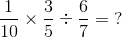
Multiply numerator by the other numerator and multiply the denominator by the other denominator for multiplication. To divide fractions, switch numerator and denominator and treat it as multiplication. The answer is 0.07.
Multiply numerator by the other numerator and multiply the denominator by the other denominator for multiplication. To divide fractions, switch numerator and denominator and treat it as multiplication. The answer is 0.07.
How much less is  than
than  ?
?
How much less is
Tap to see back →
$\frac{1}{16}$=.0625
.0665-.0625=.004=\frac{4}{1000}$=\frac{1}{250}$
$\frac{1}{16}$=.0625
.0665-.0625=.004=\frac{4}{1000}$=\frac{1}{250}$
Express as a decimal: 
Express as a decimal:
Tap to see back →
Divide 16 by 9:
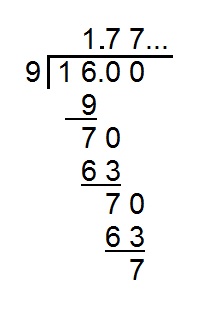
The "7" repeats forever, so

Divide 16 by 9:
The "7" repeats forever, so
Express as a decimal: 
Express as a decimal:
Tap to see back →
Divide 9 by 16:
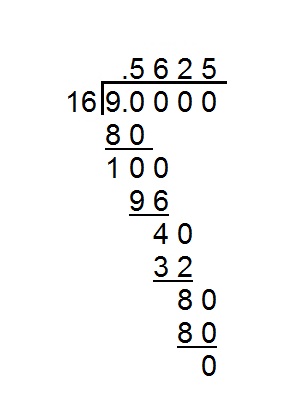

Divide 9 by 16:
Convert the fraction to a decimal.

Convert the fraction to a decimal.
Tap to see back →
We can multiply our numerator and denominator by  , which leads to
  . From here we divide by our denominator, moving the decimal two places to the left.
We can multiply our numerator and denominator by
Trevor, James, and Will were each given a candy bar. Trevor ate 7/12 of his and Will ate 20% of his. If James ate more than Will and less than Trevor, what amount could James have eaten?
Trevor, James, and Will were each given a candy bar. Trevor ate 7/12 of his and Will ate 20% of his. If James ate more than Will and less than Trevor, what amount could James have eaten?
Tap to see back →
Turn Trevor and Will’s amounts into decimals to compare: 20% = 0.20 and 7/12 = 0.5083 rounded. When the answer choices are converted into decimals, 2/7 = 0.2871 is the only value between 0.20 and 0.5083.
Turn Trevor and Will’s amounts into decimals to compare: 20% = 0.20 and 7/12 = 0.5083 rounded. When the answer choices are converted into decimals, 2/7 = 0.2871 is the only value between 0.20 and 0.5083.
Which of the following numbers is between 1/5 and 1/6?
Which of the following numbers is between 1/5 and 1/6?
Tap to see back →
Long division shows that 1/5 = 0.20 and 1/6 = 0.16666... 0.13 < 0.16 < 1/6 < 0.19 < 1/5 < 0.22 < 0.25.
Long division shows that 1/5 = 0.20 and 1/6 = 0.16666... 0.13 < 0.16 < 1/6 < 0.19 < 1/5 < 0.22 < 0.25.
The ogre under the bridge eats of a pizza and then throws the rest of the pizza to the rats. The rats eat of what is left. What fraction of the pizza is left when the rats are done?
The ogre under the bridge eats
Tap to see back →
1/5 of the pizza is left after the ogre eats his share. The rats eat 3/4 of that, so 1/4 of 1/5 of the pizza is left.
1/4 * 1/5 = 1/20 = 5%
1/5 of the pizza is left after the ogre eats his share. The rats eat 3/4 of that, so 1/4 of 1/5 of the pizza is left.
1/4 * 1/5 = 1/20 = 5%
Tap to see back →
Multiply numerator by the other numerator and multiply the denominator by the other denominator for multiplication. To divide fractions, switch numerator and denominator and treat it as multiplication. The answer is 0.07.
Multiply numerator by the other numerator and multiply the denominator by the other denominator for multiplication. To divide fractions, switch numerator and denominator and treat it as multiplication. The answer is 0.07.
How much less is than ?
How much less is
Tap to see back →
$\frac{1}{16}$=.0625
.0665-.0625=.004=\frac{4}{1000}$=\frac{1}{250}$
$\frac{1}{16}$=.0625
.0665-.0625=.004=\frac{4}{1000}$=\frac{1}{250}$
Express as a decimal:
Express as a decimal:
Tap to see back →
Divide 16 by 9:
The "7" repeats forever, so
Divide 16 by 9:
The "7" repeats forever, so
Express as a decimal:
Express as a decimal:
Tap to see back →
Divide 9 by 16:
Divide 9 by 16:
Convert the fraction to a decimal.
Convert the fraction to a decimal.
Tap to see back →
We can multiply our numerator and denominator by , which leads to . From here we divide by our denominator, moving the decimal two places to the left.
We can multiply our numerator and denominator by
Trevor, James, and Will were each given a candy bar. Trevor ate 7/12 of his and Will ate 20% of his. If James ate more than Will and less than Trevor, what amount could James have eaten?
Trevor, James, and Will were each given a candy bar. Trevor ate 7/12 of his and Will ate 20% of his. If James ate more than Will and less than Trevor, what amount could James have eaten?
Tap to see back →
Turn Trevor and Will’s amounts into decimals to compare: 20% = 0.20 and 7/12 = 0.5083 rounded. When the answer choices are converted into decimals, 2/7 = 0.2871 is the only value between 0.20 and 0.5083.
Turn Trevor and Will’s amounts into decimals to compare: 20% = 0.20 and 7/12 = 0.5083 rounded. When the answer choices are converted into decimals, 2/7 = 0.2871 is the only value between 0.20 and 0.5083.
Which of the following numbers is between 1/5 and 1/6?
Which of the following numbers is between 1/5 and 1/6?
Tap to see back →
Long division shows that 1/5 = 0.20 and 1/6 = 0.16666... 0.13 < 0.16 < 1/6 < 0.19 < 1/5 < 0.22 < 0.25.
Long division shows that 1/5 = 0.20 and 1/6 = 0.16666... 0.13 < 0.16 < 1/6 < 0.19 < 1/5 < 0.22 < 0.25.
The ogre under the bridge eats of a pizza and then throws the rest of the pizza to the rats. The rats eat of what is left. What fraction of the pizza is left when the rats are done?
The ogre under the bridge eats
Tap to see back →
1/5 of the pizza is left after the ogre eats his share. The rats eat 3/4 of that, so 1/4 of 1/5 of the pizza is left.
1/4 * 1/5 = 1/20 = 5%
1/5 of the pizza is left after the ogre eats his share. The rats eat 3/4 of that, so 1/4 of 1/5 of the pizza is left.
1/4 * 1/5 = 1/20 = 5%
Tap to see back →
Multiply numerator by the other numerator and multiply the denominator by the other denominator for multiplication. To divide fractions, switch numerator and denominator and treat it as multiplication. The answer is 0.07.
Multiply numerator by the other numerator and multiply the denominator by the other denominator for multiplication. To divide fractions, switch numerator and denominator and treat it as multiplication. The answer is 0.07.