How to find the equation of a circle - PSAT Math
Card 0 of 98
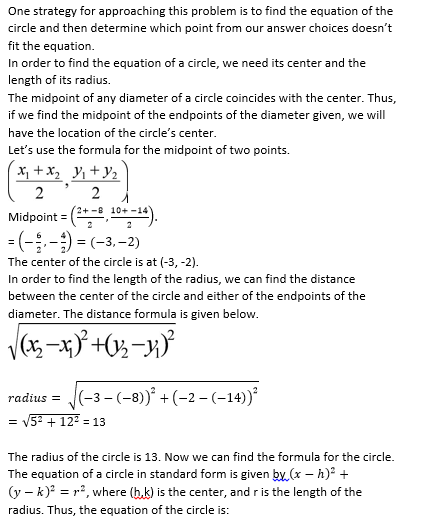
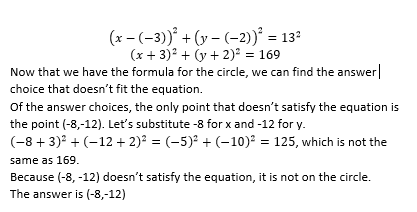
The diameter of a circle has endpoints at points (2, 10) and (–8, –14). Which of the following points does NOT lie on the circle?
The diameter of a circle has endpoints at points (2, 10) and (–8, –14). Which of the following points does NOT lie on the circle?
Tap to see back →
If the center of a circle is at (0,4) and the diameter of the circle is 6, what is the equation of that circle?
If the center of a circle is at (0,4) and the diameter of the circle is 6, what is the equation of that circle?
Tap to see back →
The formula for the equation of a circle is:
(x-h) 2 + (y-k)2 = r2
Where (h,k) is the center of the circle.
h = 0 and k = 4
and diameter = 6 therefore radius = 3
(x-0) 2 + (y-4)2 = 32
x2 + (y-4)2 = 9
The formula for the equation of a circle is:
(x-h) 2 + (y-k)2 = r2
Where (h,k) is the center of the circle.
h = 0 and k = 4
and diameter = 6 therefore radius = 3
(x-0) 2 + (y-4)2 = 32
x2 + (y-4)2 = 9
The endpoints of a diameter of circle A are located at points  and
and  . What is the area of the circle?
The endpoints of a diameter of circle A are located at points
Tap to see back →
The formula for the area of a circle is given by A =πr2 . The problem gives us the endpoints of the diameter of the circle. Using the distance formula, we can find the length of the diameter. Then, because we know that the radius (r) is half the length of the diameter, we can find the length of r. Finally, we can use the formula A =πr2 to find the area.
The distance formula is 
The distance between the endpoints of the diameter of the circle is:


To find the radius, we divide d (the length of the diameter) by two.

Then we substitute the value of r into the formula for the area of a circle.

The formula for the area of a circle is given by A =πr2 . The problem gives us the endpoints of the diameter of the circle. Using the distance formula, we can find the length of the diameter. Then, because we know that the radius (r) is half the length of the diameter, we can find the length of r. Finally, we can use the formula A =πr2 to find the area.
The distance formula is
The distance between the endpoints of the diameter of the circle is:
To find the radius, we divide d (the length of the diameter) by two.
Then we substitute the value of r into the formula for the area of a circle.
A circle is centered on point  . The area of the circle is
  . What is the equation of the circle?
A circle is centered on point 

Tap to see back →
The formula for a circle is 
 is the coordinate of the center of the circle, therefore
  and
and  .
.
The area of a circle:


Therefore:


The formula for a circle is


The area of a circle:


Therefore:


A circle has a center at (5,5) and a radius of 2. If the format of the equation for the circle is (x-A)2+(y-B)2=C, what is C?
A circle has a center at (5,5) and a radius of 2. If the format of the equation for the circle is (x-A)2+(y-B)2=C, what is C?
Tap to see back →
The circle has a center at (5,5) and a radius of 2. Therefore, the equation is (x-5)2+(y-5)2=22, or (x-5)2+(y-5)2=4.
The circle has a center at (5,5) and a radius of 2. Therefore, the equation is (x-5)2+(y-5)2=22, or (x-5)2+(y-5)2=4.
Circle A is given by the equation (x – 4)2 + (y + 3)2 = 29. Circle A is shifted up five units and left by six units. Then, its radius is doubled. What is the new equation for circle A?
Circle A is given by the equation (x – 4)2 + (y + 3)2 = 29. Circle A is shifted up five units and left by six units. Then, its radius is doubled. What is the new equation for circle A?
Tap to see back →
The general equation of a circle is (x – h)2 + (y – k)2 = r2, where (h, k) represents the location of the circle's center, and r represents the length of its radius.
Circle A first has the equation of (x – 4)2 + (y + 3)2 = 29. This means that its center must be located at (4, –3), and its radius is √29.
We are then told that circle A is shifted up five units and then left by six units. This means that the y-coordinate of the center would increase by five, and the x-coordinate of the center would decrease by 6. Thus, the new center would be located at (4 – 6, –3 + 5), or (–2, 2).
We are then told that the radius of circle A is doubled, which means its new radius is 2√29.
Now, that we have circle A's new center and radius, we can write its general equation using (x – h)2 + (y – k)2 = r2.
(x – (–2))2 + (y – 2)2 = (2√29)2 = 22(√29)2 = 4(29) = 116.
(x + 2)2 + (y – 2)2 = 116.
The answer is (x + 2)2 + (y – 2)2 = 116.
The general equation of a circle is (x – h)2 + (y – k)2 = r2, where (h, k) represents the location of the circle's center, and r represents the length of its radius.
Circle A first has the equation of (x – 4)2 + (y + 3)2 = 29. This means that its center must be located at (4, –3), and its radius is √29.
We are then told that circle A is shifted up five units and then left by six units. This means that the y-coordinate of the center would increase by five, and the x-coordinate of the center would decrease by 6. Thus, the new center would be located at (4 – 6, –3 + 5), or (–2, 2).
We are then told that the radius of circle A is doubled, which means its new radius is 2√29.
Now, that we have circle A's new center and radius, we can write its general equation using (x – h)2 + (y – k)2 = r2.
(x – (–2))2 + (y – 2)2 = (2√29)2 = 22(√29)2 = 4(29) = 116.
(x + 2)2 + (y – 2)2 = 116.
The answer is (x + 2)2 + (y – 2)2 = 116.
Which of the following equations describes all the points (x, y) in a coordinate plane that are five units away from the point (–3, 6)?
Which of the following equations describes all the points (x, y) in a coordinate plane that are five units away from the point (–3, 6)?
Tap to see back →
We are trying to find an equation for all of the points that are the same distance (5 units) from (–3, 6). The locus of all points equidistant from a single point is a circle. In other words, we need to find an equation of a circle. The center of the circle will be (–3, 6), and the radius, which is the distance from (–3,6), will be 5.
The standard form of a circle is given below:
(x – h)2 + (y – k)2 = r2, where the center is located at (h, k) and r is the length of the radius.
In this case, h will be –3, k will be 6, and r will be 5.
(x – (–3))2 + (y – 6)2 = 52
(x + 3)2 + (y – 6)2 = 25
The answer is (x + 3)2 + (y – 6)2 = 25.
We are trying to find an equation for all of the points that are the same distance (5 units) from (–3, 6). The locus of all points equidistant from a single point is a circle. In other words, we need to find an equation of a circle. The center of the circle will be (–3, 6), and the radius, which is the distance from (–3,6), will be 5.
The standard form of a circle is given below:
(x – h)2 + (y – k)2 = r2, where the center is located at (h, k) and r is the length of the radius.
In this case, h will be –3, k will be 6, and r will be 5.
(x – (–3))2 + (y – 6)2 = 52
(x + 3)2 + (y – 6)2 = 25
The answer is (x + 3)2 + (y – 6)2 = 25.
A circle with a radius of five is centered at the origin. A point on the circumference of the circle has an x-coordinate of two and a positive y-coordinate. What is the value of the y-coordinate?
A circle with a radius of five is centered at the origin. A point on the circumference of the circle has an x-coordinate of two and a positive y-coordinate. What is the value of the y-coordinate?
Tap to see back →
Recall that the general form of the equation of a circle centered at the origin is:
_x_2 + _y_2 = _r_2
We know that the radius of our circle is five. Therefore, we know that the equation for our circle is:
_x_2 + _y_2 = 52
_x_2 + _y_2 = 25
Now, the question asks for the positive y-coordinate when x = 2. To solve this, simply plug in for x:
22 + _y_2 = 25
4 + _y_2 = 25
_y_2 = 21
y = ±√(21)
Since our answer will be positive, it must be √(21).
Recall that the general form of the equation of a circle centered at the origin is:
_x_2 + _y_2 = _r_2
We know that the radius of our circle is five. Therefore, we know that the equation for our circle is:
_x_2 + _y_2 = 52
_x_2 + _y_2 = 25
Now, the question asks for the positive y-coordinate when x = 2. To solve this, simply plug in for x:
22 + _y_2 = 25
4 + _y_2 = 25
_y_2 = 21
y = ±√(21)
Since our answer will be positive, it must be √(21).
What is the equation for a circle of radius 12, centered at the intersection of the two lines:
y_1 = 4_x + 3
and
y_2 = 5_x + 44?
What is the equation for a circle of radius 12, centered at the intersection of the two lines:
y_1 = 4_x + 3
and
y_2 = 5_x + 44?
Tap to see back →
To begin, let us determine the point of intersection of these two lines by setting the equations equal to each other:
4_x_ + 3 = 5_x_ + 44; 3 = x + 44; –41 = x
To find the y-coordinate, substitute into one of the equations. Let's use _y_1:
y = 4 * –41 + 3 = –164 + 3 = –161
The center of our circle is therefore: (–41, –161).
Now, recall that the general form for a circle with center at (_x_0, _y_0) is:
(x - _x_0)2 + (y - _y_0)2 = _r_2
For our data, this means that our equation is:
(x + 41)2 + (y + 161)2 = 122 or (x + 41)2 + (y + 161)2 = 144
To begin, let us determine the point of intersection of these two lines by setting the equations equal to each other:
4_x_ + 3 = 5_x_ + 44; 3 = x + 44; –41 = x
To find the y-coordinate, substitute into one of the equations. Let's use _y_1:
y = 4 * –41 + 3 = –164 + 3 = –161
The center of our circle is therefore: (–41, –161).
Now, recall that the general form for a circle with center at (_x_0, _y_0) is:
(x - _x_0)2 + (y - _y_0)2 = _r_2
For our data, this means that our equation is:
(x + 41)2 + (y + 161)2 = 122 or (x + 41)2 + (y + 161)2 = 144
What is the equation for a circle of radius 9, centered at the intersection of the following two lines?


What is the equation for a circle of radius 9, centered at the intersection of the following two lines?
Tap to see back →
To begin, let us determine the point of intersection of these two lines by setting the equations equal to each other:


To find the y-coordinate, substitute into one of the equations. Let's use  :
:


The center of our circle is therefore  .
.
Now, recall that the general form for a circle with center at  is
is

For our data, this means that our equation is:


To begin, let us determine the point of intersection of these two lines by setting the equations equal to each other:
To find the y-coordinate, substitute into one of the equations. Let's use
The center of our circle is therefore
Now, recall that the general form for a circle with center at
For our data, this means that our equation is:
What is the radius of a circle with the equation  ?
?
What is the radius of a circle with the equation
Tap to see back →
We need to expand this equation to $x^{2}$$-8x+y^{2}$-6y=24 and then complete the square.
This brings us to $x^{2}$$-8x+16+y^{2}$-6y+9=24+16+9.
We simplify this to left ( x-4 right $)^{2}$+left ( y-3 right $)^{2}$=49.
Thus the radius is 7.
We need to expand this equation to $x^{2}$$-8x+y^{2}$-6y=24 and then complete the square.
This brings us to $x^{2}$$-8x+16+y^{2}$-6y+9=24+16+9.
We simplify this to left ( x-4 right $)^{2}$+left ( y-3 right $)^{2}$=49.
Thus the radius is 7.
A circle has its origin at  . The point
  is on the edge of the circle. What is the radius of the circle?
A circle has its origin at
Tap to see back →
The radius of the circle is equal to the hypotenuse of a right triangle with sides of lengths 5 and 7.



This radical cannot be reduced further.
The radius of the circle is equal to the hypotenuse of a right triangle with sides of lengths 5 and 7.
This radical cannot be reduced further.
A circle exists entirely in the first quadrant such that it intersects the  -axis at
  . If the circle intersects the
  -axis in at least one point, what is the area of the circle?
A circle exists entirely in the first quadrant such that it intersects the
Tap to see back →
We are given two very important pieces of information. The first is that the circle exists entirely in the first quadrant, the second is that it intersects both the  - and
- and  -axis.
The fact that it is entirely in the first quadrant means that it cannot go past the two axes. For a circle to intersect the  -axis in more than one point, it would necessarily move into another quadrant. Therefore, we can conclude it intersects in exactly one point.
The intersection of the circle with  must also be tangential, since it can only intersect in one point. We can thus conclude that the circle must have both
  - and
- and  - intercepts equal to 6 and have a center of
  .
.
This leaves us with a radius of 6 and an area of:

We are given two very important pieces of information. The first is that the circle exists entirely in the first quadrant, the second is that it intersects both the
The fact that it is entirely in the first quadrant means that it cannot go past the two axes. For a circle to intersect the
The intersection of the circle with
This leaves us with a radius of 6 and an area of:
We have a square with length 2 sitting in the first quadrant with one corner touching the origin. If the square is inscribed inside a circle, find the equation of the circle.
We have a square with length 2 sitting in the first quadrant with one corner touching the origin. If the square is inscribed inside a circle, find the equation of the circle.
Tap to see back →
If the square is inscribed inside the circle, in means the center of the circle is at (1,1). We need to also find the radius of the circle, which happens to be the length from the corner of the square to it's center.

Now use the equation of the circle with the center and  .
.
We get 
If the square is inscribed inside the circle, in means the center of the circle is at (1,1). We need to also find the radius of the circle, which happens to be the length from the corner of the square to it's center.
Now use the equation of the circle with the center and
We get
The diameter of a circle has endpoints at points (2, 10) and (–8, –14). Which of the following points does NOT lie on the circle?
The diameter of a circle has endpoints at points (2, 10) and (–8, –14). Which of the following points does NOT lie on the circle?
Tap to see back →
If the center of a circle is at (0,4) and the diameter of the circle is 6, what is the equation of that circle?
If the center of a circle is at (0,4) and the diameter of the circle is 6, what is the equation of that circle?
Tap to see back →
The formula for the equation of a circle is:
(x-h) 2 + (y-k)2 = r2
Where (h,k) is the center of the circle.
h = 0 and k = 4
and diameter = 6 therefore radius = 3
(x-0) 2 + (y-4)2 = 32
x2 + (y-4)2 = 9
The formula for the equation of a circle is:
(x-h) 2 + (y-k)2 = r2
Where (h,k) is the center of the circle.
h = 0 and k = 4
and diameter = 6 therefore radius = 3
(x-0) 2 + (y-4)2 = 32
x2 + (y-4)2 = 9
The endpoints of a diameter of circle A are located at points and . What is the area of the circle?
The endpoints of a diameter of circle A are located at points
Tap to see back →
The formula for the area of a circle is given by A =πr2 . The problem gives us the endpoints of the diameter of the circle. Using the distance formula, we can find the length of the diameter. Then, because we know that the radius (r) is half the length of the diameter, we can find the length of r. Finally, we can use the formula A =πr2 to find the area.
The distance formula is
The distance between the endpoints of the diameter of the circle is:
To find the radius, we divide d (the length of the diameter) by two.
Then we substitute the value of r into the formula for the area of a circle.
The formula for the area of a circle is given by A =πr2 . The problem gives us the endpoints of the diameter of the circle. Using the distance formula, we can find the length of the diameter. Then, because we know that the radius (r) is half the length of the diameter, we can find the length of r. Finally, we can use the formula A =πr2 to find the area.
The distance formula is
The distance between the endpoints of the diameter of the circle is:
To find the radius, we divide d (the length of the diameter) by two.
Then we substitute the value of r into the formula for the area of a circle.
A circle is centered on point . The area of the circle is . What is the equation of the circle?
A circle is centered on point
Tap to see back →
The formula for a circle is
is the coordinate of the center of the circle, therefore and .
The area of a circle:
Therefore:
The formula for a circle is
The area of a circle:
Therefore:
A circle has a center at (5,5) and a radius of 2. If the format of the equation for the circle is (x-A)2+(y-B)2=C, what is C?
A circle has a center at (5,5) and a radius of 2. If the format of the equation for the circle is (x-A)2+(y-B)2=C, what is C?
Tap to see back →
The circle has a center at (5,5) and a radius of 2. Therefore, the equation is (x-5)2+(y-5)2=22, or (x-5)2+(y-5)2=4.
The circle has a center at (5,5) and a radius of 2. Therefore, the equation is (x-5)2+(y-5)2=22, or (x-5)2+(y-5)2=4.
Circle A is given by the equation (x – 4)2 + (y + 3)2 = 29. Circle A is shifted up five units and left by six units. Then, its radius is doubled. What is the new equation for circle A?
Circle A is given by the equation (x – 4)2 + (y + 3)2 = 29. Circle A is shifted up five units and left by six units. Then, its radius is doubled. What is the new equation for circle A?
Tap to see back →
The general equation of a circle is (x – h)2 + (y – k)2 = r2, where (h, k) represents the location of the circle's center, and r represents the length of its radius.
Circle A first has the equation of (x – 4)2 + (y + 3)2 = 29. This means that its center must be located at (4, –3), and its radius is √29.
We are then told that circle A is shifted up five units and then left by six units. This means that the y-coordinate of the center would increase by five, and the x-coordinate of the center would decrease by 6. Thus, the new center would be located at (4 – 6, –3 + 5), or (–2, 2).
We are then told that the radius of circle A is doubled, which means its new radius is 2√29.
Now, that we have circle A's new center and radius, we can write its general equation using (x – h)2 + (y – k)2 = r2.
(x – (–2))2 + (y – 2)2 = (2√29)2 = 22(√29)2 = 4(29) = 116.
(x + 2)2 + (y – 2)2 = 116.
The answer is (x + 2)2 + (y – 2)2 = 116.
The general equation of a circle is (x – h)2 + (y – k)2 = r2, where (h, k) represents the location of the circle's center, and r represents the length of its radius.
Circle A first has the equation of (x – 4)2 + (y + 3)2 = 29. This means that its center must be located at (4, –3), and its radius is √29.
We are then told that circle A is shifted up five units and then left by six units. This means that the y-coordinate of the center would increase by five, and the x-coordinate of the center would decrease by 6. Thus, the new center would be located at (4 – 6, –3 + 5), or (–2, 2).
We are then told that the radius of circle A is doubled, which means its new radius is 2√29.
Now, that we have circle A's new center and radius, we can write its general equation using (x – h)2 + (y – k)2 = r2.
(x – (–2))2 + (y – 2)2 = (2√29)2 = 22(√29)2 = 4(29) = 116.
(x + 2)2 + (y – 2)2 = 116.
The answer is (x + 2)2 + (y – 2)2 = 116.