How to find the length of the diameter - PSAT Math
Card 0 of 42
If the area of a circle is four times larger than the circumference of that same circle, what is the diameter of the circle?
If the area of a circle is four times larger than the circumference of that same circle, what is the diameter of the circle?
Tap to see back →
Set the area of the circle equal to four times the circumference πr_2 = 4(2_πr).
Cross out both π symbols and one r on each side leaves you with r = 4(2) so r = 8 and therefore d = 16.
Set the area of the circle equal to four times the circumference πr_2 = 4(2_πr).
Cross out both π symbols and one r on each side leaves you with r = 4(2) so r = 8 and therefore d = 16.
Two legs of a right triangle measure 3 and 4, respectively. What is the area of the circle that circumscribes the triangle?
Two legs of a right triangle measure 3 and 4, respectively. What is the area of the circle that circumscribes the triangle?
Tap to see back →
For the circle to contain all 3 vertices, the hypotenuse must be the diameter of the circle. The hypotenuse, and therefore the diameter, is 5, since this must be a 3-4-5 right triangle.
The equation for the area of a circle is A = πr2.

For the circle to contain all 3 vertices, the hypotenuse must be the diameter of the circle. The hypotenuse, and therefore the diameter, is 5, since this must be a 3-4-5 right triangle.
The equation for the area of a circle is A = πr2.
The perimeter of a circle is 36 π. What is the diameter of the circle?
The perimeter of a circle is 36 π. What is the diameter of the circle?
Tap to see back →
The perimeter of a circle = 2 πr = πd
Therefore d = 36
The perimeter of a circle = 2 πr = πd
Therefore d = 36
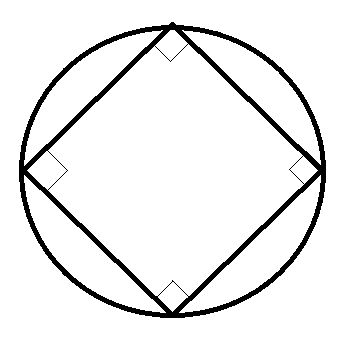
If the area of the circle touching the square in the picture above is  , what is the closest value to the area of the square?
If the area of the circle touching the square in the picture above is
Tap to see back →
Obtain the radius of the circle from the area.



Split the square up into 4 triangles by connecting opposite corners. These triangles will have a right angle at the center of the square, formed by two radii of the circle, and two 45-degree angles at the square's corners. Because you have a 45-45-90 triangle, you can calculate the sides of the triangles to be  ,
,  , and
, and  . The radii of the circle (from the center to the corners of the square) will be 9. The hypotenuse (side of the square) must be
  .
.
The area of the square is then 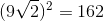 .
.
Obtain the radius of the circle from the area.
Split the square up into 4 triangles by connecting opposite corners. These triangles will have a right angle at the center of the square, formed by two radii of the circle, and two 45-degree angles at the square's corners. Because you have a 45-45-90 triangle, you can calculate the sides of the triangles to be
The area of the square is then
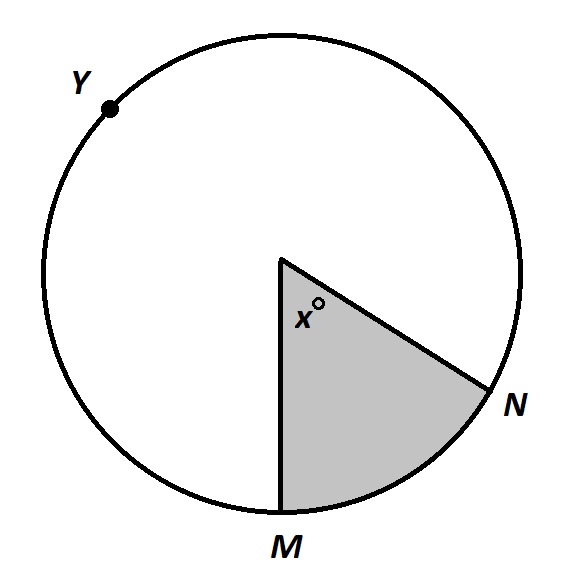
Note: Figure NOT drawn to scale.
In the above circle, the length of arc  is
is  , and
, and  . What is the diameter of the circle?
Note: Figure NOT drawn to scale.
In the above circle, the length of arc
Tap to see back →
Call the diameter  . Since
  ,
,  is
is  of the circle, and
  is
is  of a circle with circumference
  .
.
 is
is  in length, so


Call the diameter
Note: Figure NOT drawn to scale.
In the above circle, the length of arc  is 10, and
  . Give the diameter of the circle. (Nearest tenth).
Note: Figure NOT drawn to scale.
In the above circle, the length of arc
Tap to see back →
Call the diameter  . Since
  ,
,  is
is  of a circle with circumference
  . Since it is of length 10, the circumference of the circle is 5 times this, or 50. Therefore, set
  in the circumference formula:



Call the diameter
If the area of a circle is four times larger than the circumference of that same circle, what is the diameter of the circle?
If the area of a circle is four times larger than the circumference of that same circle, what is the diameter of the circle?
Tap to see back →
Set the area of the circle equal to four times the circumference πr_2 = 4(2_πr).
Cross out both π symbols and one r on each side leaves you with r = 4(2) so r = 8 and therefore d = 16.
Set the area of the circle equal to four times the circumference πr_2 = 4(2_πr).
Cross out both π symbols and one r on each side leaves you with r = 4(2) so r = 8 and therefore d = 16.
Two legs of a right triangle measure 3 and 4, respectively. What is the area of the circle that circumscribes the triangle?
Two legs of a right triangle measure 3 and 4, respectively. What is the area of the circle that circumscribes the triangle?
Tap to see back →
For the circle to contain all 3 vertices, the hypotenuse must be the diameter of the circle. The hypotenuse, and therefore the diameter, is 5, since this must be a 3-4-5 right triangle.
The equation for the area of a circle is A = πr2.
For the circle to contain all 3 vertices, the hypotenuse must be the diameter of the circle. The hypotenuse, and therefore the diameter, is 5, since this must be a 3-4-5 right triangle.
The equation for the area of a circle is A = πr2.
The perimeter of a circle is 36 π. What is the diameter of the circle?
The perimeter of a circle is 36 π. What is the diameter of the circle?
Tap to see back →
The perimeter of a circle = 2 πr = πd
Therefore d = 36
The perimeter of a circle = 2 πr = πd
Therefore d = 36
If the area of the circle touching the square in the picture above is , what is the closest value to the area of the square?
If the area of the circle touching the square in the picture above is
Tap to see back →
Obtain the radius of the circle from the area.
Split the square up into 4 triangles by connecting opposite corners. These triangles will have a right angle at the center of the square, formed by two radii of the circle, and two 45-degree angles at the square's corners. Because you have a 45-45-90 triangle, you can calculate the sides of the triangles to be , , and . The radii of the circle (from the center to the corners of the square) will be 9. The hypotenuse (side of the square) must be .
The area of the square is then .
Obtain the radius of the circle from the area.
Split the square up into 4 triangles by connecting opposite corners. These triangles will have a right angle at the center of the square, formed by two radii of the circle, and two 45-degree angles at the square's corners. Because you have a 45-45-90 triangle, you can calculate the sides of the triangles to be
The area of the square is then
Note: Figure NOT drawn to scale.
In the above circle, the length of arc is , and . What is the diameter of the circle?
Note: Figure NOT drawn to scale.
In the above circle, the length of arc
Tap to see back →
Call the diameter . Since , is of the circle, and is of a circle with circumference .
is in length, so
Call the diameter
Note: Figure NOT drawn to scale.
In the above circle, the length of arc is 10, and . Give the diameter of the circle. (Nearest tenth).
Note: Figure NOT drawn to scale.
In the above circle, the length of arc
Tap to see back →
Call the diameter . Since , is of a circle with circumference . Since it is of length 10, the circumference of the circle is 5 times this, or 50. Therefore, set in the circumference formula:
Call the diameter
If the area of a circle is four times larger than the circumference of that same circle, what is the diameter of the circle?
If the area of a circle is four times larger than the circumference of that same circle, what is the diameter of the circle?
Tap to see back →
Set the area of the circle equal to four times the circumference πr_2 = 4(2_πr).
Cross out both π symbols and one r on each side leaves you with r = 4(2) so r = 8 and therefore d = 16.
Set the area of the circle equal to four times the circumference πr_2 = 4(2_πr).
Cross out both π symbols and one r on each side leaves you with r = 4(2) so r = 8 and therefore d = 16.
Two legs of a right triangle measure 3 and 4, respectively. What is the area of the circle that circumscribes the triangle?
Two legs of a right triangle measure 3 and 4, respectively. What is the area of the circle that circumscribes the triangle?
Tap to see back →
For the circle to contain all 3 vertices, the hypotenuse must be the diameter of the circle. The hypotenuse, and therefore the diameter, is 5, since this must be a 3-4-5 right triangle.
The equation for the area of a circle is A = πr2.
For the circle to contain all 3 vertices, the hypotenuse must be the diameter of the circle. The hypotenuse, and therefore the diameter, is 5, since this must be a 3-4-5 right triangle.
The equation for the area of a circle is A = πr2.
The perimeter of a circle is 36 π. What is the diameter of the circle?
The perimeter of a circle is 36 π. What is the diameter of the circle?
Tap to see back →
The perimeter of a circle = 2 πr = πd
Therefore d = 36
The perimeter of a circle = 2 πr = πd
Therefore d = 36
If the area of the circle touching the square in the picture above is , what is the closest value to the area of the square?
If the area of the circle touching the square in the picture above is
Tap to see back →
Obtain the radius of the circle from the area.
Split the square up into 4 triangles by connecting opposite corners. These triangles will have a right angle at the center of the square, formed by two radii of the circle, and two 45-degree angles at the square's corners. Because you have a 45-45-90 triangle, you can calculate the sides of the triangles to be , , and . The radii of the circle (from the center to the corners of the square) will be 9. The hypotenuse (side of the square) must be .
The area of the square is then .
Obtain the radius of the circle from the area.
Split the square up into 4 triangles by connecting opposite corners. These triangles will have a right angle at the center of the square, formed by two radii of the circle, and two 45-degree angles at the square's corners. Because you have a 45-45-90 triangle, you can calculate the sides of the triangles to be
The area of the square is then
Note: Figure NOT drawn to scale.
In the above circle, the length of arc is , and . What is the diameter of the circle?
Note: Figure NOT drawn to scale.
In the above circle, the length of arc
Tap to see back →
Call the diameter . Since , is of the circle, and is of a circle with circumference .
is in length, so
Call the diameter
Note: Figure NOT drawn to scale.
In the above circle, the length of arc is 10, and . Give the diameter of the circle. (Nearest tenth).
Note: Figure NOT drawn to scale.
In the above circle, the length of arc
Tap to see back →
Call the diameter . Since , is of a circle with circumference . Since it is of length 10, the circumference of the circle is 5 times this, or 50. Therefore, set in the circumference formula:
Call the diameter
If the area of a circle is four times larger than the circumference of that same circle, what is the diameter of the circle?
If the area of a circle is four times larger than the circumference of that same circle, what is the diameter of the circle?
Tap to see back →
Set the area of the circle equal to four times the circumference πr_2 = 4(2_πr).
Cross out both π symbols and one r on each side leaves you with r = 4(2) so r = 8 and therefore d = 16.
Set the area of the circle equal to four times the circumference πr_2 = 4(2_πr).
Cross out both π symbols and one r on each side leaves you with r = 4(2) so r = 8 and therefore d = 16.
Two legs of a right triangle measure 3 and 4, respectively. What is the area of the circle that circumscribes the triangle?
Two legs of a right triangle measure 3 and 4, respectively. What is the area of the circle that circumscribes the triangle?
Tap to see back →
For the circle to contain all 3 vertices, the hypotenuse must be the diameter of the circle. The hypotenuse, and therefore the diameter, is 5, since this must be a 3-4-5 right triangle.
The equation for the area of a circle is A = πr2.
For the circle to contain all 3 vertices, the hypotenuse must be the diameter of the circle. The hypotenuse, and therefore the diameter, is 5, since this must be a 3-4-5 right triangle.
The equation for the area of a circle is A = πr2.