How to find the solution for a system of equations - PSAT Math
Card 0 of 98
Solve for  .
.


Solve for
Tap to see back →


For the second equation, solve for  in terms of
  .
.


Plug this value of y into the first equation.


For the second equation, solve for
Plug this value of y into the first equation.


Solve the system for  and
and  .
.
Solve the system for
Tap to see back →
The most simple method for solving systems of equations is to transform one of the equations so it allows for the canceling out of a variable. In this case, we can multiply  by
by  to get
  .
.
Then, we can add  to this equation to yield
  , so
, so  .
.
We can plug that value into either of the original equations; for example,  .
.
So,  as well.
The most simple method for solving systems of equations is to transform one of the equations so it allows for the canceling out of a variable. In this case, we can multiply
Then, we can add 

We can plug that value into either of the original equations; for example, 
So, 
Solve for  in the system of equations:


Solve for
Tap to see back →
In the second equation, you can substitute  for
for  from the first.


Now, substitute 2 for  in the first equation:


The solution is 
In the second equation, you can substitute
Now, substitute 2 for
The solution is
What is the solution to the following system of equations:


What is the solution to the following system of equations:
Tap to see back →
By solving one equation for  , and replacing
  in the other equation with that expression, you generate an equation of only 1 variable which can be readily solved.
By solving one equation for
What is the sum of  and
and  for the following system of equations?


What is the sum of
Tap to see back →


Add the equations together.


Put the terms together to see that  .
.
Substitute this value into one of the original equaitons and solve for  .
.


Now we know that  , thus we can find the sum of
  and
and  .
.

Add the equations together.
Put the terms together to see that
Substitute this value into one of the original equaitons and solve for
Now we know that
Without drawing a graph of either equation, find the point where the two lines intersect.
Line 1 : 
Line 2 : 
Without drawing a graph of either equation, find the point where the two lines intersect.
Line 1 :
Line 2 :
Tap to see back →
To find the point where these two lines intersect, set the equations equal to each other, such that  is substituted with the
  side of the second equation. Solving this new equation for
  will give the
  -coordinate of the point of intersection.

Subtract  from both sides.


Divide both sides by 2.


Now substitute  into either equation to find the
  -coordinate of the point of intersection.


With both coordinates, we know the point of intersection is  . One can plug in
  for
for  and
and  for
for  in both equations to verify that this is correct.
To find the point where these two lines intersect, set the equations equal to each other, such that
Subtract
Divide both sides by 2.
Now substitute
With both coordinates, we know the point of intersection is
Give the solution to the system of equations below.


Give the solution to the system of equations below.
Tap to see back →


Solve the second equation for  , allowing us to solve using the substitution method.


Substitute for  in the first equation, and solve for
  .
.





Now, substitute for  in either equation; we will choose the second. This allows us to solve for
  .
.




Now we can write the solution in the notation  , or
, or  .
.
Solve the second equation for
Substitute for
Now, substitute for
Now we can write the solution in the notation
Jeff, the barista at Moonbucks Coffee, is having a problem. He needs to make fifty pounds of Premium Blend coffee by mixing together some Kona beans, which cost $24 per pound, with some Ethiopian Delight beans, which cost $10 per pound. The Premium Blend coffee will cost $14.20 per pound. Also, the coffee will sell for the same price mixed as it would separately.
How many pounds of Kona beans will be in the mixture?
Jeff, the barista at Moonbucks Coffee, is having a problem. He needs to make fifty pounds of Premium Blend coffee by mixing together some Kona beans, which cost $24 per pound, with some Ethiopian Delight beans, which cost $10 per pound. The Premium Blend coffee will cost $14.20 per pound. Also, the coffee will sell for the same price mixed as it would separately.
How many pounds of Kona beans will be in the mixture?
Tap to see back →
The number of pounds of coffee beans totals 50, so one of the equations would be
 .
.
The total price of the Kona beans, is its unit price, $24 per pound, multiplied by its quantity,  pounds. This is
  dollars. Similarly, the total price of the Ethiopian delight beans is
  dollars, and the price of the mixture is
  dollars. Add the prices of the Kona and Ethiopian Delight beans to get the price of the mixture:

We are trying to solve for  in the system
Multiply the second equation by  , then add to the first:


The mixture includes 15 pounds of Kona beans.
The number of pounds of coffee beans totals 50, so one of the equations would be
The total price of the Kona beans, is its unit price, $24 per pound, multiplied by its quantity,
We are trying to solve for
Multiply the second equation by
The mixture includes 15 pounds of Kona beans.
If  and
and  , what is the value of
  ?
?
If
Tap to see back →
To solve this problem, you must first solve the system of equations for both  and
and  , then plug the values of
  and
and  into the final equation.
In order to solve a system of equations, you must add the equations in a way that gets rid of one of the variables so you can solve for one variable, then for the other. One example of how to do so is as follows:
Take the equations. Multiply the first equation by two so that there is  (this will cancel out the
  in the second equation).

Add the equations:


Find the sum (notice that the variable  has disappeared entirely):

Solve for  .
.

Plug this value of  back into one of the original equations to solve for
  :
:


Now, plug the values of  and
and  into the final expression:

The answer is  .
.
To solve this problem, you must first solve the system of equations for both
In order to solve a system of equations, you must add the equations in a way that gets rid of one of the variables so you can solve for one variable, then for the other. One example of how to do so is as follows:
Take the equations. Multiply the first equation by two so that there is
Add the equations:
Find the sum (notice that the variable
Solve for
Plug this value of
Now, plug the values of
The answer is


What is the solution of  that satisfies both equations?
What is the solution of
Tap to see back →
Reduce the second system by dividing by 3.
Second Equation:
 We this by 3.
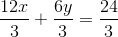

Then we subtract the first equation from our new equation.
First Equation:

First Equation - Second Equation:
Left Hand Side:

Right Hand Side:

Our result is:

Reduce the second system by dividing by 3.
Second Equation:
Then we subtract the first equation from our new equation.
First Equation:
First Equation - Second Equation:
Left Hand Side:
Right Hand Side:
Our result is:


What is the solution of  for the systems of equations?
What is the solution of
Tap to see back →
We add the two systems of equations:
For the Left Hand Side:

For the Right Hand Side:

So our resulting equation is:

Divide both sides by 10:
For the Left Hand Side:

For the Right Hand Side:

Our result is:

We add the two systems of equations:
For the Left Hand Side:
For the Right Hand Side:
So our resulting equation is:
Divide both sides by 10:
For the Left Hand Side:
For the Right Hand Side:
Our result is:


What is the solution of  for the two systems?
What is the solution of
Tap to see back →
We first multiply the second equation by 4.
So our resulting equation is:


Then we subtract the first equation from the second new equation.
Left Hand Side:

Right Hand Side:

Resulting Equation:

We divide both sides by -15
Left Hand Side:

Right Hand Side:

Our result is:

We first multiply the second equation by 4.
So our resulting equation is:
Then we subtract the first equation from the second new equation.
Left Hand Side:
Right Hand Side:
Resulting Equation:
We divide both sides by -15
Left Hand Side:
Right Hand Side:
Our result is:


What is the solution of  for the two systems of equations?
What is the solution of
Tap to see back →
We first add both systems of equations.
Left Hand Side:

Right Hand Side:

Our resulting equation is:

We divide both sides by 3.
Left Hand Side:

Right Hand Side:

Our resulting equation is:

We first add both systems of equations.
Left Hand Side:
Right Hand Side:
Our resulting equation is:
We divide both sides by 3.
Left Hand Side:
Right Hand Side:
Our resulting equation is:
Find the solutions for the following set of equations:


Find the solutions for the following set of equations:
Tap to see back →
If we multiply both sides of our bottom equation by  , we get
  . We can now add our two equations, and eliminate
  , leaving only one variable. When we add the equations, we get
  . Therefore,
  . Finally, we go back to either of our equations, and plug in
  so we can solve for
  .
.


If we multiply both sides of our bottom equation by
Solve for .
Solve for
Tap to see back →
For the second equation, solve for in terms of .
Plug this value of y into the first equation.
For the second equation, solve for
Plug this value of y into the first equation.
Solve the system for and .
Solve the system for
Tap to see back →
The most simple method for solving systems of equations is to transform one of the equations so it allows for the canceling out of a variable. In this case, we can multiply by to get .
Then, we can add to this equation to yield , so .
We can plug that value into either of the original equations; for example, .
So, as well.
The most simple method for solving systems of equations is to transform one of the equations so it allows for the canceling out of a variable. In this case, we can multiply
Then, we can add
We can plug that value into either of the original equations; for example,
So,
Solve for in the system of equations:
Solve for
Tap to see back →
In the second equation, you can substitute for from the first.
Now, substitute 2 for in the first equation:
The solution is
In the second equation, you can substitute
Now, substitute 2 for
The solution is
What is the solution to the following system of equations:
What is the solution to the following system of equations:
Tap to see back →
By solving one equation for , and replacing in the other equation with that expression, you generate an equation of only 1 variable which can be readily solved.
By solving one equation for
What is the sum of and for the following system of equations?
What is the sum of
Tap to see back →
Add the equations together.
Put the terms together to see that .
Substitute this value into one of the original equaitons and solve for .
Now we know that , thus we can find the sum of and .
Add the equations together.
Put the terms together to see that
Substitute this value into one of the original equaitons and solve for
Now we know that
Without drawing a graph of either equation, find the point where the two lines intersect.
Line 1 :
Line 2 :
Without drawing a graph of either equation, find the point where the two lines intersect.
Line 1 :
Line 2 :
Tap to see back →
To find the point where these two lines intersect, set the equations equal to each other, such that is substituted with the side of the second equation. Solving this new equation for will give the -coordinate of the point of intersection.
Subtract from both sides.
Divide both sides by 2.
Now substitute into either equation to find the -coordinate of the point of intersection.
With both coordinates, we know the point of intersection is . One can plug in for and for in both equations to verify that this is correct.
To find the point where these two lines intersect, set the equations equal to each other, such that
Subtract
Divide both sides by 2.
Now substitute
With both coordinates, we know the point of intersection is